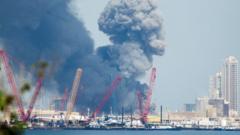
Military analysts are staring at satellite feeds of charred concrete in Bahrain and asking the wrong questions. They are obsessed with the "where" and the "how many." They want to count craters. They want to argue about missile trajectories and the failure of regional defense shields. They are missing the point entirely. These strikes aren't a traditional military offensive. They are a stress test for a global supply chain that is far more fragile than your local news anchor understands.
If you think this is about territory or "sending a message," you’ve bought into a 20th-century script for a 21st-century reality. This is kinetic arbitrage.
The Myth of the Escalation Ladder
The mainstream narrative is obsessed with the "escalation ladder." The idea is simple: Iran hits a base, the US hits back harder, and we climb toward total war. This is a comforting lie. It suggests a structured, predictable outcome that both sides want to avoid. In reality, the goal isn't to climb the ladder. It's to burn it down.
When a US base in Bahrain is targeted, the tactical damage is usually secondary to the economic volatility. I’ve watched defense contractors and energy traders react to these events for twenty years. The "success" of a strike isn't measured in casualties; it's measured in the spike of maritime insurance premiums and the sudden, frantic rerouting of tankers.
Modern warfare is no longer about occupying land. It’s about increasing the cost of your opponent’s existence until it becomes politically and economically untenable for them to stay in the room. By targeting Bahrain—the literal headquarters of the U.S. Naval Forces Central Command—the aggressor isn't trying to sink the Fifth Fleet. They are proving that the "guarantor of global trade" cannot even guarantee the safety of its own front porch.
Logistics as a Weapon of Mass Destruction
Stop looking at the missiles. Look at the Straits.
The global economy operates on a "just-in-time" basis. We don't have warehouses; we have moving ships. When a strike occurs in a theater like Bahrain, the ripple effect isn't just felt in Manama. It’s felt in a semiconductor factory in Taiwan and a car assembly line in Germany.
- The Insurance Trap: Within hours of a confirmed strike, Lloyd’s of London and other insurers adjust "war risk" premiums. For a VLCC (Very Large Crude Carrier), this can add hundreds of thousands of dollars to a single transit.
- The Reroute Reality: If the Persian Gulf becomes a "no-go" zone, the alternative is the Cape of Good Hope. That adds 10 to 14 days to a journey.
- The Energy Tax: Every cent added to the price of oil due to "geopolitical risk" acts as a tax on every human being on the planet who eats food or uses electricity.
The competitor article talks about "regional stability." There is no such thing as regional stability in an era of asymmetric drone warfare. You are either defended or you are exposed. There is no middle ground. The strike in Bahrain is a demonstration that even the most heavily fortified nodes in the American global security architecture have high-latency defenses against low-cost, high-volume saturation attacks.
The $500 Drone vs. The $2 Million Interceptor
Here is the math that nobody wants to talk about because it makes the Pentagon look incompetent.
In these regional strikes, the attacker often uses loitering munitions that cost less than a used Honda Civic. The defense systems—Patriots, THAAD, or ship-borne SM-6 missiles—cost millions of dollars per shot.
$$Cost_{Defense} \gg Cost_{Attack}$$
If I can force you to spend $2 million to stop my $20,000 drone, I am winning the war of attrition without ever winning a single battle. We are seeing the bankruptcy of the "Fortress America" strategy in real-time. You cannot protect every square inch of a global footprint when the cost of entry for the attacker has dropped to zero.
I’ve seen military budgets balloon to address these "threats," but the money is being funneled into old-world hardware. We are building better shields when the enemy has moved on to poison.
The Bahrain Pivot
Why Bahrain? Because it's the ultimate symbol of the post-WWII order. It’s where the US Navy project power into the most vital energy corridor on earth.
If the US cannot protect Bahrain, it cannot protect the global economy.
The "contrarian" take isn't that the US is weak; it's that the US is playing a game that no longer exists. While we discuss "proportional responses," the adversary is focusing on the "integrity of the network." They aren't trying to win a fight; they are trying to make the network so noisy, so expensive, and so dangerous that the players decide to leave.
The Hard Truth About Intelligence Failures
Every time a strike like this happens, the "People Also Ask" sections of the internet fill with questions about intelligence failures. "How did we not see this coming?"
The premise is flawed. We see it coming. The sensors work. The satellites work. The failure isn't in intelligence; it's in the velocity of decision-making.
Bureaucracies are slow. Kinetic strikes are fast. By the time a report reaches a desk in DC, the missiles have already landed and the oil markets have already priced in the chaos. The status quo is a world where the US military is a massive, powerful dinosaur being bitten to death by ten thousand fire ants. Each bite is small. None are fatal on their own. But the dinosaur is bleeding out regardless.
Stop Praying for De-escalation
De-escalation is a myth sold by diplomats to justify their own relevance. In the current geopolitical climate, there is no "back to normal." The strikes across the region, culminating in the Bahrain hit, represent a permanent shift in the cost of doing business in the Middle East.
If you are an investor, a policy maker, or just a citizen trying to understand the world, stop looking for "peace talks." Look for "hardening."
The only entities that will survive this shift are those that can operate in a decentralized, high-risk environment. The era of the centralized, safe hub is over. Bahrain was that hub. Now, it's just another target.
The real story isn't that Iran hit a base. It's that the base was hit and the world kept turning, just a little bit more expensively, a little bit more dangerously, and with the realization that no one is coming to save the old order.
Prepare for a world where the "secure zone" doesn't exist. You are either mobile, or you are a target. There is no third option.
Move accordingly.