The air in Los Angeles usually smells of jasmine and exhaust, a mix of the aspirational and the industrial. But lately, there is a third, invisible element hanging over the cul-de-sacs of Eagle Rock and the wide boulevards of the Westside. It is the hum of data. It is the silent flicker of a lens that doesn’t blink, doesn’t sleep, and never forgets a face—or, more accurately, a plate.
Flock Safety has arrived. It didn’t come with a brass band or a government decree. It arrived through the back door of homeowners' associations and the quiet signatures of local police departments. To some, it is the digital savior of the suburbs. To others, it is the beginning of a permanent, privatized dragnet that turns every citizen into a data point.
The Night the Car Vanished
Consider a hypothetical resident named Sarah. Sarah lives in a neighborhood where the biggest scandal is usually an unclipped hedge or a stray dog. One Tuesday, she wakes up to find her SUV gone. The glass on the driveway is the only evidence left behind.
In the old world, Sarah would call the police, a report would be filed, and the odds of seeing that car again would be roughly the same as winning the lottery. But her neighborhood recently installed a Flock camera at the main entrance.
This isn't just a "security camera." It is a sophisticated Automated License Plate Reader (ALPR). As the thief drove Sarah’s car out of the neighborhood, the camera captured the plate, the make, the model, and even specific bumper stickers. Within seconds, that data was pinged against a national "Hot List." If that car had been reported stolen elsewhere, or if the thief was driving a vehicle associated with a warrant, the police would have received a notification on their phones before the thief even hit the freeway.
For Sarah, the technology is a miracle. It feels like justice. It feels like the neighborhood finally has a pair of eyes that actually work.
The Business of the Digital Perimeter
The genius of Flock Safety isn't just in the hardware. It’s in the subscription. By offering these cameras for a yearly fee—often around $3,000 per unit—the company has bypassed the traditional hurdles of municipal infrastructure.
If a city council is too slow to vote on a surveillance budget, a group of motivated neighbors can simply pool their money. They buy the "safety" themselves. This creates a patchwork of private surveillance that plugs directly into the public police force. In Los Angeles, this roster of clients is ballooning. From gated communities in Calabasas to bustling business districts, the "Falcon" cameras are the new gatekeepers.
But there is a friction here that we rarely discuss. When we privatize the watchtower, who owns the view?
The data collected isn’t just about criminals. It’s about everyone. It’s about the delivery driver, the nurse coming home from a late shift, the teenager sneaking out, and the political activist heading to a meeting. Every time you drive past one of these grey boxes, your location is logged. Your patterns are mapped.
The Machine That Remembers Everything
If you speak to the proponents of ALPR technology, they will tell you that if you have nothing to hide, you have nothing to fear. It is a seductive argument. It’s also a hollow one.
Privacy isn't about hiding "bad" things; it’s about the right to exist without being audited. Flock’s system allows for "Filtered Searches." A police officer doesn't need a plate number to find you. They can search for "red pickup truck with a roof rack" that drove through a specific intersection between 2:00 PM and 4:00 PM last Thursday.
The machine creates a searchable history of human movement. In the hands of a dedicated detective, this is a tool for solving homicides and kidnappings. In the hands of a bored officer or a department with a history of bias, it is a tool for harassment.
Los Angeles is a city defined by its car culture. We live in our vehicles. They are our mobile sanctuaries. The introduction of a city-wide, interconnected plate-reading network effectively ends the anonymity of the road. We are moving toward a reality where "leaving no trace" is a physical impossibility.
The Transparency Paradox
The controversy in L.A. isn't just about what the cameras do, but how they got there. Several local groups have raised alarms about the lack of public oversight. When a private company holds the data, the rules of the game change.
Traditional police records are subject to public disclosure laws. Private databases? Not so much. Flock maintains that they do not sell data to third parties and that the information is deleted after 30 days unless it’s part of an active investigation.
Thirty days sounds short. Until you realize that thirty days is enough time to track a person’s entire routine. It’s enough time to know where they shop, where they worship, and whose house they stay at on Friday nights.
There is also the "mission creep" factor. Technology rarely stays in its original box. What starts as a tool to catch car thieves quickly becomes a tool to enforce parking fines, then a tool to monitor "suspicious" loitering, and eventually, a tool for predictive policing that targets neighborhoods before a crime is even committed.
A Tale of Two Cities
There is a divide forming in the hills of Los Angeles. On one side are the residents who feel besieged by a rise in property crime. To them, the Flock camera is a shield. It is the only thing standing between their family and a chaotic, under-policed world. They see the controversy as an academic luxury that people in "safe" neighborhoods can afford to debate.
On the other side are the civil libertarians and community advocates who see a digital fence being built around the poor. They see a future where certain neighborhoods are "blacklisted" by the algorithm. If a car from a high-crime zip code enters an affluent neighborhood equipped with Flock, does that trigger a "suspicious vehicle" alert?
The math is simple: $3,000 + a fear of the "other" = a permanent digital checkpoint.
We are building a society where your "right" to travel is contingent on your vehicle’s data being palatable to a machine. We are trading the messy, unpredictable freedom of the city for the sterile, monitored peace of a panopticon.
The Ghost in the Grey Box
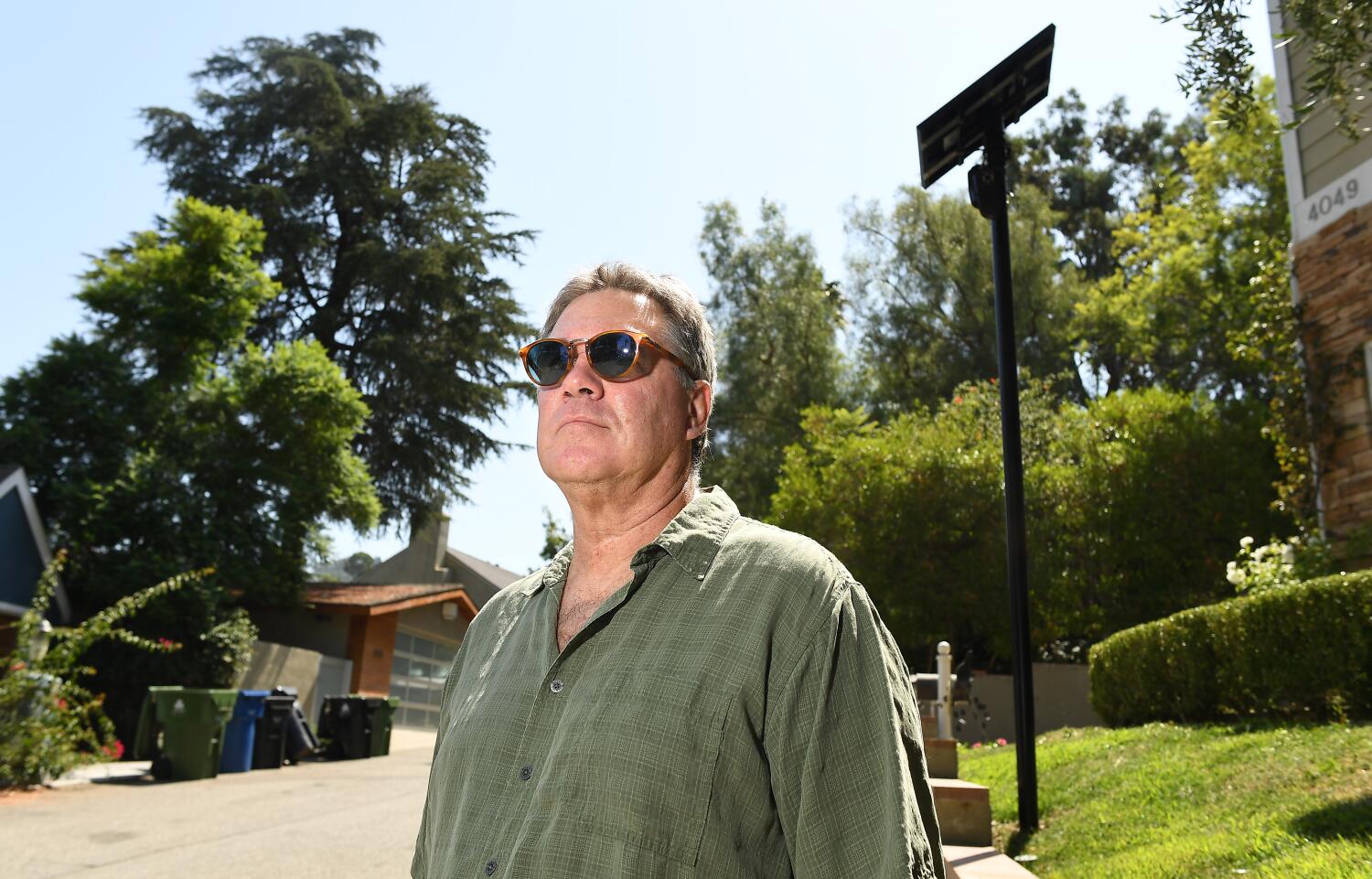
Walking down a sun-drenched street in an L.A. suburb, you might see one. It sits high on a pole, solar-powered, humming quietly. It doesn’t look threatening. It doesn’t look like the "Big Brother" of 1984. It looks like a piece of utility hardware, as mundane as a transformer or a streetlamp.
But that mundanity is exactly why it is so powerful. We have become accustomed to the trade-off. We give our fingerprints to our phones. We give our heart rates to our watches. We give our inner thoughts to search engines. Why not give our license plates to the neighborhood?
The problem is that once the infrastructure of surveillance is built, it never goes away. It only grows. It becomes more efficient, more integrated, and more invisible.
The thief who took Sarah’s SUV might be caught. That is a tangible win. But the cost of that win is a permanent record of Sarah’s life, and her neighbor’s life, and the life of every person who happened to drive down that street.
We are currently in the middle of a grand experiment. We are testing whether or not we can feel safe in a world where we are constantly watched. We are betting that the "good guys" will always be the ones behind the keyboard and that the "bad guys" will be the only ones caught in the net.
It is a high-stakes gamble. Because the watchman at the gate doesn't just see the intruders. He sees you. He sees where you’ve been. He sees where you’re going. And he never, ever forgets.
The light on the camera blinks green. A car passes. The data is logged. Somewhere, a hard drive spins, and the map of a human life is updated in real-time. The sun sets over the Pacific, the jasmine scent thickens, and the silent watchers continue their vigil, waiting for a number that doesn't belong.