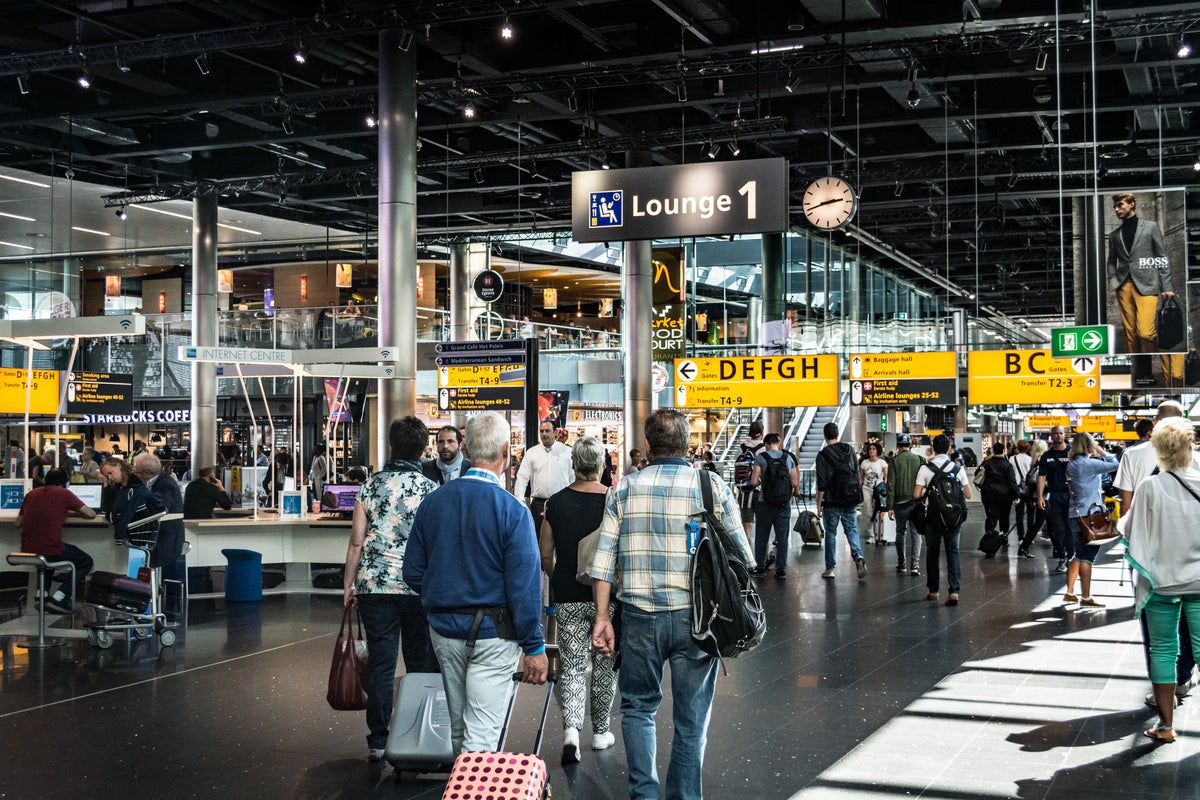
The air in Terminal 4 smells of stale coffee and rising cortisol. It is 4:15 AM. Under normal circumstances, this is the hour of the weary business traveler and the over-prepared vacationer. But today, the line for security doesn’t just snake; it stagnates. It spills past the retractable belt barriers, out into the ticketing hall, and presses against the glass doors where the pre-dawn cold still clings to the pavement.
Somewhere near the middle of this human blockade is Sarah. She is hypothetical, but her frustration is the very real sum of 800,000 federal employees currently working without a paycheck. Sarah is a Transportation Security Officer (TSO). She hasn’t been paid in three weeks. Her landlord doesn't accept "essential service" as a form of currency, and her childcare provider definitely doesn't. So, Sarah stayed home today. She isn't alone.
This is the invisible architecture of a government shutdown. We often view these political stalemates through the lens of C-SPAN cameras and partisan press releases. We see it as a debate over budgets or borders. But in the fluorescent-lit reality of an airport at dawn, the shutdown is a physical weight. It is the sound of thousands of rolling suitcases vibrating against linoleum in a rhythmic, anxious hum. It is the realization that the systems we rely on to move through the world are not clockwork. They are human.
The Math of Missing People
When a shutdown halts the flow of federal funds, the Department of Homeland Security becomes a ghost of itself. TSA agents are categorized as "essential," a word that sounds noble until you realize it means they are legally required to work for free until the political winds shift. In 2019, during the longest shutdown in American history, unscheduled absences among TSA screeners spiked by over 10 percent.
Numbers are sterile. The consequence is not.
Consider the physics of an airport checkpoint. A standard security lane is designed to process roughly 150 passengers per hour. This requires a precise choreography of agents: one to check IDs, two at the X-ray, one to manage the metal detector, and at least one for the "pat-down" area. Remove even two of those people, and the lane doesn't just slow down. It dies.
For every agent who calls out because they can't afford gas to drive to work, the queue grows by minutes. For every ten agents, those minutes turn into hours. At Hartsfield-Jackson in Atlanta, the wait times during peak shutdown cycles have ballooned to nearly 90 minutes. For a traveler like Sarah’s counterpart—let's call him David, a man trying to reach his daughter’s graduation—those 90 minutes are the difference between a celebration and a lonely terminal bench.
The State Level Rebellion
While the gears of Washington grind to a halt, some states have decided they can no longer afford to wait for a resolution. They are tired of their regional economies being held hostage by a zip code two thousand miles away.
In a bold, legally gray maneuver, Florida and Washington, D.C., along with several others, began exploring ways to backstop the federal failure. The logic is simple: if the federal government won’t pay the people keeping the state’s commerce alive, the state will. It’s a temporary band-aid on a systemic wound.
In 2019, the Port Authority of New York and New Jersey, along with officials in states like California, looked into providing zero-interest loans or direct stipends to federal workers. They recognized a truth that the federal government seemed to have forgotten: an airport is the heart of a city's economy. When the heart skips a beat, the whole body suffers.
But there is a friction here that no amount of state funding can fully lubricate. Even if a state offers a loan to an agent, the psychological toll of being a pawn in a budget war remains. You can pay a man’s rent, but you cannot easily restore his dignity after he has spent 40 hours a week being yelled at by travelers for a situation he didn't create.
The Butterfly Effect of the Boarding Pass
We tend to think of security as a barrier. It’s the thing we "get through" to get to our destination. But in reality, security is the glue of the global travel network.
If a flight is delayed in New York because half the TSA staff didn't show up, that plane doesn't arrive in London on time. The crew misses their legal rest window. The return flight is canceled. Suddenly, a father in Ohio is missing his son's wedding because of a budget dispute over a wall or a social program he’s never even used.
This is the fragility of the modern world. We have optimized our lives for efficiency, but we have built that efficiency on the backs of people we treat as interchangeable parts. When the government shuts down, we see the faces behind the blue uniforms. We see the fatigue. We see the quiet desperation of a man checking a passport while wondering if he can afford a gallon of milk on the way home.
The stress isn't just logistical. It's a safety concern. High-stress, low-morale environments are breeding grounds for errors. When an agent is preoccupied with their own eviction notice, are they as sharp at spotting a prohibited item in a blurry X-ray scan? The stakes aren't just missed flights; they are the fundamental integrity of our skies.
The Cost of Free Labor
There is a myth that "essential" workers are resilient because they have to be. We tell ourselves they are patriots. We call them heroes. We do this so we don't have to feel guilty about the fact that we are asking them to bear the burden of our collective political dysfunction.
The financial cost to the U.S. economy during a major shutdown is measured in billions. The Congressional Budget Office estimated that the 35-day shutdown in late 2018 and early 2019 reduced GDP by $11 billion. But that figure doesn't account for the "soft" costs.
It doesn't measure the loss of a senior TSA lead who decides they’ve had enough and takes a job at a local warehouse for $2 more an hour and a steady paycheck. It doesn't measure the institutional knowledge that walks out the door every time a shutdown occurs. We are hemorrhaging talent from our most sensitive sectors, and we are doing it for the sake of political theater.
Seeking the Horizon
Some travelers have turned to private alternatives. The rise of CLEAR and the increased adoption of TSA PreCheck are often touted as solutions. If you pay enough, you can bypass the chaos. It’s a tempting narrative—the idea that we can buy our way out of a public failure.
But even PreCheck requires a federal employee to man the station. Even the most expensive biometric scanner needs a human being to verify the data and respond to an alert. There is no private exit from a public crisis. We are all, eventually, in the same line.
The solution being piloted by states—essentially "loaning" money to the federal government to pay its own employees—is a radical shift in American federalism. it suggests a future where states act as semi-autonomous protectors of their own infrastructure. It’s a breakdown of the traditional hierarchy. If New York pays the TSA, who does the TSA really work for?
It is a question that lingers long after the line finally moves.
The Last Gate
Back in Terminal 4, the sun is beginning to peek over the hangars. Sarah is still home. David is finally at the front of the line. He puts his shoes in a gray plastic bin. He puts his belt in another. He looks the TSA agent in the eye—a young man who looks like he hasn't slept since the previous Tuesday.
"Tough morning?" David asks.
The agent doesn't look up. He just slides the bin forward. "Every morning is a tough morning right now, sir. Step through the scanner."
The machine whirs. The light turns green. David gathers his things and sprints toward Gate B22. He might make it. He might not. But as he runs, he passes a janitor, a gate agent, and a pilot. All of them are part of a massive, intricate machine that requires trust to function. Trust that the rules will be followed. Trust that the work will be valued. Trust that when you show up, the system will show up for you.
When that trust is broken, the machine doesn't just stop. It rusts. It becomes a series of obstacles rather than a path. And as we sit in our cramped seats, waiting for a takeoff clearance that may be delayed by an air traffic controller who is also working for free, we have to ask ourselves: how much friction can a society handle before it simply grinds to a halt?
The answer isn't in a budget. It's in the eyes of the person checking your bag.
Would you like me to analyze the specific economic impact of these state-funded stipends on local travel hubs?