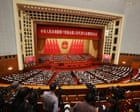
China’s decision to set an economic growth target of approximately 5% for the current fiscal period marks the formal abandonment of high-velocity expansion in favor of systemic stabilization. This target is not merely a number; it is a signal of a fundamental shift in the state’s internal cost-benefit analysis regarding debt-fueled growth versus the preservation of the social contract. To understand the implications of this target, one must dissect the three primary pressures acting upon the Chinese economy: the exhaustion of the property-led investment model, the demographic contraction of the labor force, and the geopolitical constraints on technology acquisition.
The Property Sector as a Drag Coefficient
For two decades, the real estate sector and related infrastructure spending accounted for roughly 25% to 30% of China’s Gross Domestic Product (GDP). The current 5% target acknowledges that this engine has transitioned from a primary driver to a net liability.
The mechanics of this drag are rooted in the balance sheet recession. When property values stagnate or decline, the collateral base for local government financing vehicles (LGFVs) erodes. These entities, which traditionally funded infrastructure through land-sales revenue, now face a liquidity crunch. The "Three Red Lines" policy, introduced to curb developer leverage, has effectively capped the ability of the private sector to bridge this gap.
The Wealth Effect and Consumption Inertia
The contraction of property sector valuations creates a negative wealth effect. Since nearly 70% of Chinese household wealth is tied to real estate, a cooling market suppresses domestic consumption. Without a significant appreciation in home prices, the Chinese consumer defaults to a high-savings posture. This behavior pattern directly contradicts the central government's "Dual Circulation" strategy, which relies on robust internal demand to offset external volatility.
The 5% growth target suggests that Beijing is unwilling to initiate a massive, broad-based stimulus that would reflate the property bubble. Instead, the state is opting for a controlled deflation of the sector, accepting lower headline growth to avoid a systemic financial collapse.
The Manufacturing Transition and the Search for New Productive Forces
To compensate for the decline in real estate, the state is reallocating capital toward "New Productive Forces." This conceptual framework prioritizes high-value manufacturing and energy transition technologies. The focus has shifted to the "New Three" industries: electric vehicles (EVs), lithium-ion batteries, and solar products.
- Capital Intensity vs. Employment Generation: While high-tech manufacturing creates high-value GDP, it is significantly less labor-intensive than the construction or services sectors. This creates a friction point where GDP may grow, but youth unemployment remains stubbornly high.
- Export Saturation and Trade Barriers: The strategy of exporting the way out of a domestic slowdown is meeting increased resistance. As Chinese industrial capacity grows, it encounters protective tariffs and "de-risking" policies in the European Union and North America. This geopolitical friction acts as an external ceiling on how much manufacturing can contribute to the 5% goal.
The math of this transition is punishing. For manufacturing to fully replace the growth lost from the property sector, it would need to expand at a rate that the global market likely cannot absorb without triggering significant trade conflicts.
Fiscal Space and the Local Government Debt Bottleneck
The ability to meet even a modest 5% target depends on fiscal execution. However, the transmission mechanism for fiscal policy is currently obstructed.
Central authorities have issued special sovereign bonds to fund strategic projects, but the heavy lifting of economic management occurs at the provincial and municipal levels. These local governments are trapped between two competing mandates: meeting growth targets and deleveraging their balance sheets.
The LGFV Debt Trap
LGFV debt is estimated to be in the trillions of dollars. Because these vehicles are technically off-balance-sheet, their actual debt service requirements are opaque. When a local government is forced to prioritize interest payments over new investment, the multiplier effect of government spending vanishes.
The state’s current strategy involves debt swaps—moving high-interest local debt into lower-interest provincial or central government bonds. While this reduces the immediate risk of default, it does not create new economic activity. It is a defensive maneuver, not an offensive one. The 5% target reflects the reality that a significant portion of available capital is being used to maintain existing structures rather than build new ones.
Demographic Contraction and Labor Productivity
China’s working-age population is shrinking. This is a hard physical limit on growth that cannot be solved by monetary policy. To maintain 5% growth with fewer workers, labor productivity must increase at an accelerating rate.
- The Dependency Ratio: As the population ages, a larger share of the national income must be diverted to healthcare and pensions. This reduces the pool of capital available for productive investment.
- Automation as a Necessity: The push for robotics and AI is not a luxury; it is a demographic survival strategy. If China cannot automate its manufacturing base faster than its workforce disappears, the 5% target will become mathematically impossible in the coming decade.
The current target serves as a "stress test" for these productivity gains. It forces industries to optimize rather than simply adding more low-cost labor, which is no longer an option.
The Risk of Pro-Cyclical Policy Errors
A major risk to the 5% target is the potential for pro-cyclicality. If the government becomes too focused on hitting the number, it may resort to "low-quality" growth—projects that boost GDP in the short term but provide no long-term utility. Conversely, if the focus on "security" and "regulation" becomes too intense, private sector confidence may continue to wither.
The private sector contributes roughly 60% of GDP and 80% of urban employment. If private entrepreneurs perceive that the 5% target is a state-managed exercise that excludes them, they will continue to withhold investment. This creates a self-fulfilling prophecy of stagnation where the state must step in even further, exacerbating the inefficiency of capital allocation.
The Strategic Play for Institutional Investors and Corporate Leaders
Navigating an economy aimed at 5% requires a move away from "China Beta"—investing in the general growth of the country—toward "China Alpha"—identifying specific sectors with state-mandated tailwinds.
Organizations must recalibrate their expectations from volume-based expansion to value-chain dominance. The 5% target indicates a stabilized, yet slower, environment where the winners will be those who align with the state’s drive for self-reliance in semiconductors, biotechnology, and green energy.
The primary tactical move for external observers is to monitor the "Credit Impulse"—the rate of change in new lending. If the credit impulse remains flat despite the 5% target, it confirms that the state is prioritizing debt sustainability over raw growth. If the credit impulse spikes, it signals a return to old habits and a likely future increase in systemic risk.
Success in this environment depends on recognizing that the 5% floor is also a ceiling. The era of overperformance is over; the era of managed endurance has begun.
Monitor the divergence between headline GDP and the "GDI" (Gross Domestic Income) equivalent. If GDP holds at 5% while corporate profits and household incomes lag, the growth is being engineered through non-productive state spending. Shift capital allocation toward firms with high R&D-to-revenue ratios that are positioned to capture the productivity gains necessitated by the shrinking labor pool. Ignore the aggregate; trade the structural shifts.