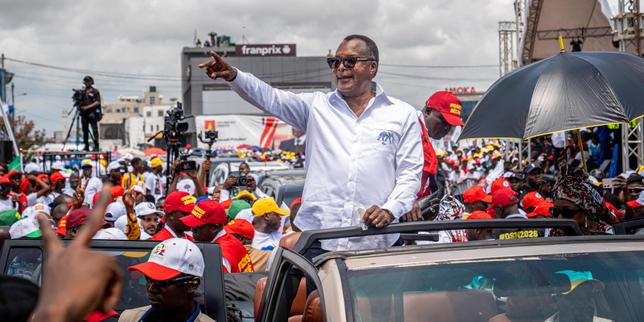
The international press loves a good caricature. They’ve spent decades painting Denis Sassou Nguesso as the "Emperor" of Congo-Brazzaville, a relic of a bygone era of African strongmen who refuses to yield the stage. They lean on the same tired tropes: the longevity of his tenure, the opulence of the lifestyle, and the supposed tragedy of a "stifled" democracy. It’s a comfortable narrative for a Western reader sipping an oat milk latte in a stable democracy. It’s also spectacularly shallow.
The lazy consensus ignores the most brutal reality of Central African geopolitics: in a region defined by the catastrophic collapse of states, the "Emperor" provides the only currency that actually matters for survival. Total, unyielding predictability.
If you want to understand the Republic of the Congo, stop looking at the length of the term and start looking at the map. To the north, you have the Central African Republic, a fractured territory where the state barely exists outside Bangui. To the east, the Democratic Republic of Congo (DRC) remains a sprawling, chaotic entity where militias operate with impunity. Against this backdrop, Brazzaville is an anomaly of stasis.
The Peace of the Graveyard or the Peace of the Bank?
Critics call it a "reign." Realists call it a buffer. I’ve sat in rooms with energy executives and regional diplomats who publicly decry the lack of democratic turnover while privately praying that nothing changes in Brazzaville. Why? Because the alternative in this specific geography isn't a Nordic-style social democracy. It’s a vacuum. And in Central Africa, a vacuum is always filled by blood.
The mistake the "Emperor" narrative makes is assuming that longevity is purely a product of ego. It’s a product of a sophisticated, multi-decade balancing act between internal ethnic factions and external extractive interests. Sassou Nguesso hasn't survived since 1979 (with a brief interruption) just because he has a loyal guard. He has survived because he has mastered the art of being the "least worst" option for everyone who has a stake in the Gulf of Guinea.
Dismantling the Myth of the Failed State
The standard critique is that the country's oil wealth has been squandered. This is the "resource curse" argument that every freshman political science student can recite in their sleep. It’s not wrong, but it’s incomplete.
Yes, the debt-to-GDP ratios have spiked. Yes, the IMF has had to step in with structural adjustments. But look at the mechanics of how that money is used. It isn't just disappearing into offshore accounts; it’s used to maintain a vast patronage network that functions as the country’s actual social safety net. In the absence of a formal, Western-style bureaucracy, the "Emperor" distributes largesse to tribal leaders and military commanders to prevent the kind of civil fragmentation that has leveled Libya or Sudan.
Is it "corruption" by Transparency International standards? Absolutely. Is it a functional mechanism for preventing a civil war that would kill hundreds of thousands? Also yes. The Western observer views this as a bug; for the survivor of the 1997 civil war in Brazzaville, it’s a feature.
The Hypocrisy of "Democratic" Intervention
Western media outlets often ask: "When will he step down?" This is the wrong question. The real question is: "What happens the day after?"
Every time the West has pushed for rapid "democratic" transition in a fragile, ethnically divided state without a strong middle class, the result has been a disaster. We saw it in Iraq. We saw it in Mali. We saw it in South Sudan. The "Emperor" is a firewall against the "Unknown."
The French, despite their occasional public posturing about human rights, know this better than anyone. TotalEnergies isn't operating in Congo because they love autocracy; they operate there because they know the rules won't change tomorrow morning. Investment requires a horizon of ten to twenty years. You don't get that in a "vibrant" but volatile democracy where every election cycle threatens to tear up existing contracts.
The False Choice of the "Younger Generation"
A common "People Also Ask" topic is whether the youth of Congo-Brazzaville are ready for change. Of course they are. Seventy percent of the population is under 30. They are connected, they are frustrated, and they want jobs that don't depend on who their uncle knows.
But here is the brutal, contrarian truth: a "youth revolution" in the current Congolese context would likely lead to a lost decade. Without institutionalized political parties or a neutral military—neither of which exists—a sudden power vacuum would trigger an ethnic scramble for the oil spigot.
The "Emperor" has effectively become the state. When you spend forty years merging your personal identity with the national infrastructure, your departure isn't just a change of leadership; it’s a controlled demolition. The West screams for the demolition but has zero plan for the debris.
The Debt Trap is a Two-Way Street
We hear constantly about Congo’s "opaque" debt to China. The narrative is that the country is being colonized by Beijing. This ignores the agency of the Congolese leadership. They aren't victims of Chinese "debt-trap diplomacy." They are using China as a hedge against Western moralizing.
By diversifying their creditors, the Brazzaville elite has ensured that no single power—not France, not the US, not the IMF—can dictate their internal politics. It’s a brilliant, if cynical, display of sovereign survival. They’ve leveraged their subsoil assets to buy political autonomy. You might hate the ethics of it, but you have to admire the execution.
Stop Asking for a Hero
The competitor article wants a hero or a villain. It wants a story of a "throne" and a "people" waiting to be liberated. That’s a fairy tale.
The reality is a complex, transactional ecosystem where stability is bought at a high price, and the "Emperor" is the head accountant. If you want to "fix" Congo, you don't do it by screaming for a coup or an abdication. You do it by building the institutions that make a single man's presence unnecessary. Until those institutions exist, every person calling for his immediate exit is effectively calling for a coin toss where the stakes are national survival.
The world doesn't need another failed state in the heart of Africa just so Western journalists can feel good about a "democratic" headline for a week.
Accept the uncomfortable truth: the "Emperor" stays because the alternatives are too terrifying to contemplate.
Stop looking for a revolution and start looking for a transition plan that doesn't involve a scorched earth. You won't find one in the op-ed pages of the mainstream press. They’re too busy writing the obituary of a man who has outlasted five French presidents and seven Americans.
Don't bet against the man who knows exactly what his silence is worth to the world.