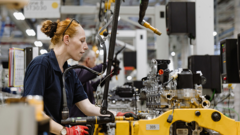
The modern luxury car is no longer a machine of iron and oil. It is a rolling supercomputer, a symphony of silicon and code wrapped in hand-stitched leather. But in June 2024, the music stopped. Across North America, the screens that power thousands of dealerships flickered, stalled, and finally went dark. This wasn't a mechanical failure or a supply chain kink. It was a digital ghost in the machine—a massive cyberattack on CDK Global, the software backbone of the automotive retail world.
For Jaguar Land Rover (JLR), a brand built on the promise of effortless elegance, the silence was deafening.
The Day the Systems Died
Imagine a sales consultant named Sarah. For years, her world has been defined by the tactile: the weight of a key fob, the scent of a new Range Rover’s interior, the precise click of a door handle. When a client walks in ready to drop $100,000 on a vehicle, the experience should be frictionless. But Sarah found herself staring at a dead monitor.
The CDK outage didn't just take away the ability to print a contract; it severed the nervous system of the dealership. Inventory tracking disappeared. Service records vanished. Financing portals became black holes. For weeks, the sophisticated infrastructure of JLR's retail network was forced to revert to the Stone Age.
Sarah had to dig through drawers to find carbon paper. She used a calculator to estimate taxes. She looked her frustrated clients in the eye and asked for their patience while the "invisible" side of the business fought a war against an unseen enemy. This wasn't just a corporate hiccup. It was a visceral reminder of how fragile our high-tech luxury truly is.
The Numbers Behind the Noise
While the human drama unfolded on showroom floors, the ledger told a sobering story. JLR reported that retail sales for the quarter ending June 30 were essentially flat, barely edging up by 0.4% to 111,180 units. In a vacuum, "flat" sounds like a failure for a brand that has been on a tear with its "House of Brands" strategy. But context changes everything.
The CDK attack paralyzed roughly 15,000 dealerships across the continent. For JLR, North America is a vital artery. When the software went down, the momentum of the Range Rover and Defender lines hit a digital wall.
Consider the financial weight of that stall. JLR noted that while wholesales (the cars they actually ship to dealers) rose 5% to 97,755 units, the actual hand-off to the customer was choked by the technical blackout. The cars were there. The buyers were there. The software was not. It is a rare moment in industrial history where the product exists in abundance, but the paperwork prevents the sale.
A Resilience Born of Scarcity
However, beneath the surface of the sales plateau, a different narrative was forming. JLR is becoming a master of the high-margin pivot. Even as the total volume of sales stayed level, the type of cars being sold shifted toward the stratosphere.
The Range Rover, Range Rover Sport, and Defender now account for a staggering 68% of the company's total sales volume. These aren't just SUVs; they are the profit engines that allow JLR to withstand a localized digital apocalypse. While the mid-tier market struggled with high interest rates and shifting consumer sentiment, the appetite for JLR’s crown jewels remained insatiable.
The order bank, often the best crystal ball in the industry, remained a testament to brand loyalty. By the end of the quarter, JLR still had 83,000 orders waiting to be fulfilled. This isn't just a backlog; it’s a shield. Most of these orders—about 70%—are for those same high-margin "power trio" models.
The strategy is clear: if you can't sell more cars, sell better ones.
The Ghost in the Charging Port
There is another tension point in this story, one that smells of ozone and electricity. The transition to EVs is no longer a distant promise; it is a current reality that every legacy automaker is navigating with white-knuckled intensity.
JLR has been cautious. While others rushed headlong into pure battery-electric vehicles (BEVs) only to see demand soften, JLR leaned into the plug-in hybrid (PHEV). It turned out to be a stroke of accidental or brilliant timing. Global retail sales of JLR’s plug-in hybrids surged by 32% year-over-year.
People are hesitant. They want the green badge and the quiet commute, but they fear the "range anxiety" that comes with a dead battery in a rural driveway. The hybrid is the bridge. It is the compromise that feels like an upgrade. By reading the room—or perhaps by simply being unable to move faster—JLR found the sweet spot of the current market.
But the real test is looming. The Range Rover Electric has a waiting list that has grown to 38,000 prospective buyers. These aren't just names on a list; they are early adopters waiting to see if a brand synonymous with V8 rumbles can translate that soul into a silent motor.
The Invisible Stakes of Recovery
As the CDK systems slowly groaned back to life in July, the "recovery" began. But "recovery" is a deceptive word. It implies a return to a previous state. For JLR, there is no going back to the way things were before the screens went dark.
The cyberattack exposed a fundamental truth about the luxury car business: the "luxury" isn't just the leather or the 0-60 time. It is the security of the transaction. It is the belief that when you spend six figures, the world around you functions with precision. When that precision fails, the brand's aura dims.
The bounce-back seen in the July numbers is the sound of a spring being released. The pent-up demand that was throttled by the software outage is now flooding back through the pipes. But the scar remains. Dealers are now looking at their digital tools with a newfound skepticism, wondering when the next ghost will haunt their servers.
The Architecture of a Turnaround
We often talk about companies as if they are monolithic blocks of capital. They aren't. They are collections of decisions made by people under pressure. JLR’s parent company, Tata Motors, has watched this dance with a mixture of patience and demand for performance.
The "Reimagine" strategy isn't just a marketing slogan; it's a survival manual. By trimming the fat—the slower-selling Discovery Sport and the aging Evoque—and doubling down on the "House of Brands," JLR has made itself smaller, leaner, and significantly more expensive.
In the high-stakes game of global automotive sales, volume is vanity, but margin is sanity. JLR had 111,180 sales, but the quality of those sales is what keeps the lights on in Gaydon. They are betting that the world doesn't need more cars; it needs more objects of desire.
The Final Shift
As the sun sets over a dealership in Los Angeles or London, the gleaming rows of Defenders look invincible. Their rugged silhouettes suggest they could climb a mountain or ford a river without breaking a sweat. It is an irony of the modern age that these mechanical beasts were brought to a standstill not by a muddy trail or a mechanical failure, but by a line of malicious code in a server farm thousands of miles away.
The recovery is real. The numbers are trending upward. The electric future is beckoning with a 38,000-person waitlist. But the lesson of the Great CDK Outage of 2024 will linger in the offices of JLR executives for years to come.
Technology is a magnificent servant, but it is a fickle master. The brand that sells the ultimate escape—the vehicle that can take you anywhere—found itself trapped in a digital cage. They have escaped that cage now, but they are moving forward with a sharper eye on the shadows.
The silence has ended, and the engines are starting again. But Sarah, the sales consultant, still keeps a pad of paper and a pen in her top drawer, just in case. She knows now that the most sophisticated machine in the world is only as strong as the connection that powers it.