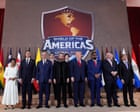
The media is currently swooning over the "Shield of Americas" summit as if it were the second coming of the Monroe Doctrine. They see twelve Latin American leaders standing on a stage with Donald Trump and they see a unified front against Chinese hegemony. They see a "fortress hemisphere." They see a "new era of cooperation."
They are seeing a mirage.
I have spent two decades watching these summits. I have seen the handshakes in Mar-a-Lago, the signed "letters of intent" that end up in paper shredders by the next fiscal cycle, and the grand proclamations of regional unity that vanish the moment a commodity price dips.
The "Shield of Americas" isn't a strategic alliance. It is a transactional temporary marriage of convenience between a populist American president and a handful of Latin American leaders who are terrified of their own shrinking balance sheets. If you think this is about shared values or long-term defense, you aren't paying attention to the math.
The China Trap Nobody Wants to Admit
The "lazy consensus" suggests that by inviting these twelve leaders to the table, the U.S. is effectively "crowding out" Chinese influence. This is a fundamental misunderstanding of how the Southern Cone operates.
You cannot "shield" a region that is already owned by the person you are shielding it from.
China is the top trading partner for Brazil, Chile, and Peru. They don't just buy soy and copper; they own the power grids. They build the 5G towers. They fund the deep-water ports. When a Latin American leader stands next to Trump and nods about "hemispheric security," they are performing for an audience of one. The moment they get back on their plane, they are checking the Shanghai Composite Index.
The U.S. offers "security" and "democracy." China offers cash and infrastructure with no lectures on human rights. In a region where leaders have a shelf life of about four years before they are ousted or jailed, the guy with the checkbook always beats the guy with the shield.
The Nearshoring Myth
The summit’s central economic pillar is "nearshoring"—the idea that we can simply move factories from Shenzhen to San Salvador or Monterrey and everyone wins. It sounds great in a stump speech. In reality, it is a logistical and legal nightmare that ignores the "Quality of Institutional Environment" (QIE).
I have advised firms that tried to pull out of Vietnam to move to Central America. They ran into a wall of reality:
- Energy Costs: In many of these "Shield" nations, electricity is 30% to 50% more expensive than in Southeast Asia.
- Labor Mismatch: You can’t swap a high-precision electronics assembler in Suzhou for a seasonal agricultural worker in Guatemala and expect the same yield.
- The Corruption Tax: The "Shield" doesn't protect you from the local police chief or the regional governor who wants a 10% "consultancy fee" to let your containers reach the port.
If the U.S. truly wanted to secure the hemisphere, it wouldn't be holding summits. It would be aggressively slashing the regulatory overhead for private equity to build private power plants in Bogotá. Instead, we get photo ops.
The Migration Shell Game
The competitor narrative claims this summit is a breakthrough for border security. "The leaders agreed to hold the line," the headlines scream.
Nonsense.
Latin American leaders use migration as their primary lever of influence over Washington. Why would they ever actually "solve" the problem? If the migrant flow stops, their leverage evaporates. They are essentially running a protection racket. "Give us aid, give us trade concessions, or we’ll let another 50,000 people walk north."
By labeling this a "Shield," Trump is actually giving these leaders a brand they can use to extract more money. It’s not a barrier; it’s a toll booth.
The Fragility of the "Twelve"
Look at the roster of the twelve leaders. It’s a chaotic mix of right-wing firebrands, desperate moderates, and "strongmen-lite" who are one bad harvest away from a coup or an impeachment.
Argentina’s Milei is a wildcard whose entire "chainsaw" economy could stall if the unions decide to shut down Buenos Aires for a month. Bukele in El Salvador has traded civil liberties for a safety record that is as fragile as it is impressive. These are not stable pillars upon which to build a continental shield.
Imagine a scenario where a global recession hits in late 2026. Copper prices crater. The "Shield" nations see their currencies devalued by 20%. Do you think they will stick with Washington's "Buy American" mandates? No. They will go to Beijing, hat in hand, and ask for a currency swap line. And Beijing will give it to them, provided they kick the Americans out of their lithium mines.
The Real Question We Should Be Asking
Instead of asking, "How can we build a shield?" we should be asking, "Why is the U.S. trying to compete in a game it already lost?"
We shouldn't be trying to out-build China in infrastructure. We can't. They have state-subsidized construction giants that don't care about profit margins. We should be playing to our actual strengths:
- Financial Tech: Forcing the dollarization of these economies to strip power from corrupt central banks.
- Intellectual Property: Moving the "brains" of production to the hemisphere while letting the "brawn" stay wherever it’s cheapest.
- Energy Dominance: Exporting cheap U.S. natural gas to bring down their manufacturing costs.
Everything else is theater. The "Shield of Americas" is a rebranding of the same failed neoliberal policies of the 90s, wrapped in a populist flag. It ignores the reality of the ground-level economy in favor of a grand geopolitical narrative that makes for good television but terrible policy.
The Cost of the Illusion
The danger of the "Shield" is that it creates a false sense of security in Washington. We think we’ve "fixed" the backyard, so we turn our attention back to the Middle East or Eastern Europe. Meanwhile, the structural rot in the Western Hemisphere continues.
The cartels are more powerful than half the governments at that summit. The "Shield" doesn't address the fact that the Sinaloa or Jalisco New Generation cartels have better logistics than Amazon and better weaponry than the Bolivian army. Unless you are talking about dismantling the black market economies that fund these leaders' rivals, you aren't talking about a shield. You're talking about a curtain.
The next time you see a group photo from this summit, don't look at the smiles. Look at the debt-to-GDP ratios of the countries represented. Look at the percentage of their exports going to China.
The "Shield" is made of cardboard. And it's already raining.
Stop looking for a grand unified theory of the Americas. It doesn't exist. There are only individual deals, individual interests, and a very short window of time before the next populist wave washes away every signature on those documents.
If you want to actually win in Latin America, stop treating it like a strategic bloc and start treating it like a series of hostile takeovers.
Stop signing treaties. Start buying assets.