The 2026 Academy Award for Best Documentary just went to Mr. Nobody Against Putin, a film shot in secret by a school videographer named Pavel Talankin. It shows Russian kids in the town of Karabash being forced to sing war songs, pledge allegiance to the state, and sit through "patriotic" lectures. But here's the thing everyone's missing: just because the government is screaming, it doesn't mean the kids are listening.
For the last few years, the Kremlin has turned Russian schools into ideological factories. They’ve introduced "Conversations about Important Things," a mandatory Monday morning lesson designed to justify the invasion of Ukraine and demonize the West. As of September 2025, they’ve even pushed this curriculum down into kindergartens, using a cartoon bear named Umka to explain why "serving the Motherland" is the only thing that matters.
It looks terrifying on paper. But when you look at how this actually plays out in a classroom, the "totalitarian" machine starts to look a lot more like a boring, bureaucratic chore that teenagers are already experts at ignoring.
The Gap Between Ritual and Belief
The mistake Western observers often make is equating compliance with conviction. In Russia, people have spent a century learning how to perform loyalty without actually feeling it. This is what the Soviet era called vranio—I know I'm lying, you know I'm lying, you know I know I'm lying, but we both go through the motions because it’s easier than going to jail.
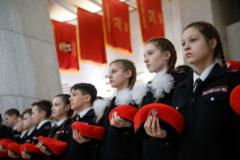
Russian schools are now the front line of this performance. Students stand for the flag and sing the anthem every Monday. They listen to "Heroes" (often veterans or even former Wagner mercenaries) tell stories of "denazification." But talk to any teacher who hasn't fled the country, and they'll tell you the same thing: the kids are on their phones.
Middle schoolers and teenagers aren't a blank slate. They have the internet. Even with the tightening of the "sovereign RUnet," they use VPNs to access YouTube, TikTok, and Instagram. They see the contrast between the drab, militaristic aesthetics of the school assembly and the vibrant, globalized world they actually want to live in.
Propaganda works best when it offers a vision of the future. The current Russian curriculum offers a vision of the 1940s. It’s hard to sell a 15-year-old on the glory of trench warfare when they’d rather be playing Genshin Impact or listening to K-pop.
Teachers Are the Weakest Link
The Kremlin's biggest problem isn't the kids; it's the people supposed to be brainwashing them. Most Russian teachers are overworked, underpaid women who took the job because they like children, not because they want to be political commissars.
While the Ministry of Education sends out strict "methodological materials"—literally scripts of what to say and how to answer "tricky" questions—teachers have developed a million ways to subvert them.
- The "Algebra" Strategy: A teacher "covers" the patriotic lesson by spending 45 minutes doing extra math problems, claiming the students need the help.
- The Boredom Defense: Teachers read the state-provided scripts in the most monotonous, soul-crushing voice possible, ensuring no one actually processes the information.
- The Technical Glitch: Oops, the video from the Ministry won't load. Better just talk about the upcoming school play instead.
This isn't organized resistance. It’s exhaustion. When the state demands total ideological mobilization, it eventually hits the wall of human apathy.
When Propaganda Backfires
There’s a real risk for Putin here: "Scientific Communism" was mandatory in every Soviet university, and it's widely credited with making an entire generation of Russians hate the government. By making "patriotism" a forced, graded subject, the state is making it uncool.
We’re seeing reports of "Heroes' Desks"—specially decorated desks dedicated to fallen soldiers—becoming objects of ridicule or intentional neglect by students. When you force a grieving process or a political stance on a teenager, the natural biological response is rebellion.
The Oscar win for Mr. Nobody Against Putin has panicked the Kremlin not because the film is "false," but because it's embarrassing. It shows the world the "small acts of complicity" that keep the system running, but it also inadvertently highlights how hollow the whole thing is. The students in the film don't look like burgeoning fanatics; they look like kids waiting for the bell to ring so they can go be themselves.
The New Curriculum of War
Don't get me wrong—the effort to militarize the youth is real and dangerous. In 2024, the subject "Fundamentals of Life Safety" was replaced with "Fundamentals of Security and Defense of the Homeland." Kids as young as 14 are now being taught how to operate combat drones and strip Kalashnikovs.
This isn't just about "values" anymore; it's about technical preparation for a perpetual war. Even if the kids don't believe the ideology, they're being given the skills to participate in the machinery of the state. That’s a much harder thing to unlearn than a history lesson.
The real test won't be whether these kids can recite the "correct" version of history on an exam. It’ll be what they do when they graduate and the state asks them to trade their lives for those "important things" they were told about on Monday mornings.
If you want to track the real impact of this propaganda, stop looking at the school assemblies and start looking at the enlistment numbers for 18-year-olds. That’s the only metric that actually matters to the Kremlin.
If you’re following this topic, your next step is to look into the "Movement of the First," Russia's new youth organization that’s attempting to replicate the Soviet-era Pioneers. It’s where the state is putting the real money, and it’s a much better indicator of how they plan to control the next generation outside the classroom. Keep an eye on their membership growth vs. actual engagement—the gap there tells the real story.