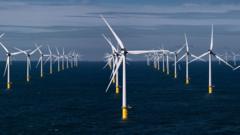
Port Talbot isn't being saved; it's being managed into a state of expensive, subsidized irrelevance.
The press releases are glowing. They speak of a "green industrial revolution" and the Celtic Sea becoming the new North Sea. They promise that the transition from blast furnaces to floating offshore wind (FLOW) foundations will provide a "like-for-like" economic lifeline for South Wales.
It is a lie of omission.
The current narrative surrounding the Port Talbot "hub" ignores the brutal physics of global supply chains and the reality of specialized labor. We are trading 100 years of high-value, primary steel production for the privilege of being a glorified assembly yard for components manufactured in lower-cost jurisdictions.
If you think bolting together someone else’s turbines is a strategy for national prosperity, you aren't paying attention to the math.
The Steel Subsidy Trap
The central irony is staggering. To build offshore wind at scale, you need massive quantities of steel. Yet, at the exact moment we are positioning Port Talbot as the "hub" for this industry, we are decommissioning the very blast furnaces capable of producing virgin steel.
Tata Steel’s transition to Electric Arc Furnaces (EAFs) is framed as a victory for the environment. In reality, it is a strategic retreat. EAFs rely on scrap steel. While they are efficient, they struggle to produce the specific, high-specification grades of virgin steel required for the massive structural integrity of floating wind foundations.
What happens when the "hub" realizes it has to import the steel for its "green" turbines from China or India?
- The Carbon Paradox: We ship iron ore to Asia, they burn coal to make steel, we ship the steel back to Wales to build a "zero-carbon" turbine.
- The Economic Leakage: The highest value-add in the chain—primary production—is gone. Port Talbot is left with the low-margin labor of welding and logistics.
I’ve seen this play out in the North Sea oil and gas sector. The UK provided the seabed, the tax breaks, and the consumers, while the high-tech engineering and manufacturing margins flowed to Norway, Houston, and Singapore. Port Talbot is currently on track to repeat this failure, but with thinner margins and higher public subsidies.
Floating Wind is Not a Proven Business Model
The industry treats floating offshore wind as an inevitability. It isn't. It is currently a high-cost experiment with a Levelized Cost of Energy (LCOE) that makes fixed-bottom wind look like a bargain.
Standard offshore wind is anchored to the seabed. Floating wind requires complex mooring systems and massive subsea cables that must withstand the violent kinetics of the Celtic Sea.
The Cost Gap
For Port Talbot to be a "success," the cost of FLOW must plummet. Currently, the LCOE for floating wind is estimated to be significantly higher than its fixed-bottom counterparts. We are betting the entire economic future of a region on the hope that a massive technological breakthrough happens exactly when we need it.
$$LCOE = \frac{\sum_{t=1}^{n} \frac{I_t + M_t + F_t}{(1+r)^t}}{\sum_{t=1}^{n} \frac{E_t}{(1+r)^t}}$$
In this equation, $I_t$ (Investment) and $M_t$ (Maintenance) for floating platforms are volatile variables that the current "hub" plan ignores. Maintenance alone in the Celtic Sea—a region known for some of the most aggressive sea states in the Northern Hemisphere—will require a fleet of specialized vessels that don't exist yet.
The "People Also Ask" sections on search engines ask: How many jobs will Port Talbot's wind hub create? The honest answer? Fewer than the steelworks lost, and they will be more precarious. Construction jobs in wind are cyclical. Once the initial build-out of the 4GW Celtic Sea project is done, the "hub" becomes a quiet maintenance yard. You cannot run a town on the back of occasional turbine repairs.
The Myth of the "Hub"
Every port from Scotland to Cornwall is claiming to be an "offshore wind hub."
When everyone is a hub, nobody is a hub. Port Talbot has deep-water capacity, which is a genuine asset, but it lacks the integrated manufacturing ecosystem.
A real industrial hub doesn't just assemble; it invents and manufactures. If Port Talbot isn't manufacturing the nacelles, the blades, or the specialized subsea power electronics, it is just a parking lot with a crane.
The Crown Estate’s "Celtic Sea" tender process is focused on capacity, not domestic content. Without strict, enforceable requirements for UK-sourced components, the Port Talbot hub will be a transit point for Danish blades and Chinese steel.
Stop Chasing the Assembly Line
If we wanted to actually disrupt this cycle, we would stop trying to compete with the sheer manufacturing volume of the Far East.
Instead of a "hub" for assembly, Port Talbot should be the global center for Floating Wind Intellectual Property.
We should be focusing on:
- Autonomous Maintenance Systems: Building the drones and subsea robots that can service these turbines in 10-meter swells without risking human life.
- Dynamic Cable Engineering: Solving the massive failure rate of subsea cables in high-energy environments.
- Hybrid Energy Storage: Integrating green hydrogen production directly onto the floating platforms to solve the intermittency problem of wind.
This requires a shift in mindset. It means moving away from the "jobs for the boys" rhetoric of the 20th century and toward a high-skill, low-volume, high-margin engineering economy.
The current plan is a 1970s solution to a 2030s problem. We are building a massive physical footprint for an industry that is rapidly moving toward automation. By the time Port Talbot is fully "up and running" as a wind hub, the very jobs they are promising will likely be performed by automated welding rigs and remote-operated cranes.
The Inconvenient Truth of the Celtic Sea
The Celtic Sea is a beast. The Crown Estate wants to unlock 4GW of floating wind by 2035. That is an aggressive, perhaps delusional, timeline.
The infrastructure required to bring that much power ashore is non-existent. The National Grid in South Wales is already strained. To make Port Talbot a true hub, we need a massive overhaul of the onshore transmission network. This involves thousands of miles of new pylons and cables across the Welsh countryside—a logistical and political nightmare that no one in the "hub" press office wants to discuss.
The public is being sold a vision of "clean, cheap energy" and "plentiful jobs."
What they will likely get is:
- Higher energy bills to subsidize the astronomical cost of floating wind.
- A hollowed-out industrial base that no longer makes its own primary materials.
- A port that is busy for five years and then waits for the next government subsidy to stay afloat.
We are watching a controlled demolition of the British steel industry, and we are being told to cheer because the rubble is being used to build a wind farm.
Port Talbot deserves better than to be a sacrificial lamb on the altar of "green" optics. It deserves a strategy that respects its history of heavy engineering by evolving it, not by turning it into a giant Lego set for international developers.
If we don't fix the supply chain and energy transmission issues first, the Port Talbot wind hub won't be a gateway to the future; it will be a monument to a missed opportunity.
Stop asking when the wind turbines are arriving and start asking why we stopped being a country that builds the things the world actually needs.