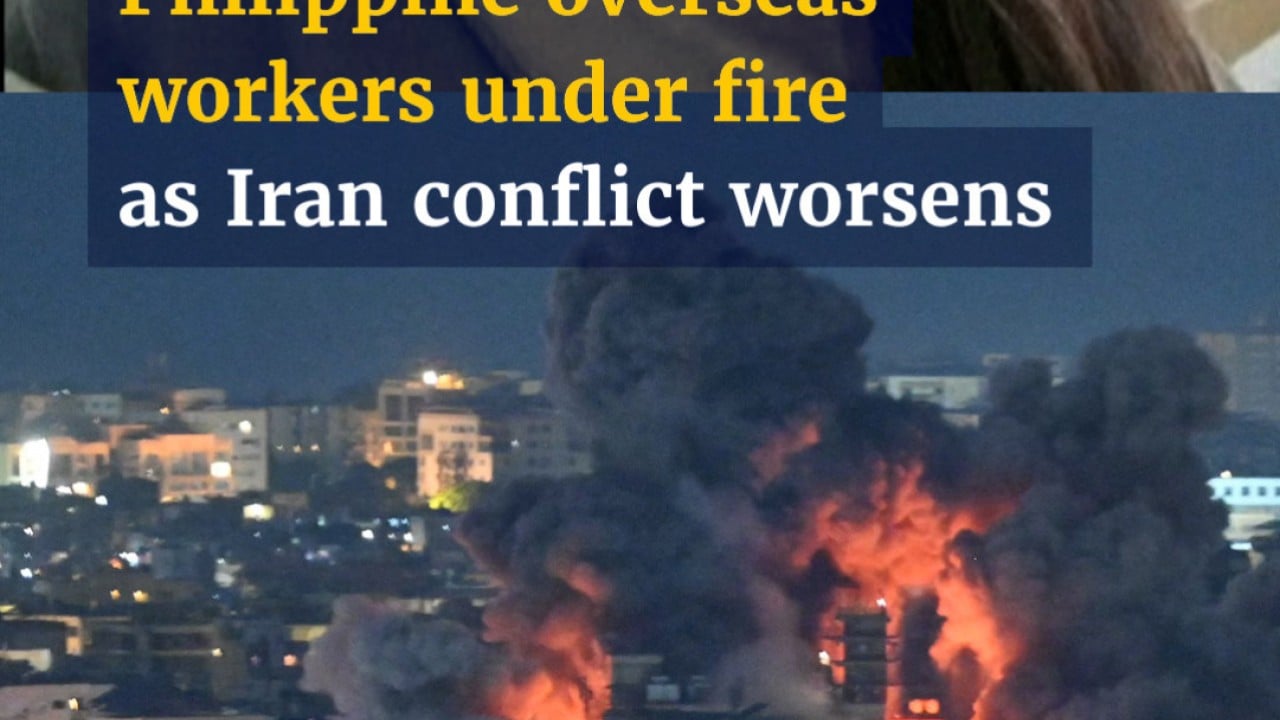
The Philippine economy operates on a structural dependency where approximately 10% of its Gross Domestic Product (GDP) is tied to the movement of human capital, specifically to the Middle East. While media narratives often focus on the immediate safety of the 1.5 million Overseas Filipino Workers (OFWs) in the region, a rigorous strategic analysis reveals a deeper systemic vulnerability: the intersection of regional geopolitical instability with the "Dutch Disease" of remittance-led consumption. The current Middle East crisis does not just threaten lives; it threatens the liquidity of the Philippine banking system and the stability of the Philippine Peso (PHP).
The Triple Threat Framework of Labor Displacement
To quantify the risk to the Philippine labor export model, we must categorize the threat into three distinct causal mechanisms.
1. The Physical Extraction Bottleneck
The most immediate risk is the logistical impossibility of mass repatriation. In a scenario of total regional escalation, the Philippine government’s ability to extract citizens is limited by the capacity of commercial aviation and the availability of naval assets. Unlike the 1990 Gulf War, where displacement was localized to Kuwait and Iraq, a multi-front conflict in 2026 involves the UAE, Qatar, and Saudi Arabia—nodes that house the vast majority of Filipino technical and medical staff. The bottleneck is not just transport; it is the sudden cessation of the "service economy" within these host nations, leading to stranded populations without contractual protections.
2. The Remittance Liquidity Gap
Remittances from the Middle East account for roughly 20-25% of total annual inflows to the Philippines. These inflows are the primary drivers of domestic household consumption. A sudden disruption creates a "Liquidity Gap" where:
- Household Default Rates Rise: Remittance-dependent families often hold debt in real estate or micro-loans. If the monthly transfer stops, the delinquency rate in the provincial banking sector spikes.
- Foreign Exchange Pressure: The Bangko Sentral ng Pilipinas (BSP) relies on these steady USD inflows to manage the PHP exchange rate. A 15% drop in Middle East remittances would force the BSP to burn through international reserves or allow the Peso to devaluate, instantly raising the cost of imported fuel and electricity.
3. The Reabsorption Friction
The Philippine domestic labor market is currently incapable of absorbing 1 million returning workers, particularly those in specialized sectors like oil and gas or high-end hospitality. This creates "Reabsorption Friction," where highly skilled workers face significant "skill-downgrading" or prolonged unemployment, leading to a net loss in the country's human capital value.
The Saudi-Riyadh Decoupling Paradox
The Saudi Vision 2030 project was intended to be the ultimate hedge for Philippine labor, promising decades of construction and service demand. However, the current crisis introduces a paradox. While the Saudi government is desperate to maintain its development timeline, the geopolitical risk premium is making international financing for these projects more expensive.
If Saudi Arabia is forced to pivot its national budget from infrastructure to defense, the "Neom-driven" demand for Filipino engineers will evaporate. This is not a hypothetical risk; it is a budgetary reallocation mechanism. The Philippine Department of Migrant Workers (DMW) is currently optimizing for a market that may fundamentally shift its spending priorities within a single fiscal quarter.
Quantifying the Socio-Economic Cost Function
The impact of the Middle East crisis can be modeled as a cost function $C$, where:
$$C = (R_{loss} + E_{repat} + I_{social}) \times D$$
Where:
- $R_{loss}$ is the total value of lost remittances.
- $E_{repat}$ is the operational cost of emergency repatriation.
- $I_{social}$ is the cost of domestic social safety nets for displaced workers.
- $D$ is the duration of the regional conflict.
This equation demonstrates that the "duration" is the most lethal variable. A short-term flare-up is manageable through existing contingency funds. A protracted conflict, however, exponentially increases $I_{social}$, as the Philippine government must then subsidize the livelihoods of millions of citizens who were previously self-sufficient contributors to the tax base.
Structural Vulnerabilities in the Recruitment Pipeline
The crisis exposes a fatal flaw in the "Agency Model" of Philippine labor export. Private recruitment agencies operate on a volume-based business model. They are incentivized to send workers into high-risk zones because the upfront placement fees are guaranteed, while the long-term geopolitical risk is externalized to the worker and the state.
This creates a "Moral Hazard" where:
- Agencies under-report risks to prospective migrants to maintain deployment numbers.
- Workers take on high-interest debt to pay for placement, making them unwilling to evacuate even when danger is imminent, as they cannot return home with unpaid debt.
- The State is forced to bail out these individuals during a crisis, effectively subsidizing the risky business practices of private recruitment firms.
The Healthcare Human Capital Leak
One of the most critical, yet under-analyzed, risks is the concentration of Filipino nurses and medical technicians in Middle Eastern hospitals. In nations like Saudi Arabia and the UAE, Filipino staff form the backbone of the secondary and tertiary healthcare systems.
If a mass exodus occurs:
- The host nations face a total collapse of their healthcare delivery systems.
- The Philippines receives a sudden influx of healthcare workers, but lacks the hospital infrastructure or the budgetary headroom to employ them at competitive wages.
- The result is a "Brain Waste" scenario where world-class medical professionals are forced into underemployment or non-medical roles to survive domestically.
Strategic Realignment of the Labor Export Policy
The Philippine government must move beyond reactive "Crisis Management" and toward "Market Diversification." Relying on a single geographic bloc (the GCC) for 25% of remittances is a failure of sovereign risk management.
The strategic play is a mandatory shift toward "High-Value, Low-Physicality" labor. By pivoting the workforce toward remote digital services and high-end technical exports that do not require physical presence in conflict zones, the Philippines can decouple its GDP from the volatility of Middle Eastern borders.
The Department of Migrant Workers should immediately implement a "Geopolitical Risk Levy" on recruitment agencies deploying to Tier-1 risk zones. This levy would fund a permanent, self-sustaining insurance pool for repatriation, removing the burden from the national budget. Furthermore, the BSP must incentivize the conversion of remittances into long-term domestic investments—such as infrastructure bonds or small-business equity—rather than pure consumption. This ensures that even if the "flow" of money stops, the "stock" of wealth generated by those workers remains active in the Philippine economy.
Transitioning from a labor-exporting nation to a talent-exporting nation is the only way to mitigate the 1-million-worker risk. This requires a fundamental redesign of the national education system to align with the demands of stable economies in Europe and North America, or the burgeoning tech sectors in Southeast Asia, reducing the over-reliance on the volatile Arabian Peninsula.