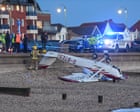
The headlines are always the same. A light aircraft—usually a Cessna or a Piper—ends up on a beach, a golf course, or a suburban hedge. The pilot "crawls out" or "escapes with minor injuries." The media treats it like a brush with death, a miraculous survival, or a sign that the skies are falling.
It is none of those things.
The recent incident in Gosport, where a pilot landed on the sand, isn't a tragedy narrowly avoided. It is a textbook example of a machine doing exactly what it was designed to do and a pilot executing a standard emergency procedure. By framing these events as "narrow escapes," we feed a culture of fear that treats general aviation (GA) like a reckless hobby rather than the backbone of modern aerospace innovation.
We need to stop talking about the "crash" and start talking about the landing.
The Myth of the "Crash"
When a car breaks down on the highway and the driver pulls onto the shoulder, we call it a mechanical failure. When a plane’s engine quits and the pilot lands on a beach, the press calls it a "horrific crash."
This linguistic laziness creates a false perception of risk. In the Gosport incident, the pilot didn't "fall out of the sky." Aerodynamics doesn't stop working just because the engine does. A light aircraft is effectively a high-performance glider with a temporary propulsion unit. If that unit fails, the pilot maintains control. They trade altitude for distance. They pick a spot. They land.
The "crawling out" narrative implies the pilot was lucky to be alive. In reality, modern light aircraft are built around a reinforced cockpit cage. They are designed to dissipate energy during a forced landing. If a pilot is walking away, the system worked. The "news" here isn't that a plane hit the ground; it’s that the safety protocols we’ve spent eighty years refining are remarkably effective.
Physics Doesn't Care About Your Fear
Let’s look at the math that the sensationalist reports ignore. A typical light aircraft like a Cessna 172 has a glide ratio of roughly 9:1. This means for every $1,000$ feet of altitude, the pilot can glide for about $1.5$ miles.
$$\text{Glide Distance} = \text{Altitude} \times \text{Glide Ratio}$$
If that pilot was at $3,000$ feet when the trouble started, they had a four-mile radius—a massive circle of potential landing spots—to choose from. Landing on a beach isn't a desperate "hail Mary." It’s a calculated choice to prioritize a flat, unobstructed surface over a populated area or a rocky field.
The public sees a wreckage. An insider sees a successfully managed energy state. We are teaching people to be afraid of the wrong thing. You shouldn't be afraid of the engine stopping; you should be afraid of the pilot who hasn't practiced their power-off 180s in six months.
The Safety Paradox
The mainstream media’s obsession with these "miracle" landings actually makes flying less safe. How? By driving up insurance premiums and suffocating the industry with reactionary regulations that don't address the root causes of genuine accidents.
When every minor off-field landing is treated like a catastrophe, regulators feel pressured to "do something." This usually results in more paperwork, higher costs for parts, and more barriers to entry for new pilots. I’ve seen flight schools shut down because their insurance tripled after a non-injury incident made the local front page.
We are pricing out the very people who keep the fleet young and well-maintained. We are left with an aging fleet of "legacy" aircraft because the cost of certifying new, safer technology is astronomical thanks to a public that demands "zero risk" in a world where risk is the price of mobility.
What the "People Also Ask" Sections Get Wrong
If you search for "Is small plane flying safe?" you get a sanitized version of the truth. The brutal reality is that general aviation is roughly as dangerous as riding a motorcycle. That sounds scary until you realize that almost all GA accidents are caused by one of three things:
- Fuel Exhaustion: Running out of gas. This isn't a mechanical failure; it's an ego failure.
- VFR into IMC: Flying into clouds when you aren't trained or equipped for it. This is a decision-making failure.
- Low-Altitude Maneuvering: Showing off. This is a character failure.
The Gosport incident doesn't fit into these categories. It appears to be a genuine mechanical issue. And yet, because the pilot did their job, it’s being used to bolster the "flying is scary" narrative.
The Real Danger is Stagnation
We are flying airframes from the 1970s because we’ve made it too expensive to build anything else. If we want fewer planes on beaches, we should be cheering for the deregulation of experimental aircraft and the rapid adoption of electric propulsion.
Electric motors have one moving part. They are exponentially more reliable than the internal combustion engines currently powering the GA fleet. But every time a pilot "crawls out" of a traditional plane and the media turns it into a circus, we reinforce the idea that aviation is a dark art that needs more oversight, rather than a technical challenge that needs more innovation.
Stop Congratulating the Pilot
I know this sounds harsh. We want to be happy the pilot is okay. But by treating a standard emergency landing as a miracle, we lower the bar for what we expect from aviators.
Landing on a beach when your engine fails is the minimum requirement for holding a private pilot license. It’s what you’re tested on. It’s what you pay an instructor to drill into your head until you can do it in your sleep.
When we celebrate a pilot for not dying in a controlled descent, we are participating in the "participation trophy" culture of safety. We should expect them to land safely. We should demand it. And we should focus our attention on why the engine failed in the first place, rather than gawking at the wings in the sand.
The Cost of Sensationalism
Every time a "beach crash" goes viral, a teenager who might have been the next great aerospace engineer decides to go into software instead because "planes are dangerous."
We are losing the talent war because we can't distinguish between a system failure and a system success. The Gosport landing was a success. The pilot is alive, the public is unharmed, and the aircraft can be recovered.
If you want to be a "sharp" observer of the industry, stop looking at the crumpled metal. Look at the flight path. Look at the decision-making timeline. Look at the fact that in a world of chaotic, unpredictable risks, aviation remains one of the few places where a total engine failure can result in a guy walking away to have a cup of tea.
The beach isn't a scene of a crime; it's a testament to the fact that we have conquered the air so thoroughly that even when our machines quit, we still get to choose where we touch the earth.
Next time you see a headline about a pilot "crawling" from a wreck, remember: he didn't crawl because he was lucky. He crawled because he was trained, the plane was engineered, and the physics of lift don't require an ignition spark.
Stop buying the fear. Start demanding the context.


