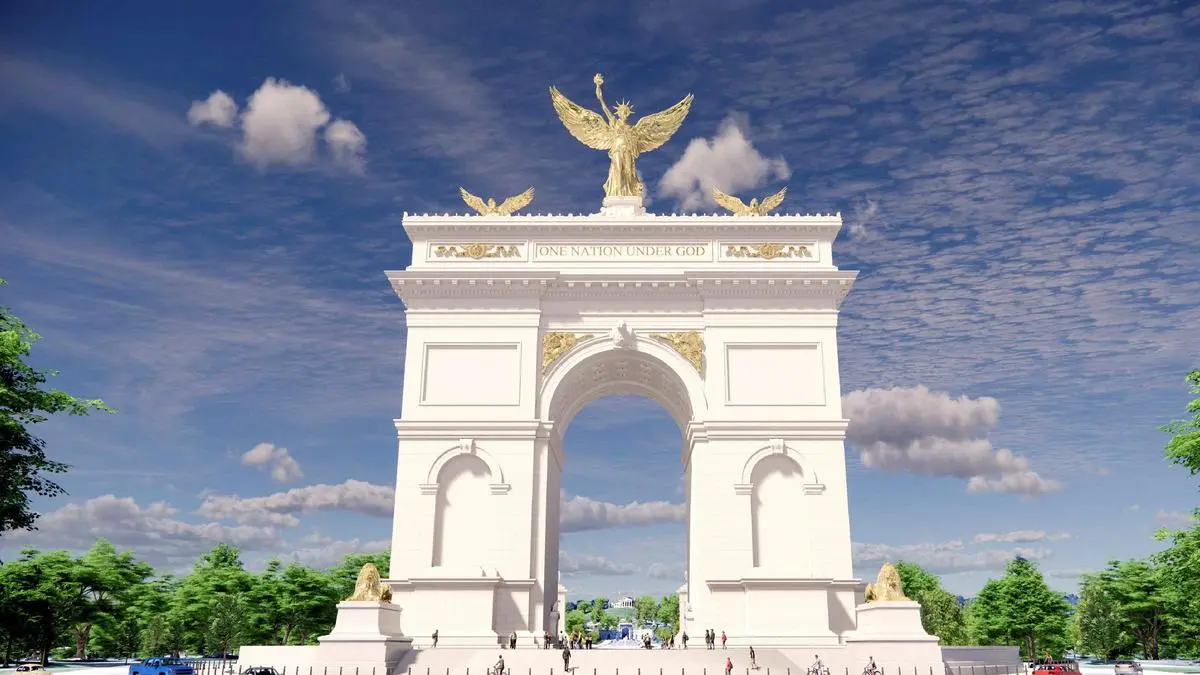
The architectural critic class is currently hyperventilating into their oat milk lattes over Donald Trump’s proposal for a massive, gilded triumphal arch in Washington, D.C. They call it "gaudy." They call it "autocratic." They call it "anachronistic."
They are wrong. Not just slightly off—dead wrong.
The pearl-clutching over golden eagles, winged figures, and bronze lions isn't about aesthetics. It’s about a deep-seated, institutional fear of permanence. For fifty years, the American capital has been strangled by a "brutalist-lite" consensus that prioritizes glass boxes and concrete slabs. We’ve built a city that looks like a high-end dentist's office in Zurich.
The proposed arch, regardless of your politics, represents a violent return to the Beaux-Arts tradition. It is a middle finger to the temporary. It is a rejection of the "disposable city." While the media focuses on the gold leaf, they miss the structural argument: Architecture is the only way a civilization proves it actually existed.
The Death of the Civic Soul
Walk through the "modern" sections of D.C. today. You’ll see structures that look like they were designed by an algorithm to be as offensive as a lukewarm cup of water. We have traded the soaring heights of the Lincoln Memorial for the "efficient use of space."
The critics claim the arch is a "vanity project." Every great monument in human history was a vanity project. Do you think the Arc de Triomphe was built to facilitate traffic flow? Do you think the Parthenon was a "holistic community center"?
Architecture is about power. It is about the projection of values into the future. When we build glass boxes, we are saying we don't expect our values to last more than thirty years—the life of a standard commercial lease. When you build a 100-foot arch out of stone and bronze, you are making a claim on the next five hundred years.
Why "Gaudy" is the New Radical
The most frequent insult hurled at the Trump arch plan is that it's "tacky." This is the ultimate elitist gatekeeping tool. In the world of high-brow design, "good taste" has become synonymous with "invisible." If it’s beige, flat, and hides behind a vertical garden, it’s "sophisticated."
But look at the history of civic pride. The Great Altar of Pergamon wasn't subtle. The Basilica of San Marco in Venice is a riot of stolen gold and mismatched marble. It’s "gaudy" by modern standards. Yet, millions of people travel across the globe to see them. Nobody flies 5,000 miles to look at a LEED-certified government annex.
The arch uses classical symbols—the eagle and the lion—because they are a universal language. They communicate strength, vigilance, and sovereignty. The modernists hate this because they want a world where symbols are "deconstructed" until they mean nothing. They want a "global" aesthetic that could be in Singapore, London, or D.C. without anyone knowing the difference.
The arch is a reclamation of place.
The Logistics of Grandeur
Critics point to the cost. They cite the "disruption" to the L'Enfant Plan. Let’s talk about the data they ignore.
Washington D.C. is a city designed around sightlines. The Pierre L'Enfant plan of 1791 was specifically created to handle grand vistas. Over the last century, we’ve cluttered those vistas with "security barriers" and "utilitarian infrastructure." A massive arch doesn't ruin the plan; it fulfills it. It provides an anchor for the eye.
From a materials perspective, the shift back to stone and heavy metal is actually the only sustainable path forward. Steel and glass buildings are energy pits that degrade quickly. Granite and bronze require minimal maintenance over centuries. If you actually cared about the "carbon footprint" of the city, you’d stop building glass towers that need constant climate control and start building thick-walled monuments that outlast empires.
Dismantling the "Dictator" Aesthetic Argument
The most intellectually lazy argument is that grand architecture equals authoritarianism. This is a historical fallacy. The very concept of the triumphal arch was popularized by the Roman Republic long before it was an Empire. The most iconic "imperial" buildings in D.C.—the Supreme Court, the National Archives—were built during the height of American democratic expansion.
To say that we cannot build something beautiful and imposing because "bad people liked big buildings too" is a form of cultural suicide. It cedes the entire concept of beauty to the villains. By this logic, we should stop using the color red because it was on the Soviet flag.
The arch isn't an "autocratic" symbol; it’s a sovereign one. There is a difference. A sovereign people has the right to build monuments that reflect their history, even the messy parts.
The Scarcity of Awe
We are living through a crisis of "Awe Scarcity." Our digital lives are flat. Our physical environments are sterile. We have forgotten what it feels like to stand beneath something that makes us feel small.
When you stand under the dome of the Capitol, you feel the weight of the institution. That feeling is necessary for a functioning society. It creates a sense of shared belonging. You can’t get that from a "sustainable mixed-use development."
The Trump arch plan, with its unapologetic lions and golden figures, is an attempt to shock the system back into a state of wonder. It’s a move from "management" back to "leadership."
Why the Resistance is Really About Fear
The people fighting this aren't worried about the traffic on Pennsylvania Avenue. They are worried about the return of the Epic.
The Epic requires heroes. It requires villains. It requires a clear sense of right and wrong. The modern bureaucratic state prefers the "Nuanced." It prefers the "Incremental." It wants everything to be a shades-of-grey compromise.
An arch is a statement. It’s a door. You are either on one side of it or the other. It forces a decision.
I’ve spent years watching developers and city planners gut the soul out of projects to appease "aesthetic boards" who haven't had an original thought since 1974. They treat the city like a spreadsheet. They forget that humans are irrational, visual creatures who crave symbolism.
We don't need another "reflective park area." We need a monument that screams.
The Final Architectural Reckoning
If this arch is built, it will be the most photographed structure in the city within a week. The tourists will love it. The locals will eventually claim it as their own. And the critics? They will move on to hating the next thing that dares to be interesting.
Stop asking if the arch is "appropriate." Start asking why we stopped building things worth looking at. The lions are coming, and the eagles are landing. You can either stay in your beige box or you can walk through the golden gate.
Architecture is a zero-sum game. You either build something that lasts, or you build something that rots. The arch is a bet on the future of the American myth.
It’s about time someone placed a big bet.