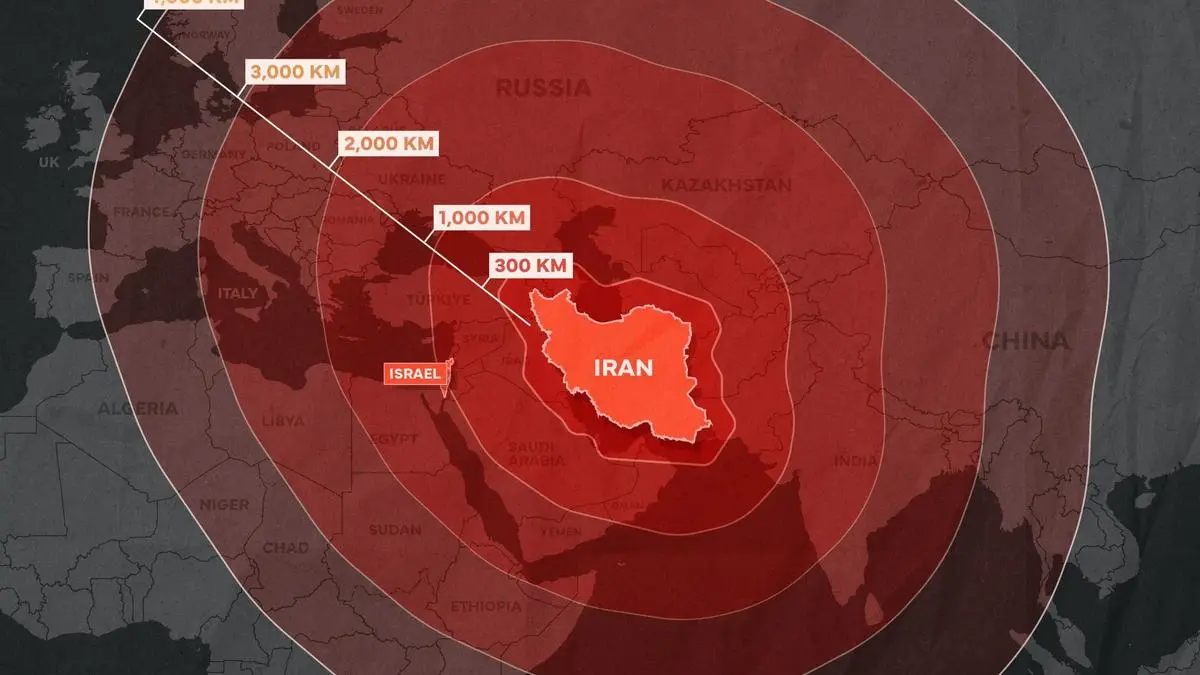
Fear sells. Specifically, the fear of a thousand-mile flight path ending in a fireball sells defense contracts, justifies naval deployments, and keeps the midnight oil burning in every think tank from Brussels to Tel Aviv. The latest alarmist rhetoric suggests that Iran’s ballistic missile capabilities now hold three continents hostage.
It is a neat, terrifying narrative. It is also fundamentally flawed.
When intelligence reports scream about "reach" and "range," they are counting kilometers on a map while ignoring the physics of meaningful warfare. Having the ability to lob a piece of metal across a continent is not the same as having a credible, integrated strike capability. We are obsessed with the "how far" and completely ignoring the "how effective."
The Payload Paradox
Let’s talk about the math that defense lobbyists conveniently forget. A missile’s effectiveness is a brutal tug-of-war between range and payload. If you want to hit a target 2,500 kilometers away, you have to pack that bird with so much fuel that your actual warhead becomes a rounding error.
To reach Europe or deep into Africa from the Iranian plateau, a missile must sacrifice its destructive potential. You end up with a multi-million-dollar delivery system carrying a conventional payload that, upon impact, does about as much damage as a single well-placed 500-pound gravity bomb. In a world of hardened silos and reinforced concrete, that is not a strategic threat; it is an expensive firework.
Unless we are talking about nuclear warheads—which, despite the perennial "two months away" headlines, remain a theoretical bridge Iran hasn't crossed—these long-range capabilities are strategically impotent. Using a medium-range ballistic missile (MRBM) to deliver a conventional explosive to a city in Southern Europe is the most inefficient way to wage war ever devised. It invites total annihilation in exchange for breaking a few windows in a Sofia suburb.
The Interception Reality Check
The "threat" narrative assumes a vacuum. It assumes the airspace between Isfahan and Rome is empty. It isn't.
The Mediterranean and the Middle East are currently the most densely monitored and defended patches of sky on the planet. Between the Aegis Ashore sites in Romania and Poland, the THAAD batteries scattered across the Gulf, and the constant presence of Arleigh Burke-class destroyers, a lone Iranian missile has a near-zero percent chance of reaching a high-value target in Europe.
The IDF and Western intelligence agencies know this. When they talk about Iran’s "ability" to attack, they are speaking in technical possibilities, not operational realities. Yes, the rocket motor can burn long enough to get there. No, the missile will not survive the terminal phase against an integrated mid-course interceptor system.
By focusing on the range of the Shahab-3 or the Khorramshahr, we are falling for a classic magician's trick: look at the big, shiny rocket while the real threat moves in the shadows.
The Drone Swarm is the Real Siege Engine
If you want to be worried about Iranian reach, stop looking at the sky for missiles. Look at the shipping lanes for lawnmower engines.
The true disruption of the status quo isn't the high-altitude ballistic arc; it's the low-altitude, slow-speed, high-volume drone swarm. The Shahed-136 costs less than a used Toyota Camry. It’s hard to track on radar because it flies low and slow. It doesn't need a massive silo or a specialized launch vehicle. You can fire them from the back of a generic flatbed truck.
While the world's media obsesses over whether an Iranian missile can reach Berlin—a scenario that would trigger Article 5 and the literal end of the Iranian state—the drone "reach" is already being felt in every global supply chain. By arming proxies in Yemen and Lebanon, Iran has extended its operational reach without ever needing to fire a missile from its own soil.
This is the nuance the "competitor" articles miss. Reach isn't about the distance from Point A to Point B. Reach is about the ability to exert influence at a distance. If you can shut down the Red Sea with $20,000 drones, you have more "reach" than a nation with a dozen ICBMs that they can never actually use.
The Deterrence Trap
We are witnessing a massive misallocation of intellectual and financial capital. We are building multi-billion-dollar missile defense shields to stop a threat that logic dictates will never be used, while the real "reach"—the asymmetrical, cheap, and persistent disruption of global trade—goes largely unaddressed.
The IDF’s warnings serve a specific political purpose: maintaining the urgency of the "Iranian Threat" to ensure continued military aid and diplomatic pressure. It’s a survival tactic for an intelligence apparatus. But for the rest of the world, adopting this perspective is a mistake.
- Stop valuing range over reliability. A missile that can fly 3,000km but has a Circular Error Probable (CEP) of 500 meters is a psychological weapon, not a military one.
- Recognize the "Proxy Reach." Iran’s true ability to attack Europe or Africa isn't through flight paths over the Mediterranean; it's through the radicalization and arming of groups already positioned on those continents' doorsteps.
- Follow the money. Look at the cost-to-kill ratio. If it costs $2 million to intercept a $20,000 drone, the attacker is winning even when their "attack" is intercepted.
The Counter-Intuitive Truth
The proliferation of Iranian missile technology is actually a sign of their conventional weakness. They cannot build a modern air force. They cannot compete in blue-water naval strength. So, they build the "poor man’s air force"—missiles and drones.
When we treat these missiles as a peer-level threat to the sovereignty of distant continents, we give the Iranian regime exactly what it wants: the prestige of being a global power without the actual economic or military infrastructure to back it up.
Stop checking the range maps. The threat isn't that they can hit us from there. The threat is that they’ve already convinced us they can, and we’re spending ourselves into bankruptcy trying to stop a ghost.
Dismantle the silo. Watch the swarm. Ignore the map.