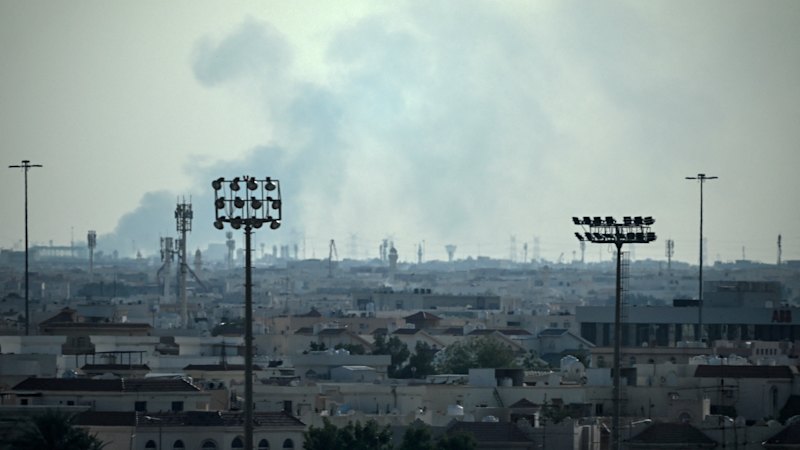
Donald Trump talks a big game about "America First," but a full-scale military conflict with Iran would be the fastest way to shred that entire platform. It’s not just about the horrific human cost or the diplomatic fallout. For a president obsessed with the stock market and the national debt, the spreadsheets simply don’t move in his favor. If you look at the current geopolitical board, a war in the Middle East is an economic suicide note for any administration trying to maintain a domestic "golden age."
The reality is that Iran isn’t Iraq in 2003. It’s a much more formidable, mountainous, and technologically capable adversary. When we talk about the cost of this potential war, we aren’t just talking about the price of Tomahawk missiles. We’re talking about the global price of oil, the stability of the US dollar, and the literal bankruptcy of the American taxpayer.
Why the Persian Gulf is an Economic Minefield
Most people focus on the military hardware, but the real battle is over the Strait of Hormuz. Roughly 20% of the world’s petroleum passes through that narrow chink in the armor every single day. Iran knows this. They don’t need to defeat the US Navy in a traditional broadside battle. They just need to make the shipping lanes unusable.
If Iran sinks a few tankers or litters the water with "smart" mines, insurance rates for cargo ships will skyrocket instantly. We’ve seen this happen on a smaller scale with Houthi rebels in the Red Sea. Now, imagine that chaos amplified by ten. Oil prices wouldn't just "rise." They would spike to levels that would trigger a global recession within weeks. For a president who treats the Dow Jones like a personal report card, that's a nightmare scenario.
High gas prices are the ultimate "incumbent killer" in American politics. You can't tell voters the economy is booming when it costs $120 to fill up a Ford F-150. Trump knows this better than anyone. His entire brand is built on the idea of a "strong" economy, and nothing weakens an economy faster than an energy crisis.
The Trillion Dollar Debt Trap
The US national debt is already screaming past $34 trillion. We're in a position where the interest payments on our debt are starting to eclipse the entire defense budget. Adding a multi-trillion-dollar war to that pile isn't just risky. It’s mathematically impossible without causing a currency crisis.
Unlike the wars in the early 2000s, which were largely financed by cheap credit and a global appetite for US Treasuries, the 2026 landscape is different. Foreign creditors are more skeptical. Inflationary pressures are stickier. If the US starts printing another $2 trillion to fund a regime-change operation in Tehran, the value of the dollar in your pocket will tank.
- The Iraq War cost: Roughly $2 trillion over two decades.
- The Afghanistan War cost: Another $2.3 trillion.
- Estimated Iran War cost: Some experts at the Watson Institute for International and Public Affairs suggest a full-scale invasion and "nation-building" effort in Iran could easily double those figures due to Iran's size and population.
Trump’s base consists largely of people who are tired of "forever wars." They want the money spent on the southern border or on American infrastructure, not on a desert thousands of miles away. Breaking that promise would alienate the very people who put him in the Oval Office.
Domestic Priorities vs Foreign Interventions
You can't have "America First" and "Global Policeman" at the same time. The math doesn't work. Every billion spent on a carrier strike group in the Arabian Sea is a billion not spent on tax cuts or domestic manufacturing incentives.
There’s also the issue of the "Deep State" narrative. Trump has spent years railing against the military-industrial complex and the "warmongers" in Washington. To suddenly pivot into a massive ground war would make him look like a puppet of the very establishment he claims to despise. It’s a branding disaster.
Iran has spent decades perfecting "asymmetric warfare." They won't meet the US in an open field. They'll use proxies in Lebanon, Iraq, Yemen, and Syria to bleed American resources and resolve. This means the war wouldn't be a "quick win." It would be a grinding, decade-long drain on the US Treasury that offers zero return on investment.
The Geopolitical Cost of Isolation
If the US goes it alone against Iran, it loses its leverage with other major powers. Europe has no appetite for another Middle Eastern refugee crisis. China is Iran's biggest oil customer and wouldn't take kindly to its energy supply being choked off by American intervention.
In this scenario, Trump risks pushing America into a corner. Instead of "America First," we end up with "America Alone." This has direct trade consequences. If the US is seen as a destabilizing force in global energy markets, countries will start looking even harder for ways to bypass the dollar. "De-dollarization" is already a buzzword in BRICS nations. A war with Iran would turn that buzzword into a stampede.
The Strategy of Maximum Pressure Without Maximum War
Trump's preferred method has always been economic strangulation—sanctions, tariffs, and bluster. It’s a high-stakes poker game where he hopes the other side folds before he has to actually put chips on the table. But the problem with "maximum pressure" is that it leaves the adversary with no choice but to lash out.
If you’re an expert in "the deal," you know that you never enter a negotiation you can't afford to walk away from. Right now, the US can't afford the "war" option, and Iran knows it. This creates a dangerous lopsidedness. When the other side knows your wallet is empty, your threats lose their sting.
Honest talk? A war with Iran wouldn't just be a military failure; it would be the end of the American century as we know it. The financial strain would force a massive retrenchment of US power globally. We'd be so busy trying to pay for the occupation of Iranian cities that we’d have nothing left to compete with China or fix our own crumbling cities.
What Happens if the Bluster Fails
The biggest mistake is thinking this would be a "surgical strike." There is no such thing as a small war with Iran. Any strike on their nuclear facilities would almost certainly trigger a regional conflagration.
If you want to stay ahead of this, stop watching the cable news pundits and start watching the bond market and oil futures. Those are the real indicators of how "favorably" a war is going for any president. When the price of Brent Crude starts ticking toward $150 a barrel, you’ll know the "cost" has officially become too high.
The path forward requires a cold-blooded look at the books. The US needs to de-escalate not because it's the "nice" thing to do, but because it's the only way to keep the American economy from cratering. We need to focus on energy independence and realistic diplomacy that doesn't involve trillion-dollar boots on the ground. Keep your eyes on the 10-year Treasury yield—that's the real scoreboard for the next administration.