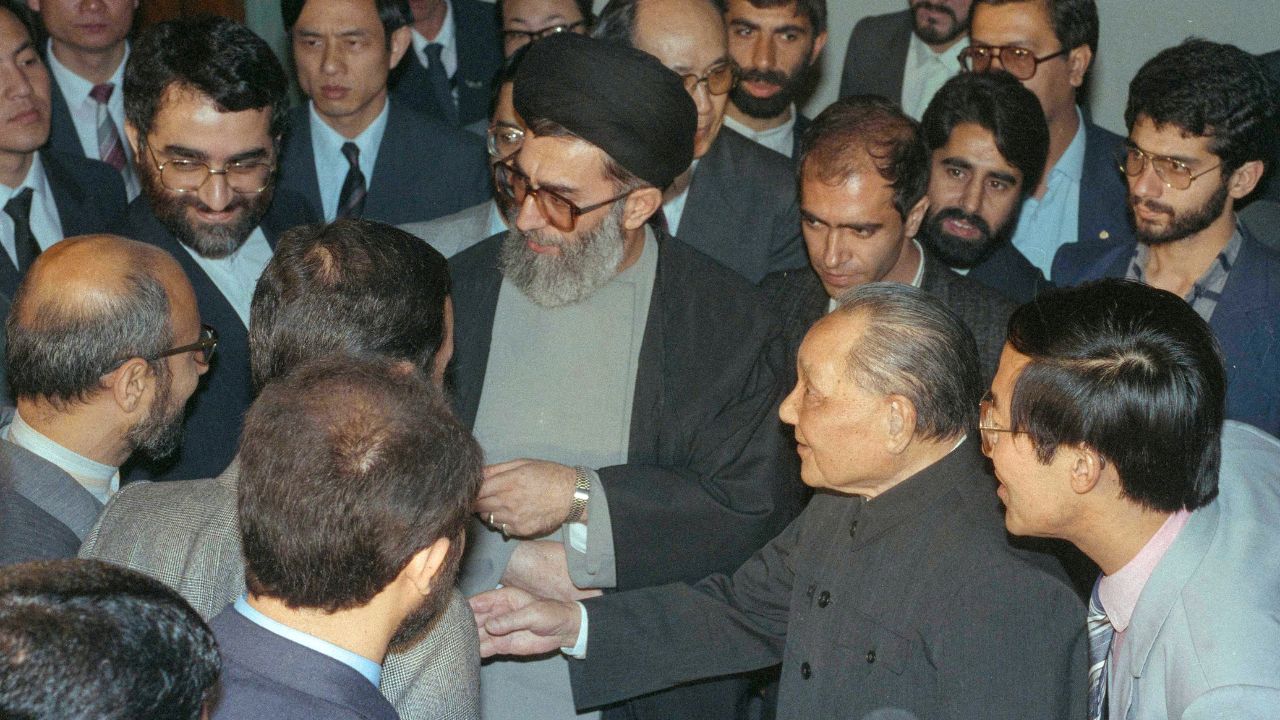
The air in the room is always still. It is a stillness that has been curated for thirty-six years. While the world outside mutated through the invention of the internet, the rise and fall of the Arab Spring, and the shifting tectons of global energy, the office of Ali Khamenei remained a static point in a spinning universe. To understand the man who has held the steering wheel of Iran since 1989, you have to look past the official portraits and the fiery rhetoric. You have to look at the persistence of a single shadow.
Most leaders are defined by their movement. They campaign, they pivot, they retire, and eventually, they fade into the lucrative obscurity of the lecture circuit. Khamenei chose a different path. He chose the path of the mountain.
The Weight of an Unexpected Mantle
In June 1989, the atmosphere in Tehran was thick with a grief that felt more like a physical weight. Ruhollah Khomeini, the father of the revolution, was gone. The transition of power was not a foregone conclusion. Imagine being the man standing in the hallway, watching the giants of the era debate your own fitness for the role. At the time, Khamenei was viewed by many as a compromise candidate, a placeholder who lacked the deep theological credentials of his predecessor.
He was a poet who played the tar, a traditional Iranian lute, and a man who had spent years in the brutal prisons of the Shah. His body bore the scars of a 1981 assassination attempt—a bomb hidden in a tape recorder that permanently damaged his right arm. When he took the oath, he wasn't just taking a job. He was inheriting a theological fortress that was under siege from both within and without.
The early years were a study in quiet consolidation. He did not have the natural charisma of Khomeini, so he built his power through the architecture of the state. He realized early on that if you control the Bureau of the Supreme Leader, the Revolutionary Guard, and the Guardian Council, you don't need to win a popularity contest. You only need to remain.
The Art of the Long Game
Consider a hypothetical shopkeeper in a bazaar in Isfahan. In 1989, he was a young man selling spices. He watched the news on a bulky television set as Khamenei was appointed. Over the next three decades, that shopkeeper saw presidents come and go. He saw the "reformist" Hashemi Rafsanjani try to open the economy. He saw Mohammad Khatami promise a "Dialogue among Civilizations." He saw the firebrand Mahmoud Ahmadinejad rattle the world’s cages, followed by the diplomatic overtures of Hassan Rouhani.
Through it all, the shopkeeper noticed one constant: the presidents were the weather, but the Supreme Leader was the climate.
Khamenei’s survival is not an accident of history. It is a masterpiece of managed tension. He mastered the ability to stay just above the fray, allowing presidents to take the blame for economic failures or social unrest, while he remained the ultimate moral and strategic arbiter. When the Green Movement erupted in 2009, he didn't blink. When the streets flooded again in recent years, his response remained anchored in a worldview formed decades ago in a prison cell.
To him, every concession is a crack in the dam. He watched the Soviet Union collapse and saw it not as a victory for democracy, but as a cautionary tale of what happens when a leader loses his nerve. He looked at Gorbachev and saw a man who traded a superpower for a pizza commercial. Khamenei decided he would never make that trade.
The Paradox of the Poet-General
There is a strange, quiet duality to the man. On one hand, he is the Commander-in-Chief who oversees a sophisticated network of regional influence stretching from Beirut to Baghdad. On the other, he is a man who hosts annual poetry nights where he sits for hours, listening to verses and offering critiques on rhyme and meter.
It is this combination of the aesthetic and the iron-fisted that makes him so difficult for the West to parse. We want him to be a caricature. We want him to be a simple "strongman." But a strongman doesn't last thirty-six years in a region as volatile as the Middle East. You have to be a chess player who is willing to wait twenty turns for a single pawn move.
The "journey in pictures" often misses the most important part: the things he didn't do. He didn't rush into a war with the United States despite decades of "Maximum Pressure." He didn't fully embrace the West, but he also didn't let the country slide into total isolation until the stakes were existential. He navigated the 2015 Nuclear Deal like a man walking a tightrope in a hurricane, skeptical of the safety net but recognizing the need to keep moving.
The Invisible Stakes of Longevity
What happens to a nation when its primary vision is dictated by one mind for nearly four decades?
The cost is often found in the silence of the young. More than 70% of Iran’s population was born after the 1979 revolution. For them, Khamenei is not a revolutionary hero; he is the only reality they have ever known. This creates a psychological friction that facts and figures cannot capture. It is the feeling of a country holding its breath, waiting for a chapter to end that has been written in a language many no longer speak.
The sanctions have bitten hard. The rial has plummeted. The "human element" is the mother in Mashhad trying to afford medicine, or the tech worker in Tehran using a VPN to see the world. They are living in the shadow of a grand strategic vision that prioritizes ideological purity over economic integration.
Yet, even his harshest critics must acknowledge the sheer willpower involved in his tenure. He survived the Iran-Iraq war, assassination attempts, internal power struggles, and the shifting alliances of his neighbors. He has outlasted seven U.S. presidents.
The Final Stanza
The pictures show a man whose beard has turned from black to silver to stark white. They show a hand that remains largely motionless, a reminder of the 1981 blast. They show a leader who is increasingly solitary, surrounded by a tight-knit circle of loyalists who share his grim determination.
The story of Ali Khamenei is not a story of progress in the way we usually define it. It is a story of resistance. It is the story of a man who believed that if he could just hold the line long enough, the world would eventually grow tired of trying to move it.
As the sun sets over the Alborz mountains, the stillness in that office remains. The man sits, perhaps reading a poem, perhaps reviewing a military report. He is eighty-six years old. He knows that his greatest challenge is no longer a foreign power or a domestic protest. It is the one force he cannot outmaneuver, no matter how many decades he wins.
Time is the only revolutionary that cannot be silenced.
The pens are ready. The ink is dry. The next chapter of Iran will be written in the space he eventually leaves behind, a space that has been shaped by his presence for so long that the vacuum will be felt like a physical shock. For now, the shadow remains, long and unyielding, stretched across the map of a nation that is both exhausted by his era and terrified of what follows it.