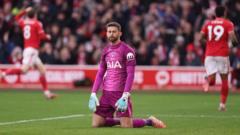
The headlines are predictable. "If Liverpool play like that at PSG, it could be 10-0." It is the kind of lazy, reactionary punditry that ignores how elite football actually functions. It assumes that a bad performance against a low-block domestic side translates linearly to a blowout against a European giant. That is not how the pitch works. That is how FIFA video games work.
In reality, the messier Liverpool look, the more dangerous they become for a team like Paris Saint-Germain.
The "10-0" narrative is built on a fundamental misunderstanding of tactical friction. When Liverpool struggle against bottom-half Premier League sides, it is usually because they are suffocated by a lack of space. They are forced to play "perimeter handball," cycling the ball around a disciplined 5-4-1. That is where they look sluggish. That is where the frustration boils over into unforced errors.
PSG does not play that way. PSG cannot play that way. Their DNA—and their wage bill—demands they occupy the same space Liverpool want to exploit.
The Myth of Defensive Solidity
Everyone loves to scream about "tightening up the back." They see a shaky performance against a mid-table side and demand a more conservative approach for the Champions League. This is a death sentence.
If Liverpool go to the Parc des Princes and try to be "solid," they lose. Period. You do not beat a frontline of world-class attackers by inviting them to camp in your final third for 90 minutes. You beat them by making the game so chaotic, so physically demanding, and so structurally broken that their individual brilliance becomes a liability rather than an asset.
I have watched teams try to "park the bus" in Paris and get dismantled because they lacked the technical proficiency to keep the ball once they won it. Liverpool’s greatest strength isn't their organization; it’s their ability to weaponize disorganization.
When the game breaks down—when passes are misplaced and the midfield becomes a blender—that is when Liverpool thrive. Jurgen Klopp’s "heavy metal football" was never about clean sheets. It was about making the opponent feel like they were drowning in a sea of transition moments.
Why PSG Fear the Mess
Let’s look at the actual mechanics of this matchup.
PSG is a team built for control. They want to dictate the tempo, move the ball through technical masters, and wait for a moment of magic. They are an aesthetic project. Liverpool, at their best, are a demolition crew.
The "10-0" alarmists point to Liverpool’s defensive high line as a weakness. They see space behind the fullbacks and imagine Mbappe or Barcola sprinting into it every three minutes. What they miss is the risk-reward ratio.
- Scenario A: Liverpool play deep. PSG keeps 70% possession. The pressure builds. Eventually, a world-class talent finds a gap. Liverpool loses 2-0 without a fight.
- Scenario B: Liverpool play their high, aggressive, "risky" line. They turn the game into a track meet. Yes, they might concede. But they also force PSG’s luxury players to track back 60 yards. They turn the game into a test of lung capacity, not just footwork.
In a track meet, I take the team with the higher collective engine every single time.
The False Correlation of Domestic Form
One of the most tiresome tropes in sports media is the idea that a "poor rehearsal" guarantees a "poor opening night."
Liverpool’s struggles often stem from a lack of motivation or tactical boredom against teams that refuse to come out of their shell. In the Champions League, the adrenaline is different. The tactical profile of the opponent is the polar opposite.
Against a PSG, the spaces that were closed against a Crystal Palace or a Nottingham Forest suddenly fly open. The pressing triggers that look mistimed in a slow-paced domestic game suddenly snap into place when the opponent is trying to play through the middle.
Data shows that Liverpool’s expected goals (xG) against top-tier opposition often remains high even when their league form is patchy. Why? Because top teams leave gaps. They have egos. They want to play. And "wanting to play" is exactly how you get killed by a Liverpool side that is supposedly "in crisis."
Stop Asking for a Boring Game
The "People Also Ask" sections are filled with queries about how Liverpool can "nullify" PSG. That is the wrong question. You don't nullify talent of that caliber; you out-produce it.
The advice usually given is to "be compact" and "stay disciplined." That is loser talk. If Liverpool go to Paris and play for a 0-0 draw, they will be picked apart by the 70th minute. The unconventional, effective path is to embrace the vulnerability.
- Squeeze the Midfield: Don't drop off. Force the ball into congested areas where physical duels are 50/50.
- Target the Fullbacks: PSG’s fullbacks are often effectively wingers. Every time Liverpool lose the ball, they shouldn't retreat; they should gamble on the turnover.
- Accept the Goal: You have to enter the stadium knowing you might concede two. If you play with the fear of conceding, you’ve already lost the tactical initiative.
The Danger of "Safe" Football
The most dangerous thing Liverpool could do in Paris is play "safe."
Safe football means sideways passes. Safe football means no one making the gut-busting run into the box because they’re worried about the counter-attack. Safe football is exactly what a team like PSG wants because it allows them to maintain their shape and conserve energy.
I’ve seen managers try to "fix" a leaky defense by dropping the line ten yards deeper, only to find they’ve inadvertently disconnected their attack from their midfield. Suddenly, the ball is coming back at them twice as fast.
Liverpool’s defense is their attack. Their best defender isn’t Virgil van Dijk—it’s the collective pressure applied 80 yards away from their own goal. If that pressure is "messy" but intense, it works.
The Psychological Edge of Being the "Underdog"
The British media has done Liverpool a massive favor by suggesting they could lose 10-0. There is nothing more dangerous than a world-class squad told they are about to be embarrassed.
PSG, conversely, struggles with the weight of expectation. They are the perennial "favorites" who often crumble the moment a game stops going according to the script. If Liverpool turn the match into a street fight—disorganized, frantic, and loud—the psychological advantage shifts instantly.
The pundits see a team that "cannot defend." I see a team that is being dared to stop caring about defending and start caring about destroying.
Forget the clean sheet. Forget the tactical discipline. If Liverpool show up in Paris and play a perfectly "organized" game, they are in trouble. If they show up and make it a nightmare of transitions and physical dominance, the 10-0 scoreline will be facing the other direction.
Stop looking for "stability" in a competition designed for volatility. Liverpool doesn't need to find their form; they need to find their nerve.
Throw the tactical manual out the window. Embrace the chaos. Let the game break.
Go to Paris and make it ugly.
The Technical Reality of the High Line
Let $D$ be the distance of the defensive line from the goal. Critics want $D$ to decrease to "protect" the keeper. But as $D$ decreases, the space for the opposition midfield to operate increases exponentially.
$$P \propto \frac{1}{D}$$
Where $P$ is the pressure on the ball. By dropping deep, Liverpool would effectively be granting PSG's playmakers the time and space to pick the perfect pass. The high line isn't an act of arrogance; it is a mathematical necessity to maintain $P$. Without $P$, the quality of chances conceded becomes far more lethal than the occasional breakaway.
Play the high line. Take the risk.
Start the game with the intent to outscore, not to survive.
If you’re worried about a 10-0 loss, you’ve already lost the mental battle.
Winning in Europe isn't about being the "better" team on paper; it's about being the team that refuses to let the game be played on paper.
Make it a scrap.
Make it a mess.
Make them hate every second of it.