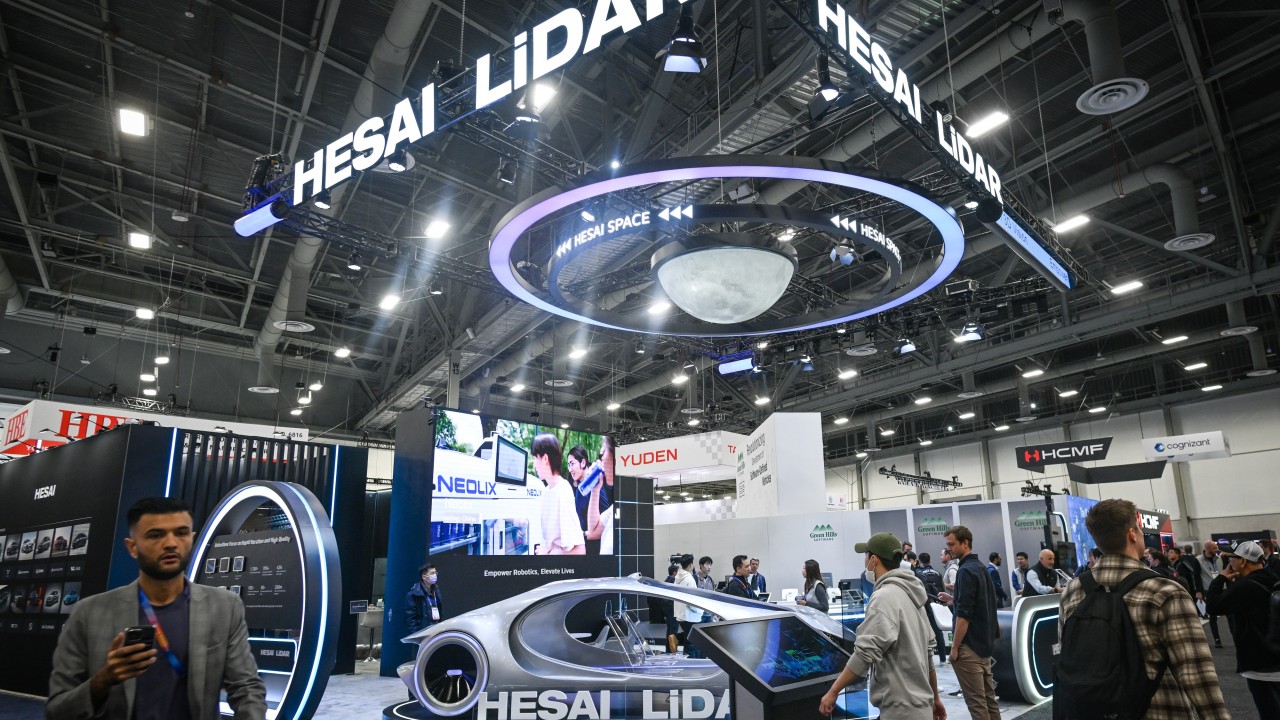
The tech press is currently swooning over a "pivot." They see Hesai and RoboSense—the heavyweights of Chinese lidar—moving their laser-focused eyes from the stalled autonomous vehicle (AV) market toward general-purpose robotics. They hear Jensen Huang praise the Chinese supply chain and assume we are witnessing a masterclass in agility.
They are wrong.
This isn't a pivot. It is a fire sale of overcapacity. The narrative that lidar is the "essential organ" for the coming age of humanoid robots is a fantasy designed to keep venture capital flowing into a hardware sector that is cannibalizing its own margins. If you are building a robotics company today and you’re doubling down on lidar-first architectures because Nvidia’s CEO gave a polite nod to his suppliers, you are walking into a trap.
The Jensen Huang Fallacy
Let’s address the elephant in the room. When Jensen Huang praises the Chinese supply chain, he isn't validated your hardware stack. He is validating his own business model.
Nvidia sells the shovels. They do not care if you dig for gold with a lidar sensor or a stereo camera, as long as you use a Blackwell chip to process the data. Huang’s endorsement of the "Chinese supply chain" is a strategic move to ensure his silicon remains the universal language of global manufacturing. It is not an endorsement of lidar’s long-term dominance.
In fact, the more complex and data-heavy the sensor, the more compute it requires. Nvidia wins when you use lidar because point clouds are computationally expensive. Of course he loves the lidar giants; they are his best involuntary sales reps.
The Deflationary Spiral Nobody Mentions
The "lazy consensus" says that as lidar prices drop, adoption will skyrocket.
Here is the reality: Lidar is a commodity that hasn't realized it's a commodity yet. The Chinese giants are in a race to the bottom that they cannot win without destroying the very R&D budgets required to make the technology "perfect."
I have seen companies blow $50 million on sensor integration only to realize that a $500 lidar unit still can't handle heavy rain, steam, or highly reflective factory floors better than a well-trained neural net using basic CMOS sensors.
We are seeing prices drop from $50,000 to $500. On paper, that looks like a victory for accessibility. In practice, it creates a "junk hardware" ecosystem. When a component’s price drops by 99%, the support, calibration, and longevity of those units follow suit. For a robot meant to operate for 10 years in a warehouse, a "cheap" sensor with a high failure rate is the most expensive part of the bill of materials (BOM).
The Humanoid Delusion
The current hype cycle suggests that humanoid robots need lidar to "see" like humans.
Stop.
Humans do not have lasers shooting out of their eyes. We operate on passive optical sensors (eyes) and massive amounts of inference (brains). The push to put lidar on everything from "Coffee-Bots" to bipedal warehouse workers is a crutch for poor software.
If you can’t solve spatial awareness with computer vision in 2026, you aren't building a robotics company; you're building a hardware integration hobby. Tesla’s "Vision Only" approach—while controversial in the AV space—is the correct North Star for mass-market robotics. Why? Because photons are free, and lasers are mechanical liabilities.
Lidar creates a "crutch" effect. Engineers use the precision of point clouds to avoid the hard work of building robust world models. The moment that robot steps into a dynamic environment where the lidar gets occluded or confused by a glass door, the system collapses.
The Sovereignty Risk
If you are a Western robotics firm "leveraging" (to use a word I despise) the Chinese lidar supply chain, you are building on sand.
The geopolitical reality is that lidar is increasingly viewed as a dual-use technology. We are one trade memo away from these sensors being classified as restricted surveillance equipment. Building your robot’s entire navigation stack around a specific Hesai or RoboSense API is a suicide pact.
The Chinese "pivot" to robotics isn't born of opportunity; it’s born of desperation. The AV market in the West is cooling, and the Chinese domestic market is hyper-competitive. They need a new dumping ground for their sensors. Robotics is the only "frontier" left that is gullible enough to buy the "lidar is essential" myth.
Logic Over Lasers: The True Hierarchy of Sensing
To understand why the lidar pivot is flawed, you have to understand the physics of data.
- Information Density: A 4K camera stream carries orders of magnitude more "semantic" data than a lidar point cloud. Lidar tells you where something is, but it’s terrible at telling you what it is.
- The Latency Trap: Processing high-res lidar data in real-time for a fast-moving robot creates a massive power draw. For a battery-operated humanoid, every watt spent firing lasers is a watt taken away from motor torque.
- The Mechanical Fail-Point: Solid-state lidar is getting better, but it still lacks the sheer resilience of a sealed camera module. In industrial environments, vibrations kill precision optics.
People Also Ask (And Why They’re Wrong)
"Can robots be safe without lidar?"
This is the wrong question. The question is: "Can a robot be safe if it relies on a sensor that can be blinded by a simple spray-paint can or a high-intensity strobe?" True safety comes from multi-modal redundancy where vision is the primary and low-cost ultrasonics or radar are the backup. Lidar is a luxury that masquerades as a necessity.
"Isn't the Chinese supply chain unbeatable in cost?"
Only if you ignore the "integration tax." The cost of the sensor is 10% of the problem. The cost of the software engineers required to maintain the stack, the field technicians required to replace failing units, and the legal teams required to navigate trade compliance makes that "$500" sensor cost $5,000 over its lifecycle.
The Strategy for the Contrarian Founder
If you want to win the robotics race, do the opposite of what the "lidar giants" want you to do.
- Design for Vision First: Build your navigation stack as if lidar doesn't exist. If you can make it work with cameras, adding a lidar later is a "nice to have" bonus, not a structural dependency.
- Own the Inference, Not the Hardware: Don't get excited about the "specs" of a new Chinese sensor. Get excited about the efficiency of your transformer models running on the edge.
- Avoid the "Humanoid" Trap: Most tasks don't need a 6-foot tall robot with lasers. They need a specialized form factor that uses the simplest sensor suite possible.
The Chinese lidar industry is currently in a state of "over-production seeking a problem." They have built incredible machines to solve a problem (Level 5 autonomy) that is still a decade away. Now, they are trying to convince the robotics world that their surplus is your solution.
Don't buy it.
The future of robotics will be won by the companies that can see the world through the cheapest lenses and the smartest brains. Lasers are just a very expensive way to admit your software isn't ready.
Stop building robots that need a $1,000 cane to walk across a room.
Build robots that can see.