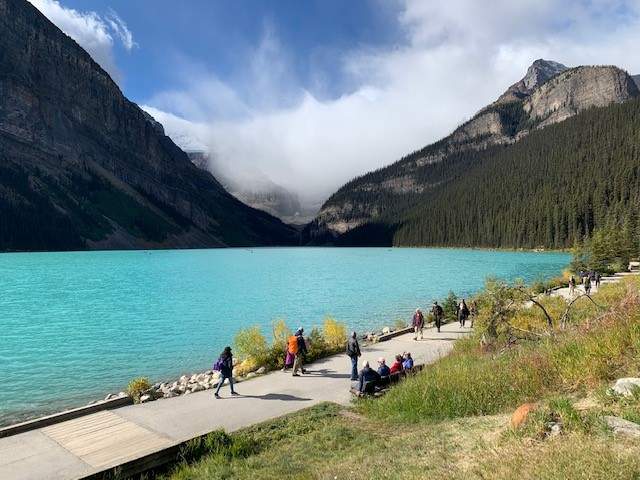
Parks Canada just dropped a hammer that's going to hurt your summer plans. If you were planning to haul a packraft or a canoe into the Banff backcountry near Lake Louise, you’re out of luck. A total watercraft ban is now in effect for the backcountry waters of the Lake Louise area. This isn't just a suggestion. It's a legal closure triggered by the discovery of whirling disease in one of the most iconic landscapes on earth.
Whirling disease is a nightmare for trout. It's caused by a microscopic parasite called Myxobolus cerebralis. Once it gets into a watershed, it's basically impossible to get out. It attacks the cartilage of young fish, making them swim in circles until they die of exhaustion or get eaten. Seeing a fish struggle with this is gut-wrenching. It’s a slow, rhythmic death that can wipe out 90% of a young trout population in a single season.
The decision to shut down paddling in the backcountry isn't about being "anti-fun." It’s about a desperate attempt to stop this parasite from hitchhiking to high-altitude lakes that are currently pristine.
The Reality of the Lake Louise Watercraft Ban
Let’s be clear about what’s closed. We aren't just talking about the main shore of Lake Louise where the tourists take selfies. Parks Canada has restricted all watercraft—including paddleboards, kayaks, canoes, and even those ultralight packrafts—from the backcountry water bodies in the Lake Louise area.
If you've hiked into places like Egypt Lake or any of the smaller tarns tucked away in the Bow Valley, those are now off-limits for floating. You can still hike there. You can still camp. But if you put a boat in that water, you’re risking a massive fine and, more importantly, the health of the entire ecosystem.
The parasite was detected in the Lake Louise area late last year. Since then, officials have been scrambling to map the spread. The problem is that the spores are incredibly resilient. They can survive in the mud stuck to your boots or the damp seams of your inflatable kayak for years. One accidental dip in an infected pond followed by a trek to a clean lake is all it takes to ruin a fishery forever.
How Whirling Disease Actually Spreads
Most people think the fish pass it to each other. That’s only half the story. The parasite has a complex life cycle that involves a tiny tubifex worm that lives in the mud at the bottom of lakes and streams.
When a fish dies, it releases spores. The worms eat the spores. Then the worms release "triactinomyxons" (TAMs), which are the infectious stage of the parasite. These TAMs float through the water looking for a fish to hook onto.
Here is where you come in.
- Mud in your treads: The tubifex worms and the spores love the silt.
- Damp gear: If your life jacket or felt-soled wading boots don't dry out completely, the parasite stays alive.
- Standing water: That little bit of water left in the bottom of your kayak is a transport vessel for disaster.
In a place like Banff, where the water is interconnected through complex underground systems and seasonal runoff, the risk is exponential. Parks Canada is trying to create a firebreak. By banning watercraft in the backcountry, they're removing the primary way these spores move uphill.
Why This Hits Banff So Hard
Banff National Park isn't just a park; it's a sanctuary for Westslope Cutthroat Trout and Bull Trout. Both are already facing uphill battles against habitat loss and climate change. Whirling disease is the final straw.
I’ve talked to anglers who have seen the impact in places like the Crowsnest Pass, where the disease was first found in Canada back in 2016. It’s devastating. You go from seeing vibrant, rising fish to seeing nothing but empty water and the occasional deformed juvenile spinning in the shallows.
The Lake Louise area serves as the headwaters for the Bow River. If the infection takes a firm hold here, it flows downstream. It hits the world-class fly-fishing stretches near Calgary. It hits the irrigation systems. It changes the biology of the entire province.
The Logistics of the Closure
You might be wondering if this applies to the rental canoes at the Lake Louise foreshore. For now, those are managed under strict "Clean, Drain, Dry" protocols. Because those boats never leave that specific lake, the risk of them spreading the disease to other lakes is lower.
The backcountry is the real concern. There is no one at a remote alpine lake to inspect your gear. There are no wash stations at the trailhead for Skoki Lodge. Parks Canada is relying on a total ban because they can’t trust every single hiker to properly decontaminate their gear to the 180°F (82°C) standard required to kill the spores.
Honestly, the "Clean, Drain, Dry" mantra isn't enough anymore. Research from the University of Alberta suggests that even a small amount of residual moisture can harbor viable spores for weeks in cool, shaded conditions. In the high Rockies, nothing ever truly dries out fast enough to be safe.
What You Can Actually Do
Don't be the person who thinks the rules don't apply to them. "Oh, it’s just a small packraft," or "I only used it once." That’s how these disasters start. If you want to help, you need to change how you recreate in the Rockies.
- Stick to the frontcountry: Use the designated lakes where watercraft are still permitted and follow the mandatory inspection programs.
- Ditch the felt soles: Many jurisdictions have already banned felt-soled boots because they are impossible to clean. If you're still wearing them, switch to rubber.
- Hot wash everything: If you've been in any water in the Bow Valley, your gear needs a soak in water hotter than 140°F (60°C) or a bleach solution before you move to a different watershed.
- Report what you see: If you see a fish swimming in circles or with a blackened tail, take a photo, note the coordinates, and tell a park ranger immediately.
The backcountry is a privilege, not a right. We've spent decades treating these lakes like our personal playgrounds without considering the biological cost. This closure is a wake-up call.
Check the Parks Canada "Important Bulletins" page before every trip. These closures can expand overnight if new detections come back from the lab. Pack your hiking boots, leave the boat at home, and give the trout a fighting chance to survive the season.



.png?width=1200&auto=webp&trim=0%2C0%2C0%2C0)