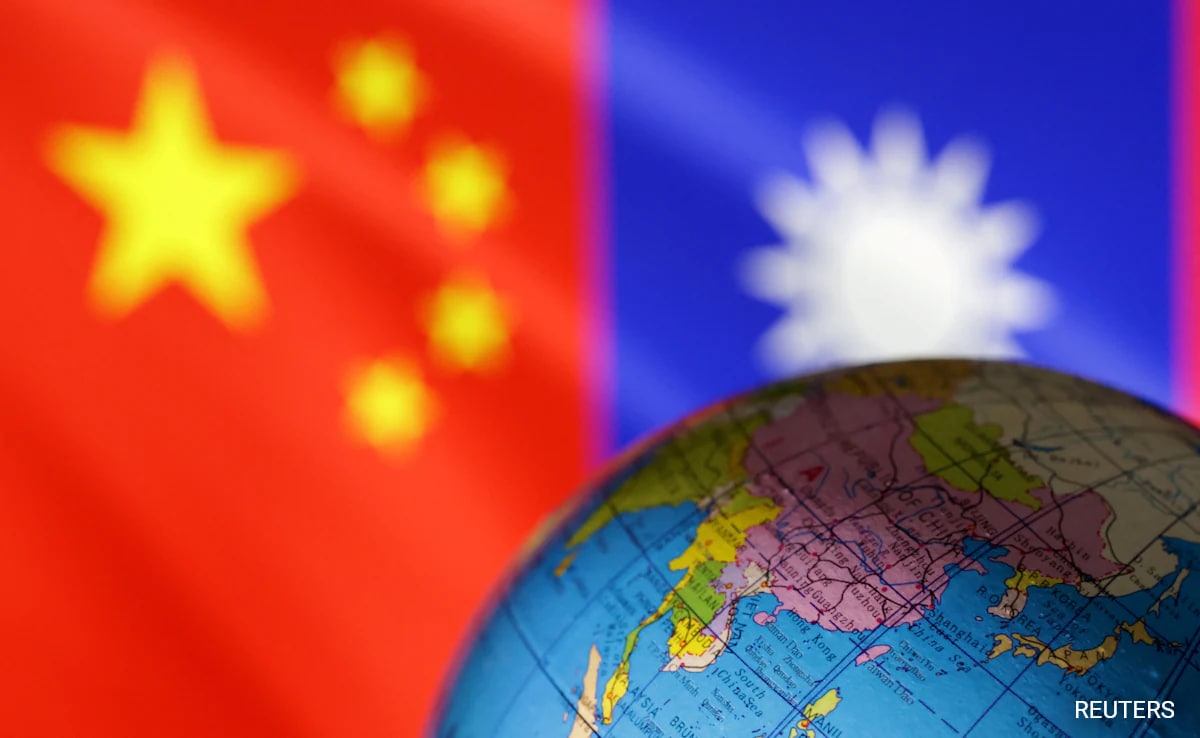
The fixation on 2027 as a definitive "deadline" for a Chinese kinetic invasion of Taiwan ignores the fundamental economic and structural calculus governing Beijing's decision-making. While Western intelligence identifies 2027 as the year the People’s Liberation Army (PLA) aims to achieve the technical capability for a cross-strait operation, capability does not equal intent. The strategic shift is not toward a localized military victory, but toward a comprehensive "Grey Zone" stranglehold designed to achieve political capitulation without triggering the catastrophic global economic decoupling that a hot war would necessitate.
The Triad of Strategic Constraints
Beijing operates under three primary constraints that prioritize non-kinetic coercion over a full-scale amphibious assault.
- The Silicon Shield and Supply Chain Fragility: Taiwan produces over 90% of the world's most advanced semiconductors. A kinetic conflict would likely destroy this infrastructure, either through collateral damage or deliberate sabotage. For China, which remains heavily dependent on these chips for its own domestic tech sector and military modernization, an invasion that destroys the prize is a strategic failure.
- Economic Insulation Deficit: China has not yet achieved the level of "Fortress Economy" status required to withstand G7-level sanctions. Until the Yuan is more widely internationalized and domestic consumption can fully replace export markets, the risk of a frozen central bank balance sheet—similar to Russia’s experience—remains a powerful deterrent.
- Amphibious Complexity and the Multi-Domain Rubik's Cube: Crossing 100 miles of the Taiwan Strait with enough force to hold territory against a "porcupine" defense strategy is the most difficult military maneuver in modern history. The PLA lacks the battle-hardened logistical experience required to execute this without immense risk of a public, regime-threatening failure.
Mechanics of the Stranglehold Strategy
Instead of a D-Day style landing, the focus has shifted to a "Coercive Encirclement" model. This is quantified by the frequency and location of PLA sorties and naval maneuvers that incrementally normalize a military presence within Taiwan’s Air Defense Identification Zone (ADIZ).
The Customs Quarantine Model
Rather than a traditional military blockade—which is an act of war under international law—Beijing is more likely to implement a "quarantine." This involves the China Coast Guard (CCG) declaring the waters around Taiwan as domestic territory and requiring merchant vessels to submit customs filings to Chinese authorities.
- Legal Warfare (Lega-fare): By framing the restriction of movement as a law enforcement action rather than a military blockade, Beijing creates a "grey area" for US and allied intervention.
- Economic Attrition: The goal is to drive up insurance premiums for shipping to Taiwan until the island’s economy becomes unviable, forcing Taipei to the negotiating table.
- Energy Vulnerability: Taiwan maintains limited liquefied natural gas (LNG) reserves. A functional quarantine that delays tankers by just 14 days could trigger a total collapse of the island’s power grid.
The Technology of Subjugation: Beyond Kinetic Force
The integration of cyber and cognitive warfare serves as the force multiplier for non-military control. The objective is to degrade the "will to fight" among the Taiwanese populace and leadership before a single shot is fired.
Cognitive Domain Operations
Beijing’s strategy utilizes fragmented social media ecosystems to amplify internal political divisions within Taiwan. This is not merely "misinformation" but a structured attempt to frame the choice for Taiwan as a binary between "Peace and Prosperity" (Unification) or "War and Destruction" (Independence).
Infrastructure Vulnerability
The 2023 cutting of subsea internet cables to the Matsu islands served as a proof-of-concept. By targeting the physical layer of the internet, the PLA can isolate Taiwan from the global information economy.
The "Kill Web" concept involves:
- Precision Cyber Strikes: Targeting SCADA systems (Supervisory Control and Data Acquisition) to disable water and power without physical bombing.
- Satellite Jamming: Neutralizing GPS and communication links to degrade the coordination of Taiwan’s mobile missile launchers.
Quantifying the 2027 Benchmark
The 2027 date is significant because it marks the centenary of the PLA. However, the "Davidson Window"—the period in which an invasion is deemed most likely—is being re-evaluated by analysts who track Chinese domestic stability.
The structural slowdown of the Chinese economy acts as a double-edged sword. On one hand, it may tempt leadership to use nationalism (and an invasion) as a distraction. On the other, the immense cost of war—estimated by Bloomberg Economics at $10 trillion, or 10% of global GDP—would likely finalize the collapse of the "Chinese Dream" of middle-class prosperity.
The Cost Function of Invasion
If we define the Cost of Invasion ($C_i$) as:
$$C_i = (M_c + E_s + P_r) - V_t$$
Where:
- $M_c$ = Direct Military Cost
- $E_s$ = Economic Sanction Impact
- $P_r$ = Political Regime Risk
- $V_t$ = Value of Taiwan (Assets intact)
The current value of $(M_c + E_s + P_r)$ far exceeds $V_t$, especially if $V_t$ is reduced to zero by the destruction of the semiconductor fabs. Therefore, the strategic pivot must be toward securing $V_t$ through political subversion rather than kinetic destruction.
The Failure of "Strategic Ambiguity"
The United States' long-standing policy of strategic ambiguity is losing its efficacy as the military balance in the First Island Chain shifts. The US and its allies (Japan, Australia, Philippines) are moving toward "Strategic Clarity" through increased rotational deployments and the "Enhanced Defense Cooperation Agreement" (EDCA).
The bottleneck for the US is industrial capacity. While the PLA Navy is the largest in the world by hull count, the US maintains a qualitative edge in undersea warfare. However, the US defense industrial base is currently struggling to produce the Long-Range Anti-Ship Missiles (LRASMs) and Joint Air-to-Surface Standoff Missiles (JASSMs) at the scale required for a high-intensity conflict.
The Asymmetric Counter-Play
Taiwan’s shift toward a "Porcupine Defense" is the primary variable that complicates Beijing’s timeline. This strategy prioritizes:
- Sea Mines and Mobile Coastal Defense Cruise Missiles (CDCMs): Making the strait impassable for large amphibious transport docks.
- Man-Portable Air-Defense Systems (MANPADS): Ensuring that even if the PLA gains air superiority, they cannot safely land paratroopers or operate helicopters.
- Civilian Resilience: Training a territorial defense force to ensure that any occupation would be met with an enduring insurgency.
The limitation of this strategy is that it addresses a kinetic invasion while remaining highly vulnerable to the "Grey Zone" quarantine. Taiwan is a trade-dependent island; it can survive a rain of missiles longer than it can survive a total cessation of trade.
Strategic recommendation for the 2025–2027 period
The focus of Western policy must shift from purely military deterrence to "Economic Deterrence." This requires the formalization of a "Collective Defense" economic pact, where an attack on Taiwan’s trade—via quarantine or blockade—is met with a synchronized, pre-agreed sanction package from the G7.
By removing the uncertainty of the international response, the "Economic Sanction Impact" ($E_s$) in the cost function remains prohibitively high. Simultaneously, Taiwan must accelerate its energy independence through hardened micro-grids and increased storage, specifically targeting the 14-day LNG bottleneck. The goal is to move the "Decision Point" for Beijing indefinitely by ensuring that the non-military path to control is just as stalled as the military one.