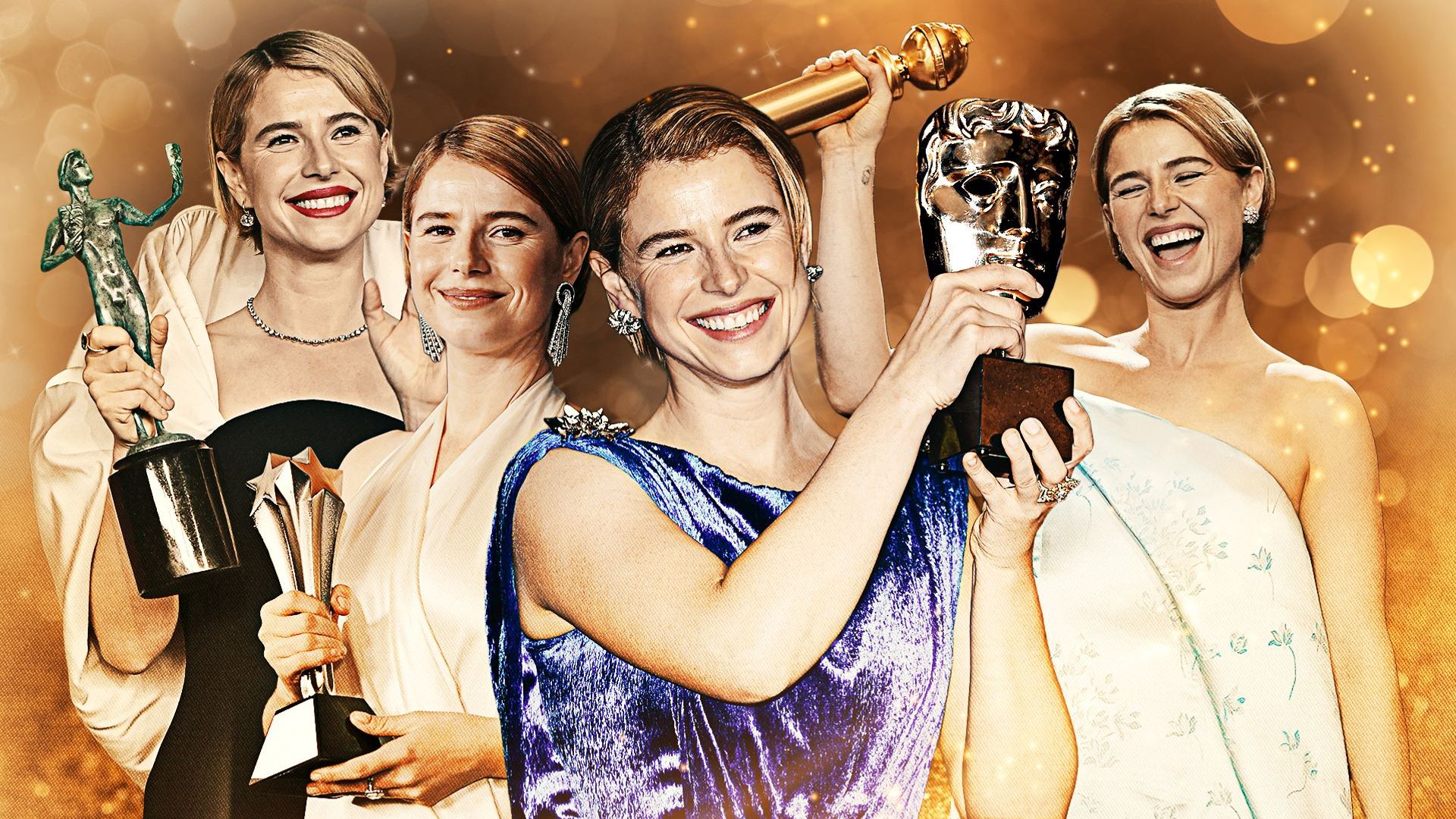
The modern film industry is currently obsessed with a specific brand of lightning caught in a bottle. This isn't the traditional, manufactured glow of a studio-molded starlet, but rather the raw, jagged edges of Jessie Buckley. Her trajectory from a 2008 reality television runner-up to an Academy Award nominee and Olivier Award winner represents more than just a successful career. It is a fundamental shift in what audiences demand from their leading actors. People no longer want the mask; they want the nerves, the sweat, and the unvarnished psychological truth that Buckley provides in every frame.
The Reality TV Trap and the Great Escape
Most performers who get their start on a talent search show like I'd Do Anything find themselves stuck in a perpetual loop of light entertainment. They become "personalities" rather than artists. The industry usually puts these individuals into a box labeled "disposable." Buckley, however, leveraged that early exposure as a technical training ground rather than a final destination. She didn't try to hide her past; she outgrew it by sheer force of talent.
The pivot from Andrew Lloyd Webber’s stage to the bleak, atmospheric tension of Beast (2017) was a calculated risk that paid off. In that film, Buckley dismantled the "girl next door" archetype. She played Moll Huntford with a simmering, dangerous internal life that suggested a woman capable of anything. It wasn't a performance designed to make the audience like her. It was a performance designed to make the audience fear for her, and eventually, of her. This willingness to be unlikable is the secret engine of her career.
The Economics of Authenticity
Streaming platforms and independent studios like A24 have changed the financial calculus of stardom. In the old system, a star’s value was measured by their ability to sell tickets to a broad, four-quadrant audience. Today, value is found in "prestige stickiness"—the ability of an actor to generate critical acclaim, social media discourse, and awards buzz that keeps subscribers paying.
Buckley is the ultimate asset in this new economy. Her presence in a project like I'm Thinking of Ending Things or The Lost Daughter provides an immediate stamp of intellectual rigor. Producers know that she won't just say the lines; she will inhabit the subtext. This reduces the marketing burden. When Buckley is on the poster, the "prestige" audience knows exactly what they are getting: a deep dive into the human psyche that refuses to offer easy answers.
Vocal Precision as a Narrative Tool
While many actors treat their musical background as a side hobby, Buckley integrates it into her dramatic work. In Wild Rose, she didn't just sing country songs; she used the genre’s inherent grit to tell the story of a woman suffocated by her own circumstances. There is a specific rasp in her voice, a slight crack that she allows to surface at moments of high emotional stakes.
This isn't accidental. It’s a tool.
By refusing the "perfect" take in favor of the "honest" one, she creates a visceral connection with the viewer. Most actors are afraid to look or sound "bad." Buckley seems to hunt for those moments. She understands that the cracks are where the light—or the darkness—gets in.
The Anti-Star Strategy
Observe her red carpet appearances or her rare interviews. There is a distinct lack of the polished, PR-managed sheen that defines her peers. She often appears as if she’s just wandered in from a long walk on a windy cliffside. This "anti-star" branding is incredibly effective in an era where audiences are skeptical of anything that feels manufactured.
By maintaining a level of mystery and refusing to engage in the constant self-promotion cycle of Instagram, she preserves her "chameleon" status. We don't know enough about the "real" Jessie Buckley to let it interfere with our belief in her characters. When she plays a young Queen Victoria or a grieving widow in Men, there is no baggage of a celebrity persona to drag along. She remains a blank canvas, which is the most powerful thing an actor can be.
Challenging the Industry Standard
The rise of Buckley has forced a re-evaluation of casting trends. For years, the industry favored "safe" choices—actors who looked a certain way and performed within a certain predictable range. Buckley’s success has opened doors for a different kind of performer: the character-lead. This is someone who has the magnetic pull of a movie star but the transformative skills of a character actor.
We are seeing a move away from the "superhero physique" and toward the "expressive face." Buckley’s face is a map of shifting emotions. She can move from joy to devastating sorrow in the span of a single breath, without moving a single muscle. It’s a masterclass in internal acting.
The Risk of Overexposure
The only real threat to Buckley’s upward trajectory is the industry’s tendency to overwork its brightest stars. When a performer becomes the "it" person for prestige drama, they are often cast in everything, leading to a blurring of roles. However, Buckley has shown a remarkable ability to say "no."
Her choices are idiosyncratic. She moves between massive historical epics and tiny, experimental horror films. This unpredictability keeps her fresh. It prevents the audience from being able to pin her down. As long as she continues to choose scripts that challenge her own comfort level, she will remain the most interesting person on the screen.
Redefining the Oscar Path
The traditional path to an Oscar used to involve a specific type of "transformative" role—usually involving heavy prosthetics or playing a well-known historical figure. Buckley’s nomination for The Lost Daughter broke that mold. She was nominated for playing a young mother struggling with the mundane, crushing reality of parenthood.
There were no flashy speeches. There was no "Oscar clip" of her screaming in the rain. Instead, there was a quiet, haunting portrayal of regret and exhaustion. This recognition from the Academy signals a maturing of the awards circuit. It suggests that they are finally starting to value the difficulty of playing internal conflict over the spectacle of external transformation.
The Power of the Gaze
In many of her roles, Buckley is the one doing the observing. She has a way of looking at her co-stars that makes the audience feel like she is seeing right through them. This "active listening" is a rare skill. Most actors are just waiting for their turn to speak. Buckley is always in the moment, reacting to the smallest shifts in the environment.
This presence makes her an invaluable scene partner. She elevates everyone around her. When you watch her opposite Olivia Colman or Riz Ahmed, you aren't watching two people reciting lines. You are watching a high-stakes chess match.
The industry is currently looking for the "next" Jessie Buckley, but they are looking in the wrong places. You can’t manufacture this kind of career through social media metrics or test screenings. It requires a level of courage that most people simply don't have—the courage to be truly seen, in all your messy, complicated glory.
She has set a new standard. The era of the untouchable, perfect movie star is over, and we have Jessie Buckley to thank for burying it. The future belongs to the messy. It belongs to the brave.
Next time you watch her, pay attention to her hands. They are never still. They are always searching, clutching, or trembling, telling a story that her words might be trying to hide.