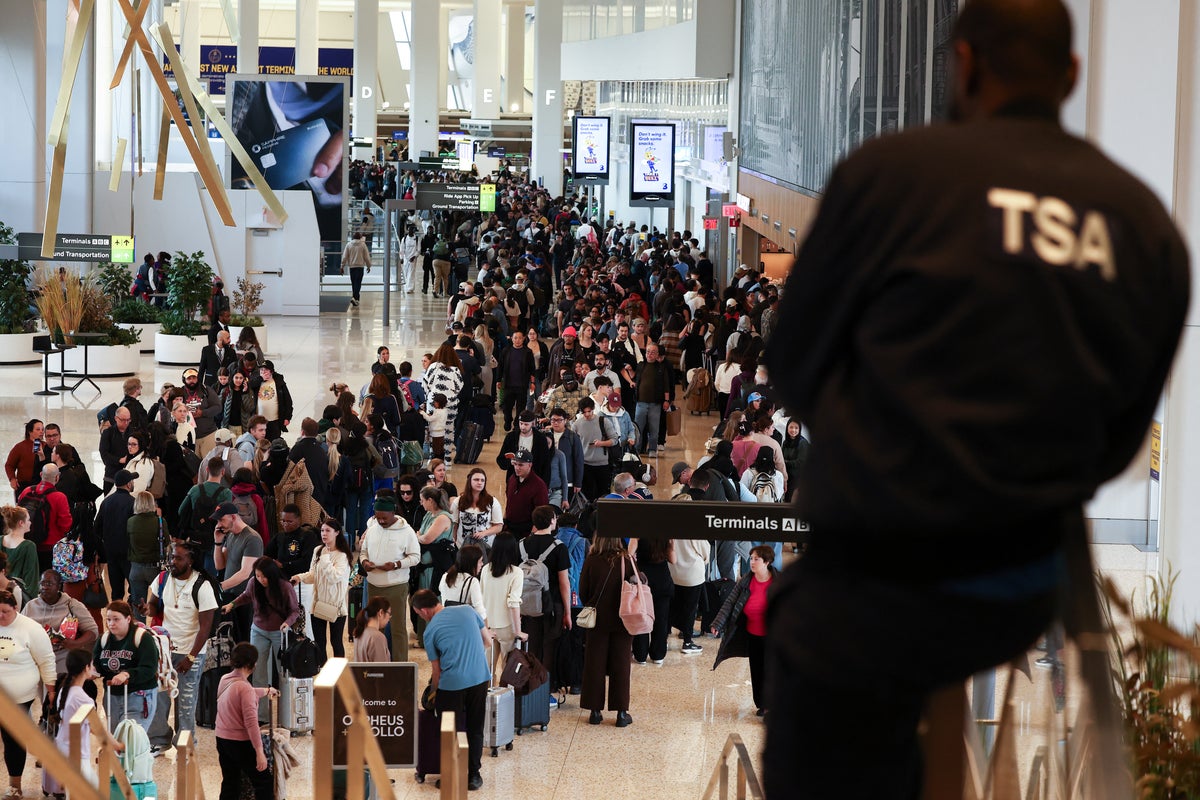
The belt comes off. The shoes click against the plastic bin. A laptop slides out of its sleeve. For most of us, the TSA checkpoint is a liminal space—a necessary annoyance, a thirty-minute hurdle between the parking garage and a pressurized cabin at thirty thousand feet. We see the navy-blue shirts, the latex gloves, and the steady, rhythmic motion of arms directing us toward the metal detectors. What we rarely see is the person inside the polyester.
Right now, that person is starving.
As the Department of Homeland Security shutdown grinds into its third week, the machinery of American travel is running on the fumes of human desperation. We are witnessing a quiet, localized collapse of the middle class, hidden in plain sight behind the plexiglass shields of our nation's airports. This isn't a policy debate or a line item on a legislative budget. It is a father wondering if his car's gas tank will hold enough fuel to get him to a shift that isn't paying him. It is a mother skipping a meal so her child doesn't have to.
The Geography of the Front Seat
Consider David. He isn't a real person in the sense that he exists in a single zip code, but he is the composite reality of thousands of federal employees currently working without a paycheck. David has been with the TSA for six years. He knows the density of a water bottle versus the density of liquid explosives by the way the X-ray hues shift on his monitor. He is a professional.
Last night, David didn't sleep in his apartment. He slept in his 2014 Ford Focus in the employee parking lot at O'Hare.
He isn't alone. Reports from major hubs across the country—from Miami to Seattle—confirm that TSA agents are increasingly "lot-camping." They do this because the commute costs money they no longer have. When you aren't sure when the next four-digit deposit will hit your bank account, a forty-mile round trip becomes a luxury. The car becomes a bedroom. The terminal bathroom becomes a dressing room.
The irony is thick enough to choke on. The very people tasked with securing the borders of the nation are unable to secure the borders of their own lives. We ask them to remain hyper-vigilant, to spot the minute anomalies that could signal a catastrophe, while their brains are screaming about the "Final Notice" taped to their front door.
The Plasma Economy
When the liquid assets run dry, people begin to look at what else they can liquidate. For an increasing number of federal workers, the answer is biological.
Plasma donation centers located near major airports have seen a localized surge in "new donors" wearing government-issued slacks. It is a visceral, haunting image: an officer of the law sitting in a vinyl recliner, watching their own blood circulate through a centrifuge to earn fifty dollars for groceries. This is the new American side-hustle.
The math of a shutdown is brutal. Most TSA agents earn between $35,000 and $50,000 a year. In high-cost-of-living cities like New York or San Francisco, that salary is already a tightrope walk. Remove one paycheck, and the rope snaps. Remove two, and the fall begins.
Safety is not just a matter of technology or protocols. It is a matter of cognitive load. Human factors engineering tells us that stress degrades performance. A brain preoccupied with an impending eviction is a brain that might miss the slight, dark blur of a weapon in a crowded suitcase. By forcing these men and women to work under the crushing weight of insolvency, the system is actively eroding the security it claims to prioritize.
The Ghost Shifts
Walking through an airport during a shutdown feels different. The air is thinner. You might notice a few more lanes closed than usual. You might see a supervisor jumping in to pull bags off the belt. This is the "sick-out" in action.
Critics often point to these absences as a lack of patriotism or a breach of duty. That perspective is a luxury of the fed and the funded. When you cannot afford childcare because you can't pay the sitter, you stay home. When your car is repossessed, you stay home. When the stress manifests as a physical ailment because you’ve been living on ramen and tap water, you stay home.
The agents who do show up are carrying the weight of those who didn't. They are working double shifts, their eyes rimmed with red, their voices cracking as they repeat the same instructions for the thousandth time that day. They are the skeletal remains of a bureaucracy that has forgotten its most basic obligation: the exchange of labor for the means of survival.
The Invisible Stakes
We often talk about the "cost" of a shutdown in terms of GDP or lost tourism revenue. Those numbers are abstractions. They don't capture the smell of a cold car interior at 4:00 AM. They don't capture the humiliation of an officer of the United States government applying for food stamps.
There is a psychological contract between a state and its servants. The servant provides their time, their discretion, and their safety; the state provides a foundation of stability. When that contract is unilaterally shredded, the damage isn't just financial. It is foundational. It breeds a cynicism that lasts long after the back pay is finally issued. It tells a generation of workers that they are disposable pawns in a game where the players never miss a meal.
A security line is more than a queue. It is a social agreement. We agree to be searched, and they agree to protect us. But protection requires a clear mind and a steady hand.
Next time you stand in that line, look at the person behind the table. Look past the badge and the uniform. Look at the creases in their shirt and the fatigue in their stance. They are there, guarding the gate, while their own homes are left undefended. They are donating the very fluid in their veins to keep the lights on, all while making sure your flight leaves on time.
The system is running on the sacrifice of people who have nothing left to give, yet find a way to give it anyway. The belt comes off. The shoes go in the bin. The line moves forward. But the man holding the tray is wondering if he’ll have a place to park his bed tonight.