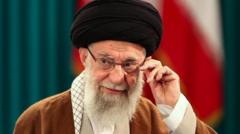
The confirmation of Ayatollah Ali Khamenei’s death on March 1, 2026, following targeted airstrikes, has not just ended a thirty-seven-year reign. It has detonated the central pillar of a complex, trillion-dollar survival machine designed to outlive the man himself. For decades, the "iron grip" often described by Western analysts was less a physical clench and more a digital and financial web that transformed Iran from a traditional theocracy into a hybrid military-industrial corporation.
The "why" of Khamenei’s longevity was his genius for institutionalized paranoia. He did not simply lead; he duplicated. By creating parallel structures for every state function—the Islamic Revolutionary Guard Corps (IRGC) to shadow the regular army, and the Bait-e Rahbari (The House of the Leader) to shadow the cabinet—he ensured that no single general or minister could ever amass enough capital to challenge him. Now, that very redundancy is the primary source of the chaotic friction as a temporary leadership council struggles to maintain order amidst a collapsing currency.
The Trillion Dollar Shadow State
While the world focused on the morality police, the true source of the Supreme Leader’s power was the Bonyads. These are ostensibly charitable foundations that evolved into massive, tax-exempt conglomerates. They answer to no one but the Office of the Supreme Leader.
Estimates suggest that Khamenei controlled assets exceeding $200 billion through organizations like Setad (Execution of Imam Khomeini’s Order). This is not just wealth; it is the ultimate tool of political patronage. If a mid-level commander in the IRGC remains loyal during a riot, his family’s business interests are protected by the Bonyad network. If he wavers, he is bankrupted overnight.
This economic architecture created a "sanction-proof" elite. While the Iranian rial plummeted to 1.4 million per dollar in early 2026, the inner circle operated in a separate reality of bartered oil and shadow banking. This wasn't mismanagement; it was a deliberate decoupling of the regime's survival from the public's welfare.
Command and Control in the Digital Bunker
The "how" of the regime's control relied heavily on a sophisticated domestic surveillance apparatus that merged Chinese hardware with local ideological fervor. In the weeks leading up to the March 2026 strikes, the regime deployed its "containment governance" model to suppress the largest protests since 2022.
Unlike previous uprisings, the 2025–2026 wave was met with temporal dispersion. Instead of a single, bloody crackdown that creates martyrs, the security apparatus used AI-driven facial recognition to identify protesters, then quietly disabled their bank accounts and "smart" subsidy cards. It was a digital strangulation. The state didn't need to kill every dissenter when it could simply make it impossible for them to buy bread or fuel.
The IRGC’s Intelligence Organization, which operates independently of the Ministry of Intelligence, turned the Iranian internet into a National Intranet. This "halal net" allowed the regime to shut down global access while keeping internal military and financial communications running. It was a kill switch designed for exactly this moment: the death of the sovereign.
The Succession Crisis of the Three Clerics
The Iranian constitution dictates that an 88-member Assembly of Experts must choose a successor. However, the internal reality is a brutal tug-of-war between the clerical establishment and a "military junta" of IRGC generals who have no interest in another strong-willed Ayatollah.
Recent reports indicate that Khamenei left a secret shortlist of three names: Gholam-Hossein Mohseni-Ejei, Asghar Hejazi, and Hassan Khomeini.
| Candidate | Power Base | Primary Liability |
|---|---|---|
| Mojtaba Khamenei | IRGC, Intelligence | The "hereditary" stigma; lacks clerical rank. |
| Mohseni-Ejei | Judiciary, Hardliners | Deeply unpopular; seen as a face of repression. |
| Ali Larijani | SNSC, Technocrats | Distrusted by ultra-hardliners; seen as too pragmatic. |
The friction is most visible in the newly formed Defense Council. This body was created in late 2025 to centralize military decisions during the "Twelve-Day War" with Israel. By concentrating power here, the IRGC has effectively sidelined the Assembly of Experts before a single vote could be cast. We are witnessing the transition from a theocracy to a praetorian state where the turban provides the veneer, but the boots hold the floor.
The Fractured Opposition
The tragedy of the 2026 uprising is its lack of a "teleology"—a shared end-state. The protesters are united by what they hate, but they are geographically and ideologically fragmented. The regime has spent decades ensuring no intermediary institutions—labor unions, independent student groups, or local councils—could survive.
In the absence of a structured opposition, the collapse of the central authority doesn't necessarily lead to democracy. It is more likely to lead to a "warlordism" of the Bonyads, where different IRGC factions fight for control over specific sectors of the economy, such as telecommunications or petrochemicals.
The regime's ultimate insurance policy was always the "Axis of Resistance." By funding proxies in Lebanon, Iraq, and Yemen, Khamenei ensured that any threat to his person would result in a regional conflagration. As the US and Israel trade strikes with Tehran today, that insurance policy is being cashed in. The survival of the system no longer depends on Khamenei’s heartbeat, but on the ability of his "shadow machinery" to keep the lights on and the internet off.
The true test of the "iron grip" begins now. Without the arbiter at the top to settle disputes between the generals and the priests, the friction within the machine may finally generate enough heat to melt the gears. The question for 2026 isn't who will be the next Supreme Leader, but whether the office itself can survive the weight of the empire Khamenei built.
Would you like me to analyze the specific economic holdings of the IRGC-controlled Bonyads to see which factions are most likely to seize power next?

