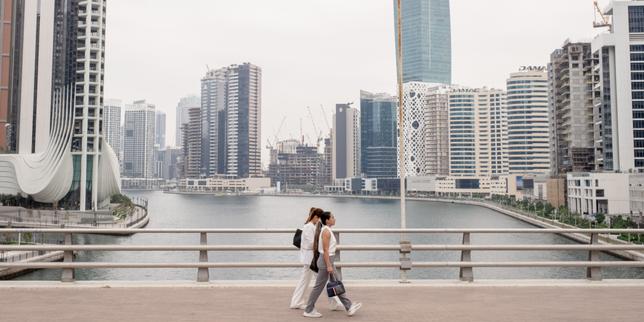
Arash sits in a glass-walled office on the 42nd floor of a Dubai Marina skyscraper, watching the sunset bleed into the Persian Gulf. To the casual observer, he is the embodiment of the "Dubai Dream." He wears an Italian suit. He drinks espresso from a machine that costs more than a mid-sized sedan. But if you look closely at his hands, they are restless. He is constantly checking three different phones, each encrypted, each tied to a different life.
Across that narrow stretch of turquoise water lies Iran. To Arash, it is no longer a country. It is a gravity well.
For decades, Dubai served as the "lung" of the Iranian economy. It was the place where Iranian entrepreneurs could breathe, trade, and connect with a world that their own government had spent forty years antagonizing. But the air is thinning. Between the crushing weight of international sanctions and the paranoid tightening of the regime in Tehran, the Iranian business diaspora is finding that the bridge they built is collapsing from both ends.
The Ledger of Ghost Money
Running a business in this environment isn't about supply chains or marketing strategies. It is about alchemy.
Because of the SWIFT banking ban, an Iranian entrepreneur cannot simply "wire" money to a supplier in Germany or a distributor in China. Instead, they rely on the hawala system—a centuries-old trust-based network that operates in the shadows. Imagine you want to buy a shipment of medical components. You give your rials to a broker in a dusty back alley of Tehran. That broker calls a cousin in Dubai. That cousin releases the equivalent value in dirhams to your supplier. No money actually crosses the border. Only promises do.
It is a system built on a handshake. But in 2026, the world doesn't accept handshakes. Global compliance standards, driven by the Financial Action Task Force (FATF), have turned the screw. Dubai, once the "Wild West" of Middle Eastern finance, is cleaning up its act to stay on the world’s "white lists." For people like Arash, this means that even if his business is 100% legal, his passport is a radioactive asset.
"The bank called me last Tuesday," Arash says, his voice dropping. "They didn't ask about my revenue. They didn't ask about my growth. They asked where my father was born. Two days later, my corporate account was frozen."
This is the "Black Hole" effect. Iran has become a place where information goes in, but nothing—not data, not money, not people—comes out without being warped.
Two Fires and No Exit
The "Two Fires" aren't just a metaphor; they are a daily tactical reality.
On one side, you have the Western sanctions regime. These are cold, bureaucratic, and relentless. They function like an automated software update—once you are flagged, the system shuts you out. There is no one to argue with. A shipping company in Jebel Ali sees "Tehran" on a bill of lading and simply hits 'Delete.'
On the other side, you have the Iranian state itself. To the regime, a successful expat businessman isn't a national pride; they are a flight risk or, worse, a source of hard currency to be squeezed. Entrepreneurs report "invitations" to meet with officials when they return to visit family—meetings that often end with demands for "partnerships" with entities linked to the Revolutionary Guard.
Consider a hypothetical—but very common—scenario: A tech founder develops a revolutionary app in Dubai. She uses an Iranian coding team because they are brilliant and affordable. The moment she pays them, she violates US secondary sanctions. If she stops paying them, the Iranian authorities accuse her of "economic sabotage" and threaten her family’s property back home.
She is trapped. Static.
The Architecture of Silence
In the cafes of Al Quoz, where Iranian artists and techies used to gather to talk about the future, the conversation has changed. It is quieter now. The talk isn't about "scaling" or "disruption." It is about "exit."
But where do you go when your home is a prison and your refuge is turning into a courtroom?
The younger generation—the 20-somethings who arrived in Dubai with nothing but a laptop and a dream of being the next Unicorn—are looking further afield. They are looking at Lisbon, at Toronto, at Istanbul. But even there, the shadow follows. The "Iranian" label acts as a permanent digital scar. Every time they try to open a Stripe account or a Shopify store, the algorithm flags them.
It is a strange form of mourning. You are mourning a country that still exists, but that you can no longer touch. You are mourning a business that is profitable on paper but paralyzed in practice.
The Human Cost of Compliance
We often talk about sanctions as "surgical" or "targeted." This is a lie we tell ourselves to feel better about the collateral damage. Sanctions are a carpet bomb of the soul.
When a bank closes an account, they don't just stop a transaction. They stop a child’s school tuition. They stop a life-saving surgery. They stop the ability of a middle-class family to imagine a year from now.
In Dubai, this manifests as a frantic, low-level anxiety. You see it in the way people hold their breath when a government SMS hits their phone. Is it a visa renewal? Or is it a notification that their residency is being revoked because of "security considerations" that are never explained?
The tragedy is that these are the very people who should be rebuilding Iran. These are the secular, globalized, educated elite who believe in the power of the market and the necessity of international cooperation. By cutting them off, the world isn't just punishing the regime; it is starving the only viable alternative to it.
The Ghost in the Machine
Arash finishes his espresso. The lights of the Palm Jumeirah are twinkling below, a billion-dirham playground built on the idea that money has no smell and no borders. But for him, the borders are everywhere. They are in the fiber-optic cables, in the bank ledgers, and in the unspoken pauses during a business lunch.
He tells a story about a shipment of grain he tried to facilitate last month. It was humanitarian. It was exempt from sanctions. It was meant to feed people.
"I had the permits," he says. "I had the letters from the UN. I had the buyer and the seller. But I couldn't find a single bank in the Emirates willing to process the payment. They told me, 'It’s not that it’s illegal, Arash. It’s just that you aren't worth the paperwork.'"
That is the ultimate indignity of the Iranian entrepreneur in 2026. You aren't a villain. You aren't even a target. You are simply a clerical error that no one wants to fix.
The sun is gone now. The Gulf is a dark, churning expanse. Somewhere out there, dhows are still moving in the night, carrying smuggled car parts and electronics, bypassing the high-rises and the high-finance world that has rejected them.
The "lung" is collapsing. The entrepreneurs are learning to hold their breath, moving deeper into the shadows, waiting for a day when they can be seen as people again, rather than just risks to be mitigated. Until then, they live in the flicker—between the golden light of the city and the absolute black of the horizon.
One phone rings. Then another. Arash sighs and picks them both up.