In the quiet corners of a Kyiv apartment, the hum of a refrigerator is often the only sound until the sirens begin. For a family huddled there, the threat isn't just an abstract concept of "warfare." It is a specific, jagged piece of metal. It is a drone, buzzing like a lawnmower in the sky, carrying internal components that have traveled across borders, through gray markets, and into the hands of an operator thousands of miles away.
While the world watches the front lines, a different kind of war is being waged in the halls of parliament and the fine print of international law. Recently, a high-ranking Iranian official, Ahmad Bakhshayesh Ardestani, made a statement that stripped away the thin veneer of diplomatic deniability. He didn't just suggest that Iran was involved; he essentially drew a bullseye on Ukraine, calling it a "legitimate target."
This wasn't just a slip of the tongue. It was a cold admission of a transactional reality.
The Barter of Blood and Circuits
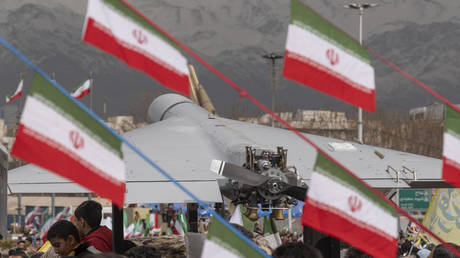
War is rarely just about ideology. It is a ledger. On one side of this ledger, we have the Shahed drones—the "suicide" UAVs that have become a staple of the Russian arsenal. They are cheap, effective, and terrifying. On the other side, there is the desperate need for specialized technology and currency.
Think of a marketplace where the currency isn't gold, but geopolitical leverage. Iran has long been under the crush of Western sanctions. Russia, once a superpower that looked down on regional players, now finds itself needing those players to keep its invasion alive. The exchange is simple: Iran provides the hardware to overwhelm Ukrainian air defenses, and in return, it receives the "soybeans and corn" mentioned in official narratives—along with the much more valuable promise of Russian satellite technology and advanced fighter jets.
When Ardestani speaks of Ukraine as a target, he is acknowledging that the drones aren't just being sold; they are being tested. Ukraine has become a laboratory for Iranian military hardware. Every time a drone hits a power substation or is shot down by a Patriot missile, data is generated. That data is the real profit. It tells the manufacturer how to tweak the guidance system, how to bypass electronic jamming, and how to make the next version even more lethal.
The Invisible Bridge from Tehran to Moscow
There is a path these weapons take. It isn't a straight line. It’s a zigzag through the Caspian Sea, involving "dark" ships that turn off their transponders to avoid detection. These vessels carry more than just crates; they carry the physical manifestation of a new, defiant alliance.
For the average person in the West, Iran and Russia might seem like an unlikely pair. One is a conservative theocracy; the other is a post-Soviet federation. Yet, they are bonded by a shared resentment of a world order they feel has marginalized them.
Imagine a mechanic in a small Iranian workshop. He might not care about the Donbas or the borders of 1991. But he understands that his livelihood depends on the production lines remaining open. He is a small gear in a massive machine that ends with a fireball in a Ukrainian wheat field. This is the human element of the supply chain—the thousands of individuals whose daily labor is now tethered to the destruction of a country they will never visit.
The Iranian leadership’s rhetoric has shifted. They used to deny sending weapons entirely. Then they admitted to sending a "small number" before the war began. Now, with Ardestani’s declaration, the mask is off. They are no longer hiding because they no longer feel they have to. They see the shift in the global winds. They see a West that is tired, distracted by its own internal politics, and hesitant to escalate.
The Calculus of Legitimacy
What makes a country a "legitimate target"? In the eyes of the Iranian hardliners, Ukraine earned this status by becoming a "pawn" of NATO. This is the narrative they sell to their own people. They argue that by defending itself with Western weapons, Ukraine has forfeited its sovereignty and become a combatant in a larger war against the East.
It is a dangerous logic. If providing defensive weapons makes a nation a target, then the entire concept of a neutral or non-combatant state evaporates. It creates a world where every factory, every shipping lane, and every civilian city is a fair game if it sits on the wrong side of an ideological fence.
Ukraine is currently the most heavily signaled territory on earth.
The "legitimacy" Ardestani speaks of is a justification for the export of terror. By framing Ukraine as an aggressor, Iran justifies its own involvement to its domestic audience and its allies in the "Axis of Resistance." It turns a mercenary transaction—selling drones for food and jets—into a moral crusade.
The Weight of the Admission
Why speak up now? Why would a member of the National Security and Foreign Policy Committee be so blunt?
The timing is everything. Russia is pushing hard in the East. The U.S. is headed into an election cycle. The European Union is debating the long-term viability of its support. Ardestani’s words are a signal of confidence. He is betting that the consequences of this admission will be minimal compared to the rewards of the partnership.
But for the people on the ground, the "stakes" are not political. They are visceral.
Consider the "hypothetical" case of Elena, a schoolteacher in Kharkiv. She doesn't read the transcripts of the Iranian parliament. She doesn't track the movement of cargo ships in the Caspian. She only knows that when the "moped" sound fills the air, she has four minutes to get her students into the basement. To her, the "legitimacy" of her school as a target is a grotesque joke. She is living in the friction point between two regimes that have decided her life is a small price to pay for a strategic edge.
The Echo in the Halls of Power
This admission forces the hand of the international community. For months, diplomats have played a game of "we know, you know, but we won't say it out loud." That game is over. When a government official explicitly confirms the exchange of weapons for regional support, the "plausible" part of "plausible deniability" vanishes.
The real question isn't whether Iran is helping Russia. We have the wreckage, the serial numbers, and now the verbal confirmation. The real question is what this alliance portends for the future of global security. If Iran can provide the "swarm" technology to overwhelm modern defenses, what does that mean for other flashpoints in the Middle East or the South China Sea?
The "Ukrainian target" is just the first page of a new manual on 21st-century warfare. It is a manual written in the blood of civilians and the ink of high-tech trade agreements.
The hum of the refrigerator in Kyiv continues. Outside, the sky is dark. Somewhere, a drone is being fueled. A man in a suit in Tehran has already decided that whatever happens next is perfectly legal, perfectly justified, and perfectly necessary for the survival of his own world.
The target has been named. The rest is just physics.