In a quiet lab in Israel, a small, orange lifeform waited for the engine to start.
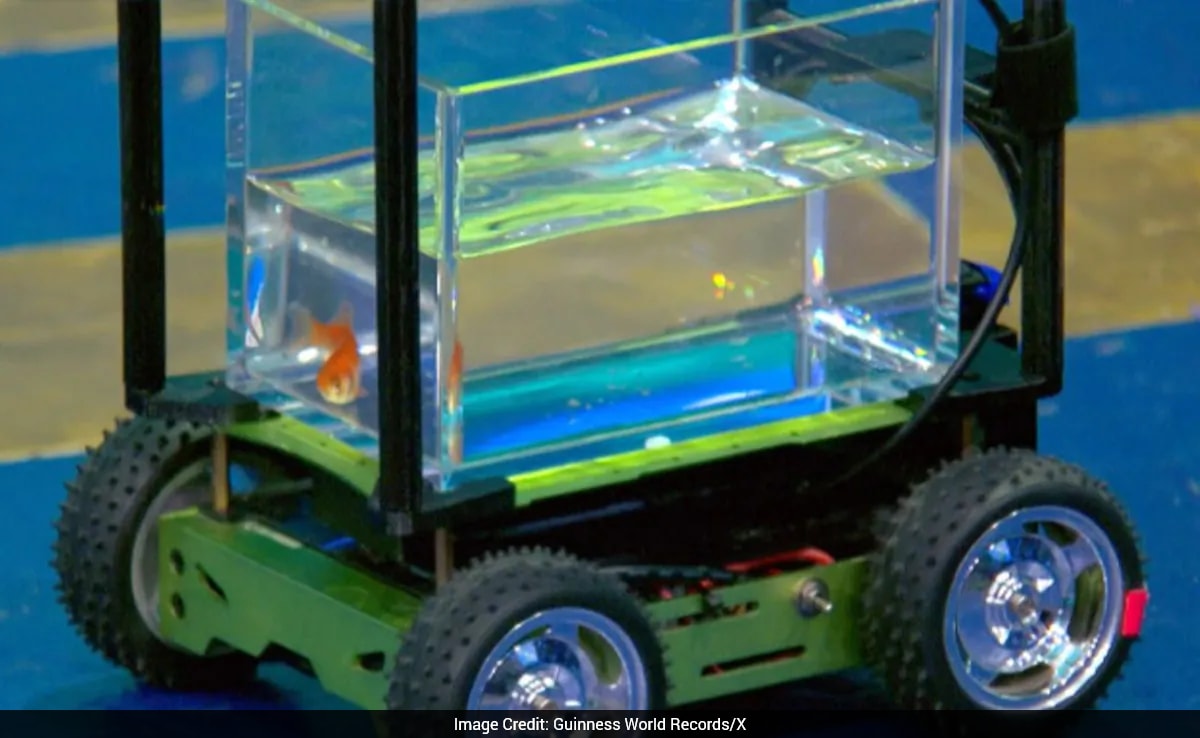
There was no steering wheel. There were no pedals. There was only a plexiglass tank, a set of wheels, and a camera that watched every flick of a fin with the intensity of a hawk. To a casual observer, it looked like a child’s science project gone rogue. To the team at Ben-Gurion University of the Negev, it was a fundamental interrogation of what it means to possess a mind.
We often think of navigation as a high-level human achievement. We plot courses, we memorize landmarks, and we use GPS to correct our many failures of intuition. We assume that our ability to move through the world is tied to our specific biology—our legs, our eyes, our inner ears. But the researchers wanted to know if the "map" inside a brain is universal. Could a creature evolved for the three-dimensional, weightless drift of a pond understand the two-dimensional, friction-heavy physics of a laboratory floor?
The goldfish did not know it was an explorer. It only knew it wanted the pea.
The Mechanics of a Displaced Mind
The vehicle was dubbed the FOV—Fish Operated Vehicle.
It functioned through a deceptively simple translation of intent. A LIDAR system, the same laser-sensing technology used in high-end autonomous cars, tracked the fish’s position relative to the walls of the tank. If the goldfish swam toward the front right corner of its watery home, the wheels below the tank spun to move the entire rig in that direction.
The fish was the pilot. The water was the cockpit. The air was the alien frontier.
The challenge wasn't just about movement. It was about consequence. In the water, a fish lives in a world of near-constant buoyancy and 360-degree freedom. On land, the FOV introduced the concept of boundaries, obstacles, and the crushing reality of terrestrial space. To succeed, the fish had to learn that its "swimming" was now "driving." It had to connect a biological impulse with a mechanical result.
Consider the mental leap required. If you were placed in a dark room and told that by blinking your left eye, you could move a giant robot in a forest three miles away, how long would it take you to stop blinking at random and start navigating toward a specific tree?
The Longest Mile
The world record didn't happen by accident. It was the result of Pavlovian persistence.
Day after day, the researchers placed a colorful target on the far side of the room. If the fish reached it, a pellet of food dropped into the tank. At first, the movements were erratic. The FOV would stutter, bump into walls, or spin in circles as the fish struggled to comprehend its newfound agency.
Then, the breakthrough.
The fish began to "solve" the room. It learned to account for the lag in the motors. It learned to avoid "dead zones" where the camera couldn't see it. It learned that the world outside the glass wasn't just a blurry background, but a map that could be conquered.
The distance covered during the record-breaking run wasn't just a measurement of meters. It was a measurement of adaptability. By traveling the longest distance ever recorded for a fish-operated craft, this tiny animal proved that the "navigation center" of the brain—the area that helps us find our way home or remember where we parked—is far more flexible than we ever imagined.
Space is space, whether it is wet or dry.
The Invisible Stakes
It is easy to laugh at a fish in a car. It feels like a punchline. But look closer at the implications.
If a goldfish can drive a car, the barrier between different types of life begins to thin. It suggests that the "software" of the brain can be ported to different "hardware" with surprising ease. This isn't just about fish; it's about us. It's about how we might one day interface with machines, how we might control prosthetic limbs that feel like alien attachments, or how we might navigate digital landscapes that have no physical footprint.
We are all, in a sense, pilots of vehicles we didn't design. Our brains sit in a dark, watery vault of the skull, interpreting electrical signals to move a body through a world it only perceives through sensors. We are the fish. The body is the FOV.
During the experiments, the researchers upped the ante. They changed the starting positions. They added decoys. They even tried to distract the fish with false targets.
The goldfish ignored them. It had a goal. It had a map. It had a sense of purpose that transcended its own species.
The Horizon in the Tank
We spend so much time looking for intelligence in the stars, searching for signals from civilizations that look or think like us. Perhaps we should be looking at the creatures that have been beside us for millennia.
The record-breaking journey of the goldfish wasn't a feat of engineering, though the FOV was clever. It wasn't a feat of endurance, though the distance was significant. It was a feat of translation. It was a bridge built between two worlds that should never have met.
The fish eventually reached the target, the motor hummed to a halt, and the reward was granted. In that moment, the lab in Israel felt a little smaller, and the potential of the mind felt infinitely larger.
The orange pilot drifted back to the center of its tank, suspended in the water, waiting for the next horizon to appear beyond the glass. It didn't need to see the world to know it could move through it. It just needed a reason to try.