The air in the corridors of the Beit Rahbari is thick with more than just the scent of rosewater and heavy Persian carpets. It is thick with the silence of a heartbeat skipping. For decades, the Islamic Republic of Iran has functioned as a massive, intricate machine of divine bureaucracy, all pivoting on the singular will of an aging man. But as Ali Khamenei enters his mid-eighties, the machine is stuttering.
The question of who sits in the chair next is no longer a matter of dry constitutional procedure. It is a high-stakes ghost story.
Consider the average shopkeeper in the Grand Bazaar. He doesn't look at the succession as a political transition. To him, it is a weather system. He remembers 1989. He remembers the transition from the revolutionary fire of Khomeini to the calculated pragmatism of Khamenei. Back then, the world was different. There were no smartphones to broadcast a protest in forty-four milliseconds. There was no AI-driven surveillance to track a dissenter's gait through a crowded square.
Today, the successor doesn't just inherit a country; they inherit a digital panopticon and a population that has learned to whisper in encrypted code.
The Architecture of a Hidden Throne
To understand the weight of the coming transition, we have to look at the "Office of the Supreme Leader." It isn't just a workspace. It is a shadow state.
While the President of Iran—a role recently left tragically vacant by the helicopter crash that claimed Ebrahim Raisi—handles the optics of inflation and international finger-pointing, the Supreme Leader holds the keys to the IRGC (Islamic Revolutionary Guard Corps). This is the military-industrial complex that controls everything from port construction to satellite launches.
The successor will be the one who can keep the IRGC satisfied. Money speaks. Power shouts.
The facts are stark. The Assembly of Experts, a body of 88 clerics, is technically tasked with choosing the next Leader. In reality, they are an audience watching a play whose ending has already been written in the backrooms of the security apparatus. For years, Ebrahim Raisi was the chosen protagonist. He was the "Butcher of Tehran," a man with the "right" scars and the "right" lack of hesitation.
Then, a mountainside in Varzaqan intervened.
The helicopter went down. The fog cleared. And suddenly, the neat line of succession was a jagged edge.
The Bloodline and the Bureaucracy
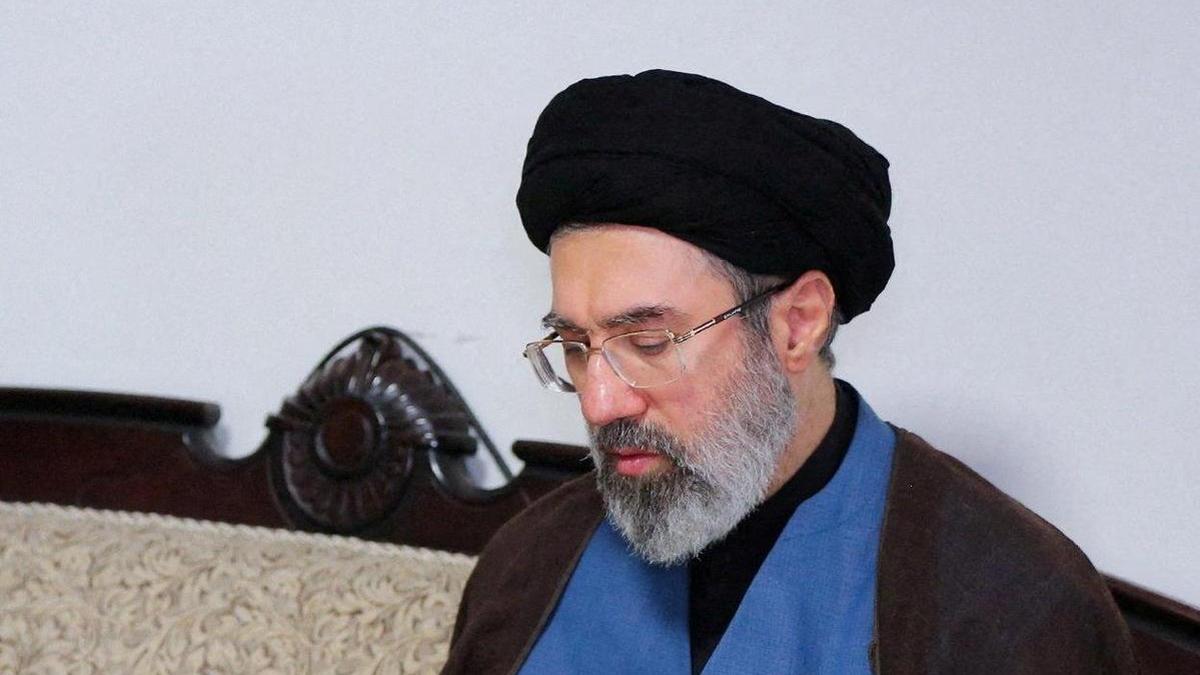
Now we look at Mojtaba Khamenei. He is the Supreme Leader’s second son.
He is a man who exists mostly in the negative space of Iranian politics. You rarely hear him speak. You see him in the background of grainy photographs, a quiet figure in a black turban. But in the architecture of power, the quietest person is often the most dangerous.
Hypothetically, imagine a boardroom where the product is survival. The shareholders are the generals of the IRGC. They don't want a reformer. They don't want a firebrand who might accidentally start a war they aren't ready to finish. They want continuity. They want their assets protected.
Mojtaba represents the ultimate insurance policy.
But there is a historical ghost in the room: the Revolution itself was fought to end a monarchy. To pass the mantle from father to son would be a poetic irony that even the most hardened clerics might find difficult to swallow. It turns a "Republic" back into a "Dynasty."
The tension is visible in the way the state media handles his name. They have recently begun referring to him with the title "Ayatollah," a promotion in the clerical hierarchy that happened almost overnight. It is the theological equivalent of a corporate promotion to Vice President just before the CEO retires.
The Invisible Stakes of the Digital Border
While the clerics debate theology and bloodlines, there is another war being fought in the servers beneath Tehran.
Iran has spent the last decade building what it calls the "National Information Network." It is a digital curtain. When the next Leader takes power, they will have their finger on a kill-switch that can effectively disconnect eighty-five million people from the global internet in a matter of minutes.
This isn't just about blocking Twitter. It is about control.
The next Leader will inherit a population that is younger, more tech-savvy, and more exhausted than at any point since 1979. The "Woman, Life, Freedom" protests weren't just a moment; they were a shift in the tectonic plates of the Iranian soul.
The real struggle for the next Supreme Leader won't be in the Assembly of Experts. It will be in the streets of Isfahan and the dormitories of Sharif University. It will be the struggle to maintain a 7th-century governing philosophy using 21st-century facial recognition software.
The Sound of the Loom
In the carpet shops of the capital, there is a saying about the patience of the weaver. A Persian rug takes years to finish. Every knot is deliberate. Every color is chosen to outlast the person who dyed the wool.
The transition to a new Supreme Leader is the final knot in a very long, very blood-stained rug.
We often make the mistake of thinking these shifts happen in a vacuum of "Geopolitics." We talk about oil prices and regional hegemony. We forget the human cost of a missing heartbeat. When the news finally breaks—and it will, perhaps in the dead of a Tuesday night—that the chair is empty, the world will hold its breath.
The IRGC will move into the streets. The internet will go dark. The borders will close.
And in that darkness, the true face of the next Iran will be revealed. It won't be a choice made by the people. It will be a choice made by those who have the most to lose if the machine stops turning.
The shadow of the son grows longer every afternoon. The rosewater scent in the halls of the Beit Rahbari is being replaced by the smell of ozone and cooling server racks. The transition is already happening. We are just waiting for the announcement.
The rug is nearly finished. The weaver is tired. The pattern, however, looks hauntingly familiar.