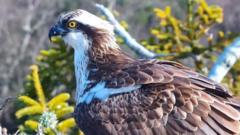
The return of breeding pairs of Pandion haliaetus (Osprey) to historical nesting sites represents more than a biological milestone; it is a successful audit of long-term environmental infrastructure investment. While public discourse focuses on the sentiment of "history-making" arrivals, the actual mechanism of success relies on a rigorous triad of site fidelity, caloric availability, and the mitigation of anthropogenic structural interference. Reintroduction success is not a binary outcome of "return" but a function of sustained occupancy and reproductive yield over a multi-generational horizon.
The Tri-Factor Framework for Nest Site Viability
The viability of a nesting site is governed by three specific variables that determine whether a returning pair will attempt a clutch or abandon the territory. These variables function as a hierarchy of needs for the species.
1. Geospatial Fidelity and Structural Integrity
Ospreys exhibit extreme philopatry, meaning they return to the same nesting coordinates year after year. The "nest" is an accumulating asset. Over decades, these structures can weigh several hundred kilograms. A failure in the structural substrate—whether a dead tree (snag) or a man-made platform—results in a significant energy deficit as the pair is forced to divert resources from egg production to primary construction.
2. The Foraging Radius and Caloric Density
A nest's success is tethered to its proximity to shallow, clear water bodies. Unlike other raptors, ospreys are almost exclusively piscivorous. The energetic cost of transport (ECT) becomes the primary constraint on chick survival. If the distance between the nest and a reliable fish source exceeds a critical threshold (typically 5-10 kilometers), the frequency of delivery cannot sustain a full brood of three.
3. Competitor and Predator Pressure
The presence of Haliaeetus leucocephalus (Bald Eagle) or terrestrial predators like raccoons introduces a tax on the nest's output. In high-density areas, inter-species competition for nesting platforms creates a bottleneck. If a site lacks physical exclusion measures (such as predator guards on poles), the probability of recruitment—chicks reaching breeding age—drops toward zero regardless of the parents' experience.
The Mechanics of Translocation and Recruitment
The "history-making" aspect of modern osprey populations often stems from translocation projects. These are high-stakes logistics operations where chicks are moved from high-density "source" populations to "sink" environments where the species has been extirpated.
The logic of translocation rests on the biological "imprint" window. Ospreys are moved before they fledge (take their first flight), ensuring they identify the new location as their "home" site. The success of this strategy is measured by the Recruitment Rate, calculated as:
$$R = \frac{N_{returning}}{N_{translocated}} \times S_{adult}$$
Where $N$ is the number of individuals and $S$ represents the annual survival rate. This equation highlights a harsh reality: because raptor juvenile mortality is naturally high (often exceeding 50% in the first year), a translocation project requires a minimum "seeding" volume over 3-5 years to establish a self-sustaining population. A single pair returning is a proof of concept, not a proof of recovery.
Anthropogenic Infrastructure as a Double-Edged Variable
Human-built structures have become the primary housing market for ospreys, moving them from natural snags to utility poles and purpose-built platforms. This shift introduces two distinct operational risks that are often overlooked in standard conservation narratives.
The Electrocution Bottleneck
Utility poles provide the height and visibility ospreys require, but their wing span (up to 180 cm) frequently bridges the gap between energized conductors or between a conductor and a ground. This creates a lethal "circuit" during takeoff or landing. Mitigation requires the installation of "bird-safe" configurations, such as increased phase separation or insulated covers. Without these engineering adjustments, utility infrastructure acts as an ecological trap—attracting birds to their death.
Synthetic Entanglement
The use of baling twine and plastic debris in nest construction is an increasing cause of mortality. Ospreys are attracted to the tensile strength of these materials, but the plastic does not biodegrade and creates snares for both adults and chicks. A "successful" return to a nest site is frequently negated by the presence of high-density polyethylene (HDPE) waste within the foraging radius.
Quantifying the Success of "First" Sightings
When a history-making bird returns to a site like the Scottish Highlands or a specific estuary in the United States, observers often mistake the arrival for the end of the mission. In reality, the arrival marks the start of the "Critical Window of Disturbance."
The first 14 days of site re-occupation are the most volatile. Human interference—drones, photography, or nearby construction—triggers a cortisol response in the birds that can lead to nest abandonment. A "data-driven" approach to conservation ignores the aesthetics of the bird and focuses on the "Buffer Zone" radius.
- 0-250 meters: High-sensitivity zone; no human activity permitted.
- 250-500 meters: Moderate-sensitivity zone; restricted motorized access.
- 500+ meters: Low-sensitivity zone; standard activity permitted.
These zones are not arbitrary; they are based on the "flush distance"—the point at which a raptor leaves the nest to circle a perceived threat, wasting precious calories and leaving eggs vulnerable to cooling or predation.
Predictive Modeling for Population Expansion
To forecast the future of these "history-making" sites, we must look at the age-class structure of the surrounding region. Ospreys are "k-strategists," meaning they invest heavily in a few offspring rather than producing many.
If the current returning pairs are older (8+ years), the population is at risk of a sudden crash if recruitment from younger cohorts fails. A healthy ecosystem requires a "staggered" age demographic. The most valuable data point is not that a bird returned, but whether the bird is a "recruit" (a new breeder) or a "veteran."
The expansion of the species follows a "stepping-stone" model. New nests will likely appear within 15-30 kilometers of the successful "history-making" site. Mapping these potential secondary sites is the priority for land managers. Identifying high-quality aquatic habitats that currently lack nesting structures allows for the proactive installation of platforms, "pre-heating" the environment for the next generation of dispersers.
Strategic management must shift from monitoring individual birds to hardening the regional infrastructure. This involves the systematic replacement of hazardous utility crossarms within a 20-mile radius of any active nest and the implementation of seasonal fishing restrictions to ensure caloric abundance during the crucial brooding months of May and June. The objective is to move from "historic returns" to "normalized occupancy," where the presence of the apex predator is no longer a news event, but a baseline ecological fact.