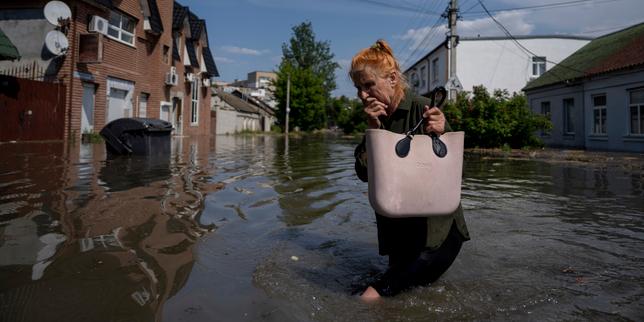
Olena did not lose her home to a shell. She lost it to the water, and then to the salt, and finally to a silence so profound it felt like a physical weight.
Before the Nova Kakhovka dam collapsed in southern Ukraine, her garden was a riot of unruly tomatoes and mint. After the breach, the Dnipro River didn't just flood her village; it rearranged the very chemistry of her existence. When the water finally receded, it left behind a grey, cracked moonscape laced with industrial grease and heavy metals. The soil, once the richest black earth in Europe, was dead.
We often measure war in heartbeats stopped and concrete shattered. We count the tanks, the drone strikes, and the rising tallies of the displaced. But there is a slower, more insidious violence unfolding across Gaza, Lebanon, and the jagged borders of Iran. It is the deliberate assassination of the landscape itself. Environment-as-weapon is not a new concept, but in the twenty-first century, we have perfected the art of making land uninhabitable for generations.
The Scorch and the Salt
In Gaza, the air often tastes of pulverized concrete and something sharper—a metallic tang that clings to the back of the throat. This isn't just the "smell of war." It is the aerosolized remains of an ecosystem. When a high-density explosive hits an urban center, it doesn't just clear a building. It releases a cocktail of asbestos, lead, and combustion byproducts into the aquifer.
The water table under Gaza was already gasping. Now, with the destruction of treatment plants and the infiltration of seawater and sewage, the act of drinking has become a gamble against enteric fever and kidney failure. This is "ecocide" in its most literal sense: the killing of the home. If you destroy a people's ability to draw clean water from their own ground, you have conquered them more effectively than any occupying garrison ever could.
Consider the olive groves of Southern Lebanon. For a farmer in Nabatieh, an olive tree is not merely "vegetation." It is a bank account. It is a family tree. It is a 200-year-old witness to his grandfather’s birth. When white phosphorus rains down, it doesn't just burn the leaves; it seeps into the root systems and the upper layers of the soil. The fire is chemical. It is persistent. Even after the smoke clears, the land remains a scorched vacuum where nothing edible will grow for years.
The Chemistry of Displacement
We treat environmental damage as "collateral," a bureaucratic word that suggests an accident. But there is nothing accidental about the targeting of fuel depots or the systematic flooding of tunnels with salt water. These are calculated moves designed to render the geography itself hostile to human life.
In Iran, the environmental stakes are different but no less lethal. Decades of "water-wars" and internal mismanagement have been exacerbated by the shadow of regional conflict. When a country is under the constant pressure of potential strikes, long-term ecological preservation becomes a luxury it feels it cannot afford. Wetlands are drained for security perimeters. Forests are cleared for visibility.
The result is a feedback loop of misery.
Dust storms in the Khuzestan province are now so thick they can be seen from space. These are not natural weather events. They are the screams of a desiccated landscape. When the marshes die, the people leave. They migrate to overstuffed cities, creating social friction and economic precarity. War creates the desert, and the desert, in turn, fuels the next war.
It is a cycle governed by the laws of thermodynamics rather than politics.
$S = k \log W$
In physics, entropy always increases. In a conflict zone, the "disorder" (S) isn't just found in the broken politics; it’s in the broken molecules of the soil. Once you push an ecosystem past its tipping point, you cannot simply sign a peace treaty and expect the birds to return.
The Invisible Shrapnel
Modern munitions are marvels of engineering and horrors of chemistry. A single missile strike leaves behind a residue of RDX, TNT, and heavy metals like antimony and mercury. These don't vanish when the news cameras move on to the next flashpoint.
In Ukraine, scientists are finding that the "breadbasket of the world" is being seeded with lead. The wheat grown in these craters will eventually find its way into the global supply chain. We are, quite literally, eating the remnants of the war. The shrapnel is no longer just metal shards in a soldier's leg; it is a microscopic toxin in a child’s cereal bowl in North Africa or East Asia.
This is the hidden cost of the "technological edge." We have built weapons that are so efficient they continue to kill long after the ceasefire is signed. They kill through the groundwater. They kill through the milk of livestock grazing on contaminated pastures. They kill through the very air that circulates across borders, indifferent to sovereignty.
The Psychological Horizon
There is a specific kind of grief associated with the loss of a landscape. Solastalgia. It is the distress caused by environmental change while you are still at home.
Imagine standing on your porch in the Bekaa Valley or the outskirts of Kharkiv. You are safe, for now. But the horizon is different. The river where you swam is a sludge of oil and dead fish. The forest where you gathered mushrooms is a grid of "Keep Out" signs and unexploded ordnance. The silence of the birds is louder than the artillery.
This psychological erosion breaks the spirit of a community. It severs the connection between the past and the future. If the land cannot sustain your children, why stay? Why rebuild? This is the ultimate goal of environmental warfare: to make the cost of remaining higher than the cost of fleeing.
The Great Unraveling
The world’s "green" transition is being fought in the same dirt where these wars are waged. We talk about lithium, cobalt, and rare earth minerals as the keys to our future. Yet, we are poisoning the very earth we need to mine, and diverting the trillions of dollars needed for climate resilience into the production of carbon-heavy explosives.
A single day of high-intensity conflict produces more carbon emissions than a small nation does in a year. The fires at the refineries, the constant sorties of fighter jets, the massive logistics chains of heavy armor—war is the most carbon-intensive human activity on the planet.
We are burning the house to win an argument about who gets to sit in the living room.
The tragedy of the 21st century is that we finally have the data to see the catastrophe coming, but we have reverted to the most primitive method of settling disputes. We are using 19th-century territorial logic equipped with 21st-century chemical persistence.
The Silence After the Storm
Olena eventually returned to her village, but she didn't bring seeds. She brought a shovel to clear the toxic silt from her doorstep. She found a single, stunted sunflower growing near a rusted piece of metal that used to be part of a bridge.
She didn't pick it. She watched it.
That flower is a miracle, but it is also a warning. It is absorbing the toxins of the earth into its fibers, turning the sun's energy into a beautiful, poisonous bloom. Nature is resilient, yes. It will return. But it will return in a form we may not recognize, and in a way that may no longer have room for us.
The maps of the future will not be drawn by generals or diplomats. They will be drawn by the shifting sands, the rising salt, and the dry beds of rivers that once gave life to civilizations. We are not just fighting over the land. We are fighting against it.
And in that war, the land never surrenders; it simply ceases to provide.
The craters will eventually fill with rain. The vines will cover the husks of the tanks. The earth will bury our iron and our ego. But the water will still be bitter, and the soil will still be cold, and the ghosts of the trees will stand as the only monuments to a victory that left everyone with nothing to eat and nowhere to call home.