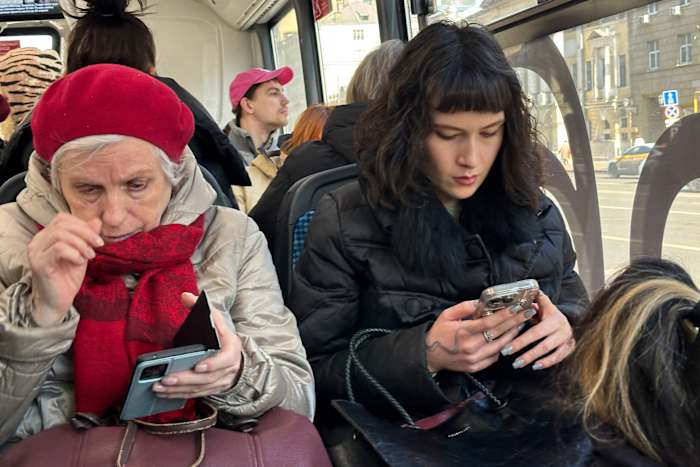
The screen didn't just go blank. It died with a specific, agonizing stutter.
Mikhail was in the middle of sending a photo of his daughter's first steps to his mother in Kazan. The little loading circle spun. It hitched. Then, the connection timed out. He toggled his Wi-Fi. He toggled his cellular data. He restarted his phone, a ritual of desperation familiar to anyone whose lifeline has been severed. But the app, a blue-and-white icon that had become the central nervous system of his social and professional life, remained a ghost.
This wasn't a glitch. It was an amputation.
When a government decides to block a messaging platform—in this case, Telegram—they aren't just stopping "data packets." They are intervening in the private whispers of millions. They are stopping the grandmother from seeing the baby, the business owner from fulfilling an order, and the activist from checking if their friend made it home. In Russia, the recent attempts to throttle and dismantle these digital bridges have been met with a resistance that is less about politics and more about the fundamental human need to be heard.
The Great Invisible Wall
Imagine a city where, overnight, every bridge is dismantled. The authorities claim it's for "security," citing a refusal by the bridge-builders to hand over the keys to every vehicle crossing the water. To the officials in Moscow, Telegram’s refusal to provide encryption keys to the FSB was a matter of law and order. To the user, it felt like being told the police have a right to sit in your living room and listen to your sleep-talking.
The Russian media regulator, Roskomnadzor, didn't just flip a switch. They went to war with the internet's very architecture. To block one app, they ended up blacklisting millions of IP addresses. They broke the digital infrastructure of banks, retail sites, and even smart ovens. It was a scorched-earth policy applied to cyberspace.
The irony is that the more the state pushed, the more the populace learned to push back. Digital literacy became a survival skill. People who barely knew how to update their operating systems were suddenly discussing the merits of "SOCKS5 proxies" and "Virtual Private Networks" over tea. It was a national crash course in subversion.
The Protest of the Paper Planes
Resistance rarely starts with a roar. It starts with a rustle.
In the wake of the blocks, a curious thing happened in the courtyards of Moscow and St. Petersburg. People didn't just take to the streets with banners; they took to their balconies with paper. The logo of Telegram is a paper plane—a symbol of light, fragile, but unstoppable communication. Thousands of these white gliders were launched into the gray Russian sky.
It was a quiet, poetic middle finger to the censors.
However, the state’s response was anything but poetic. The police presence at organized rallies was suffocating. At Sakharov Avenue, the metal detectors and the lines of riot gear created a physical manifestation of the digital wall. Young students, the "digital natives" who have never known a world without instant connectivity, stood face-to-face with men in helmets who viewed the internet as a chaotic frontier that needed to be tamed and fenced.
Consider the hypothetical case of Lena, a twenty-year-old university student. To her, the block wasn't about "security protocols." It was about her art collective. They used Telegram to organize pop-up galleries because it was the only place they felt safe from the prying eyes of local administrators who found their work "troubling." When the app went dark, her community scattered. The "frustration" mentioned in news reports isn't just an annoyance; it is the grief of losing a communal space. It is the anxiety of realizing that your private thoughts are only private as long as the state allows them to be.
The Persistence of the Ghost App
The reality of censorship is that it is often a theater of the absurd. Despite the bans, despite the legal threats, and despite the millions of rubles spent on blocking technology, the app persisted. It became a "ghost app," functioning through mirrors and rotating IPs, used by the very government officials who publicly decried it.
This creates a bizarre, bifurcated reality. The law says the door is locked, but everyone is climbing through the window, and the locksmith is pretending not to notice while he climbs through the window himself.
But this "cat and mouse" game has a dark side. It fosters a culture of perpetual illegality. When the most basic act of communication requires you to bypass federal law, the line between a law-abiding citizen and a dissident blurs until it disappears. You aren't a criminal because you want to overthrow the government; you’re a criminal because you want to send a "Happy Birthday" GIF to your aunt without a filter.
The stakes are higher than a single app. We are witnessing the trial run for a "Sovereign Internet." This isn't just a Russian phenomenon; it's a global temptation. Governments look at the borderless nature of the web and see a threat to their Westphalian sovereignty. They want an internet with borders, checkpoints, and a "kill switch."
The Cost of the Silence
What happens to a society when it can no longer trust the tools it uses to speak?
Trust is a non-renewable resource. Once you convince a generation that their private messages are a matter of state record, they don't stop talking—they just stop saying anything meaningful. They retreat into metaphors. They use coded language. They become experts in the "Aesopian language" that characterized the Soviet era, where a story about a fox and a wolf was actually a scathing critique of the Politburo.
The frustration the world sees on the streets of Moscow isn't just about an app. It's about the feeling of being treated like a child in your own home. It’s the indignity of having your digital mail opened before you can read it.
Mikhail eventually got his photo through. He stayed up until 2:00 AM, following a tutorial on a fringe message board to set up a proxy. When the "Sent" checkmark finally turned blue, he didn't feel a sense of triumph. He felt exhausted. He looked at his sleeping daughter and wondered what kind of web she would inherit. Would it be a vast, open ocean of information, or a series of stagnant, walled-off ponds?
The paper planes have mostly landed now, melting into the slush of the city streets. The protests are smaller, suppressed by a combination of legal pressure and the sheer fatigue of constant digital gymnastics. But the frustration remains, a low-frequency hum beneath the surface of daily life. It is the sound of millions of people waiting for the next bridge to be cut, holding their breath, and wondering which word will be the one that finally breaks the silence.
The screen stays lit, but the shadows it casts are getting longer.