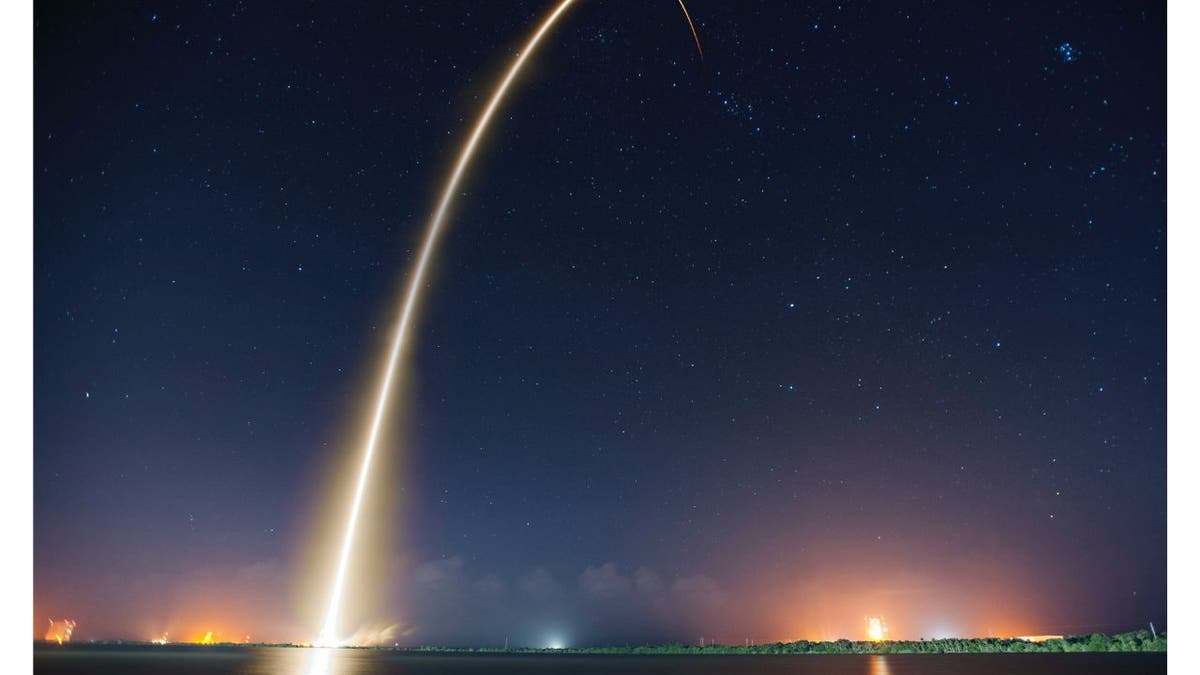
The coffee in Elias’s mug had gone cold hours ago, a stagnant dark pool reflecting the fluorescent hum of the laboratory. It was 3:14 AM. Outside the high-altitude observatory in the Atacama Desert, the stars were so bright they looked like jagged holes poked in a velvet curtain. For twenty years, Elias had listened to that silence. He had mapped the hiss of pulsars and the rhythmic thrum of dying stars, sounds that were predictable, mathematical, and utterly indifferent to human existence.
Then, the signal arrived.
It wasn’t a Hollywood laser beam or a symphonic burst of music. It was a stutter. A sequence of prime numbers encoded in a narrowband radio frequency that no nebula or collapsing sun could ever produce. In that moment, the "Unknown" stopped being a philosophical thought experiment discussed over wine at faculty mixers. It became a physical presence.
Everything we thought we knew about our place in the universe evaporated.
Most people assume that meeting an extraterrestrial intelligence would be a moment of global unity, a "Contact" style epiphany where the world holds hands. The reality is far more jagged. When we finally meet the unknown, we won't just be looking at them. We will be forced, for the first time, to look at ourselves through a lens that isn't human.
The mirror is terrifying.
The Breakdown of the Human Monopoly
For all of recorded history, humanity has enjoyed a monopoly on "higher intelligence." We are the benchmark. We define what it means to be sentient, creative, and dominant. But the moment a signal—or a craft, or a probe—originates from a source we didn't build, that monopoly shatters.
Consider the psychological weight of the "Great Filter" theory. This hypothesis suggests that there is a barrier to long-term survival that most civilizations hit and fail to cross. If we find a signal from a civilization far more advanced than ours, it means the filter is likely behind them. They survived their nuclear age. They survived their climate crises. They survived their AI uprisings.
Suddenly, our petty geopolitical squabbles look like children fighting over a specific pebble on a beach that is currently being swallowed by a tidal wave.
The existential dread doesn't come from the threat of invasion. It comes from the threat of insignificance. If they have mastered interstellar travel or faster-than-light communication, our most advanced technology is their Neolithic flint tool. We aren't the protagonists of the story anymore. We are a footnote in a very long, very crowded book.
The Biological Chasm
We often imagine aliens as "us but green" or "us but with more eyes." This is a failure of imagination. Evolution on Earth is a specific response to Earth’s specific gravity, its specific atmospheric pressure, and its specific $O_2$ levels.
Imagine a life form that evolved in the high-pressure liquid methane oceans of a moon like Titan. Their biology wouldn't be carbon-based in the way ours is. Their very concept of "sight" or "touch" would be unrecognizable.
$C + O_2 \rightarrow CO_2$
This simple chemical reaction powers our lives. But what if their metabolic engine is built on something we can barely theorize? When we meet the unknown, we are likely to find that "life" is a much broader category than we ever dared to dream. We might not even recognize them as alive at first. They could be crystalline structures that think at the speed of shifting tectonic plates, or sentient gas clouds that communicate through changes in electromagnetic fields.
The communication gap wouldn't just be about language. It would be about the fundamental way we perceive reality. We see in three dimensions and experience time linearly. If we meet a species that perceives time as a physical dimension they can move through—much like we move through a hallway—conversation becomes impossible. How do you say "hello" to someone who is experiencing your birth and your death simultaneously?
The Social Fracture
Back in the Atacama, Elias watched the data stream. He knew that once he hit "send" to notify the central authorities, the world would change. Not just the scientific world. All of it.
Religion would have to reckon with a creator who had other children.
Stock markets would collapse as the value of Earth-bound resources like gold or oil became uncertain in a universe where such things might be harvested from asteroids by the megaton.
Governments would scramble to be the first to "represent" humanity, likely descending into bickering that would make us look like a dysfunctional family in front of the neighbors.
There is a concept in sociology called "Ontological Security." It’s the stable mental state derived from a sense of continuity in one's events in life. Meeting the unknown is the ultimate ontological shock. It breaks the continuity. It tells us that our history is just a prologue.
Some would worship the newcomers. Others would hide. Most would simply be paralyzed by the sheer scale of the change. We saw a microcosm of this during the global pandemic—a much smaller "unknown"—where the sudden shift in reality caused massive splits in how people processed truth and safety. Now, multiply that by the entire galaxy.
The Silence of the Stars
There is a haunting possibility that we often ignore. What if we meet the unknown and it doesn't care?
The most chilling scenario isn't a hostile takeover. It’s indifference. Imagine a super-intelligence passing through our solar system, utilizing the sun’s gravity for a slingshot maneuver, and completely ignoring our frantic radio signals. To them, we are the equivalent of ants on the side of a highway. The cars don't hate the ants. The drivers aren't trying to destroy the ants. They simply don't see them.
If we are ignored, the blow to the human ego would be fatal. We have spent millennia telling ourselves stories about how the stars were put there for us to navigate by, how the universe was a theater for our dramas. To find out we are a background detail would be the hardest truth we’ve ever had to swallow.
The First Step into the Fog
Elias didn't hit send right away. He stood on the balcony of the observatory and looked up. For the first time, the stars didn't look like distant points of light. They looked like eyes.
We are currently a species in its adolescence. We are loud, messy, and convinced of our own immortality. Meeting the unknown is the moment of adulthood. It is the moment we realize the house is much bigger than we thought, and we aren't the only ones living in it.
The stakes are nothing less than the soul of our species. Will we shrink into xenophobia and fear, or will we find a way to expand our definition of "us" to include the truly alien?
Our history is a long line of us drawing circles in the dirt and saying "everything inside this circle is my tribe, and everything outside is a monster." We drew the circle around our village, then our city, then our nation. Meeting the unknown forces us to draw the circle around the entire planet. And even then, it won't be enough.
The signal kept pulsing on the screen. It was a rhythmic, steady beat. A heartbeat from across the dark.
Elias reached for the keyboard. His hand shook, just a little. Not because he was afraid of what was out there, but because he was finally realizing what was in here. We have been screaming into the void for a long time, hoping for an answer.
Be careful what you wish for.
Because once the silence ends, it can never be reclaimed.
The dark is no longer empty, and we are no longer alone, and the morning sun is about to rise on a world that no longer belongs to us.
Would you like me to explore the specific protocols scientists currently have in place for the first thirty minutes after a confirmed extraterrestrial signal is detected?