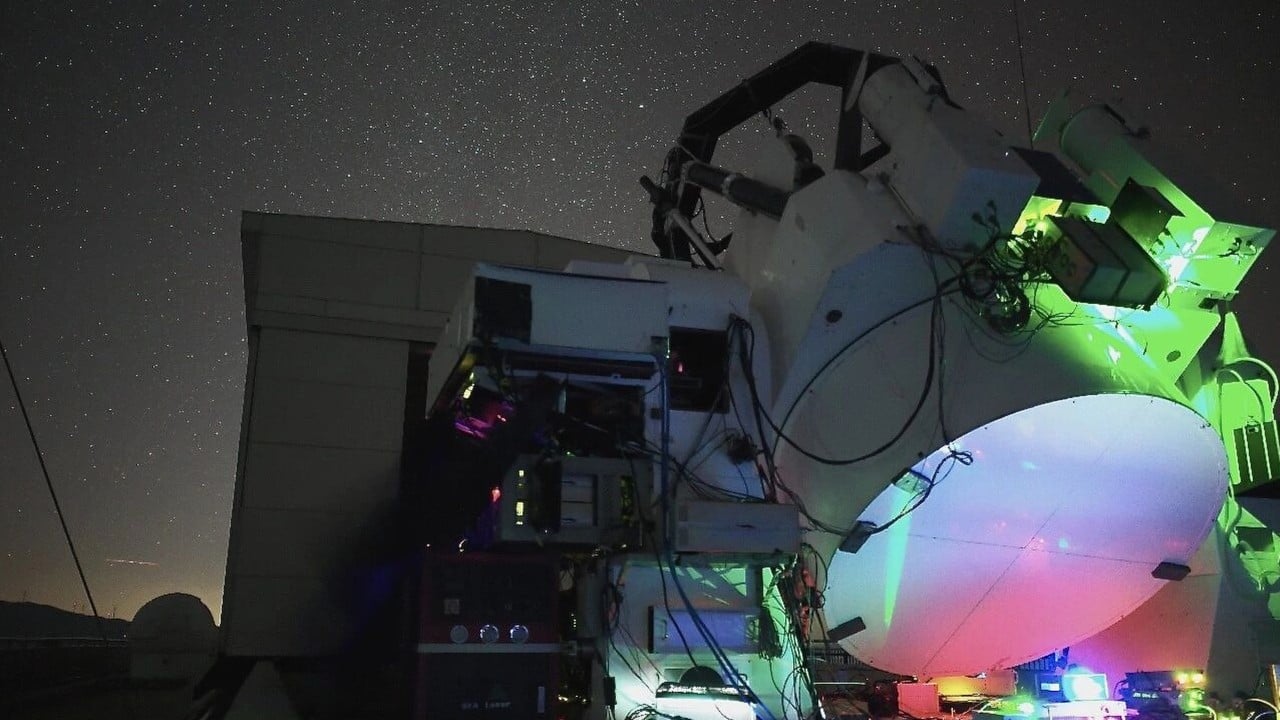
The distance between Earth and a satellite in high orbit is roughly 36,000 kilometers. For decades, we’ve relied on radio waves to bridge that gap. It’s reliable, sure, but it’s also painfully slow compared to the data demands of 2026. Imagine trying to stream 8K video through a dial-up modem from the nineties. That’s essentially what our current space infrastructure feels like when handling massive datasets.
A team of Chinese researchers recently changed the math. By successfully testing a high-speed laser communication link between a ground station and a satellite in geosynchronous orbit (GEO), they’ve pushed data transfer rates into a territory that makes traditional radio look like a relic. We aren't just talking about a minor incremental upgrade here. This is a fundamental shift in how we move information across the vacuum of space.
Why Radio is Hitting a Wall
Radio frequency (RF) communication has served us well since the days of Sputnik. It’s hearty. It can punch through clouds and rain with relative ease. But RF has a major problem: bandwidth. The electromagnetic spectrum is crowded, and the physics of long-wavelength radio waves limits how much data you can pack into a signal.
Laser communication, or optical communications, uses light. Because light has a much higher frequency than radio waves, it can carry significantly more information. Think of it as replacing a narrow gravel path with a twelve-lane fiber-optic highway. While a high-end RF link might struggle to hit a few gigabits per second over long distances, lasers are now proving they can handle 10 gigabits, 100 gigabits, and eventually terabits.
The challenge has always been the atmosphere. Space is easy; it's a vacuum. But the 10 kilometers of air closest to Earth is a chaotic mess of dust, water vapor, and heat-induced turbulence. This "atmospheric shimmer" scatters laser beams. It’s the same reason stars twinkle. For a laser to hit a receiver 36,000 kilometers away while the Earth is spinning and the satellite is moving, you need precision that borders on the impossible.
The Breakthrough in High Orbit
The recent milestone achieved by the Chinese Academy of Sciences (CAS) and associated aerospace entities involves a stable, high-speed link with a satellite in high Earth orbit. Most previous laser successes happened in Low Earth Orbit (LEO), where satellites are only a few hundred kilometers up. High orbit is a different beast entirely.
At GEO altitudes, the "pointing, acquisition, and tracking" (PAT) requirements become insanely strict. You're trying to hit a target the size of a dinner plate from thousands of miles away while both objects are in motion. The Chinese team utilized advanced adaptive optics to compensate for atmospheric turbulence in real-time. Think of it as a "smart" lens that deforms its shape hundreds of times per second to cancel out the blurring effects of the air.
This isn't just a lab experiment. The reported speeds suggest we can now move entire data centers' worth of information from orbit to ground in minutes rather than days. If you’re running a weather satellite that generates petabytes of imaging data, or a military surveillance bird that needs to offload high-def video instantly, this tech is the only way forward.
The Real World Impact on Your Internet
You might think space lasers are only for NASA or the military, but the implications for consumer tech are massive. We're currently seeing a gold rush in satellite internet, led by constellations like Starlink. However, those systems mostly live in LEO.
High-orbit satellites have one massive advantage: they stay fixed over one spot on Earth. A single GEO satellite can cover an entire continent. If we can solve the speed bottleneck using lasers, GEO satellites become much more viable for high-speed, low-cost global backhaul.
- Remote Research: Scientists in Antarctica or the middle of the Pacific can upload massive climate models instantly.
- Disaster Response: When ground infrastructure gets wiped out by a hurricane or earthquake, a laser-linked GEO satellite can provide an instant "fiber-like" connection to the rest of the world.
- Global Sovereignty: Nations are racing to build their own independent optical networks. If you don't own the "cables" in the sky, you're at the mercy of those who do.
Hard Truths About Optical Links
I'm not going to tell you that radio is dead. It isn't. Lasers have a "Kryptonite" problem: clouds. A thick enough storm will stop a laser beam cold. That's why the Chinese strategy—and the strategy of any serious space power—is a hybrid approach.
You keep the radio for the "must-have" low-bandwidth commands and emergency pings. You use the lasers for the "big data" dumps when the sky is clear. To get around the weather issue, you build a network of ground stations across different climate zones. If it’s raining in Shanghai, you beam the data to a station in the Gobi Desert where it’s clear.
The Chinese team demonstrated a level of consistency in their tracking that suggests they’ve cracked the code on "link persistence." They kept the connection alive even as atmospheric conditions shifted. That’s the "secret sauce." It’s one thing to hit a target once; it’s another to hold that connection for hours with zero packet loss.
The Geopolitical Stakes are Sky High
Space is no longer a "front" for a cold war; it's a massive, multi-trillion-dollar industry. High-speed communication is the nervous system of that economy. If you control the fastest, most reliable way to get data from high orbit, you own the backbone of the next-generation global internet.
While the U.S. and Europe have had their own laser successes—NASA’s Laser Communications Relay Demonstration (LCRD) being a prime example—the Chinese breakthrough is unique in its focus on GEO-to-ground high-data-rate stability. They’re moving fast. They’re building a constellation of these satellites. And they’re doing it with an eye toward a "sovereign" satellite internet that doesn't rely on terrestrial cables controlled by other powers.
I don't think people realize how quickly the world of satellite comms is changing. We’re moving from a world where we "monitor" satellites to a world where we "interact" with them in real-time. High-def imagery, global connectivity, and even deep-space exploration depend on the pipes we're building now.
What You Should Watch Next
The next logical step for this technology isn't just ground-to-satellite. It's satellite-to-satellite "crosslinks." If you have a thousand satellites in orbit all talking to each other via laser, you don't even need ground stations for every hop. You can bounce a signal from Beijing to Buenos Aires through space faster than it can travel through an underwater fiber-optic cable.
Speed-of-light communication in a vacuum is about 30% faster than it is inside glass fiber. For high-frequency traders, government intelligence, or just anyone who hates lag, that's a massive deal.
If you’re interested in where the money and power in tech are moving, watch the "laser-com" space. Companies like SpaceX, Amazon (Project Kuiper), and the state-backed Chinese aerospace giants are pouring billions into this. It's the new space race, and it's happening right above your head.
Forget the old days of "buffering" signals from the stars. The bottleneck is finally breaking.