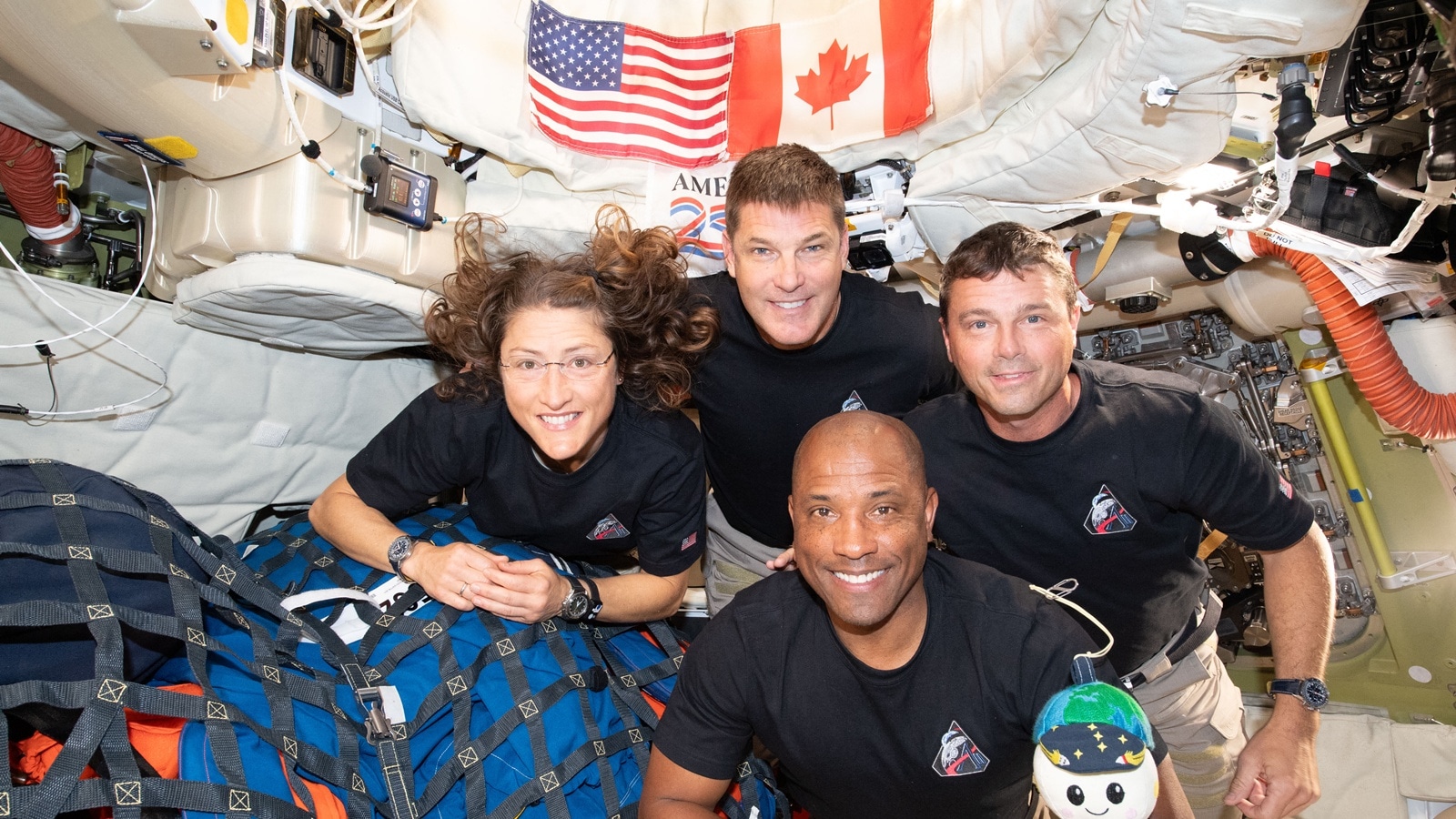
NASA is preparing to send humans back to the moon, but the human body is not built for the trip. While much of the public discourse surrounding the Artemis program focuses on the engineering marvels of the SLS rocket or the Starship HLS, a much more volatile variable remains unsolved. That variable is the fragile biological makeup of the four crew members who will spend ten days cramped inside the Orion capsule. Ten days sounds like a short vacation, but in the harsh environment of cislunar space, it is long enough for the body to begin a rapid, measurable decline.
The immediate threat is not just the vacuum of space or a hardware failure. It is the invisible, relentless bombardment of ionizing radiation and the systemic "fluid shift" that begins the moment the engines cut out and weightlessness takes over. For the Artemis II crew, scheduled to fly a figure-eight trajectory around the moon, the mission is a high-stakes medical experiment as much as a flight test.
Radiation and the Deep Space Gauntlet
Low Earth Orbit (LEO), where the International Space Station (ISS) resides, is a relatively safe neighborhood. The Earth’s magnetic field acts as a protective shield, deflecting the majority of high-energy solar particles and galactic cosmic rays. Artemis astronauts will leave that shield behind.
Once the Orion spacecraft pierces the Van Allen belts, the crew will be exposed to radiation levels significantly higher than anything experienced by ISS residents. This isn’t a theoretical concern. Deep space radiation can cause acute symptoms like nausea and fatigue, but the real danger is the long-term damage to DNA. We are talking about high-LET (Linear Energy Transfer) particles. These act like microscopic cannonballs, ripping through cellular structures and causing double-strand DNA breaks that the body often struggles to repair correctly.
NASA’s current strategy relies heavily on the "Storm Shelter" concept. If a solar flare occurs, the crew must stack water bags and equipment against the walls of the capsule to create a makeshift barrier. It is a primitive solution for a multi-billion dollar mission. The reality is that ten days of exposure could potentially increase an astronaut’s lifetime risk of cancer and cardiovascular disease in ways we still don’t fully quantify because our data set—the Apollo veterans—is too small and aging rapidly.
The Fluid Shift and the Pressure Cooker Effect
Within minutes of entering microgravity, the body’s internal plumbing goes haywire. On Earth, gravity pulls blood and interstitial fluids toward the legs. In space, that fluid migrates toward the head. This isn't just about "puffy face syndrome."
This upward surge increases intracranial pressure. For a ten-day mission, this manifests as persistent headaches, sinus congestion, and a troubling degradation of visual acuity. We call this SANS (Spaceflight Associated Neuro-ocular Syndrome). While ten days might not lead to permanent blindness, it is long enough to cause the optic nerve to swell and the back of the eye to flatten.
The heart also takes a hit. Without the need to pump blood against gravity, the heart muscle begins to atrophy almost immediately. It becomes "lazy." When the Artemis astronauts return to Earth and attempt to stand up on the recovery ship, many will experience orthostatic intolerance—their blood pressure will crater, and they will faint. The transition from the moon’s vicinity back to a 1g environment is a violent shock to a cardiovascular system that has spent over a week in a state of suspended ease.
The Microbiome Mutiny
One of the most overlooked aspects of the Artemis mission is what happens to the billions of bacteria living inside the astronauts. Spaceflight weakens the human immune system. We’ve seen this on the ISS: T-cell production drops, and latent viruses like shingles or Epstein-Barr often reactivate.
Simultaneously, some bacteria become more virulent in space. The lack of convection and the way fluids behave at a cellular level can lead to thicker biofilms, making common infections harder to treat with standard antibiotics. In a tiny capsule like Orion, where four people are sharing the same air and recycled water for 240 hours, a minor bacterial outbreak could become a mission-ending event. There is no "ER" in deep space. If a crew member develops a serious infection halfway to the moon, the mission becomes a race against time and biology.
Bone Loss in Hyper-Speed
We used to think bone loss was only a concern for long-duration stays on the ISS. We were wrong. The process of bone resorption—where the body breaks down bone tissue—starts within days of leaving Earth.
During the Artemis II mission, the crew will not have access to the massive treadmills and resistive exercise devices found on the ISS. Orion is too small. While NASA has developed a compact exercise device, it cannot fully replicate the mechanical loading required to keep bones and tendons healthy. The astronauts will be leaking calcium into their bloodstreams almost immediately. This isn't just about brittle bones; that excess calcium has to go somewhere, and it often ends up forming kidney stones. Imagine trying to navigate a high-speed atmospheric reentry while passing a kidney stone. It is a nightmare scenario that flight surgeons take very gallery.
The Psychological Siege
Isolation is a quiet killer. On the ISS, astronauts can look out the window and see the familiar curves of Earth. It is a psychological tether. On the way to the moon, Earth shrinks to a tiny blue marble. This is the "Overview Effect" turned sour—a sense of profound detachment and vulnerability.
The Orion capsule provides about 330 cubic feet of livable space for four adults. That is roughly the size of a small professional van. For ten days, there is no privacy. No real shower. The noise of the life support system is constant. The stress of the mission, combined with sleep deprivation caused by the lack of a natural day-night cycle, creates a powder keg of cognitive decline. Studies on Earth-based analogs show that communication between crew members and ground control often becomes strained after the first week. Small irritations become major grievances. In a high-stakes environment where a single misplaced decimal point can be fatal, the mental health of the crew is a critical failure point.
The Apollo Comparison Fallacy
Critics often point to the Apollo missions as proof that ten days in space is "no big deal." This is a dangerous oversimplification. The Apollo astronauts were in their 30s and early 40s, mostly test pilots with a "right stuff" mentality that often involved hiding medical symptoms from flight surgeons. Furthermore, the Artemis missions aim for a different demographic and a much higher standard of safety.
We also have better diagnostic tools now. We can see the damage that the Apollo era couldn't. We now know that the Apollo 14 crew, for example, experienced significant heart arrhythmias that were downplayed at the time. To suggest that because we "did it before," we are safe now is to ignore 50 years of progress in space medicine. The Artemis crew isn't just repeating history; they are venturing into a higher-radiation environment with a body of knowledge that tells us the risks are far greater than we once suspected.
Testing the Limits of Human Resilience
The Artemis II mission is a bridge. It is designed to prove that Orion can keep humans alive in deep space before we attempt a lunar landing with Artemis III. But the biological data we gather from these ten days will likely be more important than the telemetry from the engines.
If the crew returns with significant neurological or cardiovascular markers, it will force a total reassessment of our plans for Mars. If we struggle to keep four people healthy for 240 hours, a 500-day mission to the Red Planet remains a fantasy. The moon is a harsh mistress, but she is also a mirror, reflecting the hard limits of our terrestrial biology.
Astronauts are often viewed as superheroes, but they are essentially bags of salt water and fragile tissue being flung through a radioactive void. The Artemis program isn't just testing a new rocket; it is testing the breaking point of the human animal. We are sending our best people into a meat grinder of cosmic rays and fluid shifts, hoping that the ten-day mark is the limit of what we can endure without permanent scarring.
The mission success won't be defined by the splashdown in the Pacific. It will be defined by the blood work, the MRI scans, and the cognitive tests conducted in the months that follow. We are going to the moon to stay, but our bodies might have other plans.