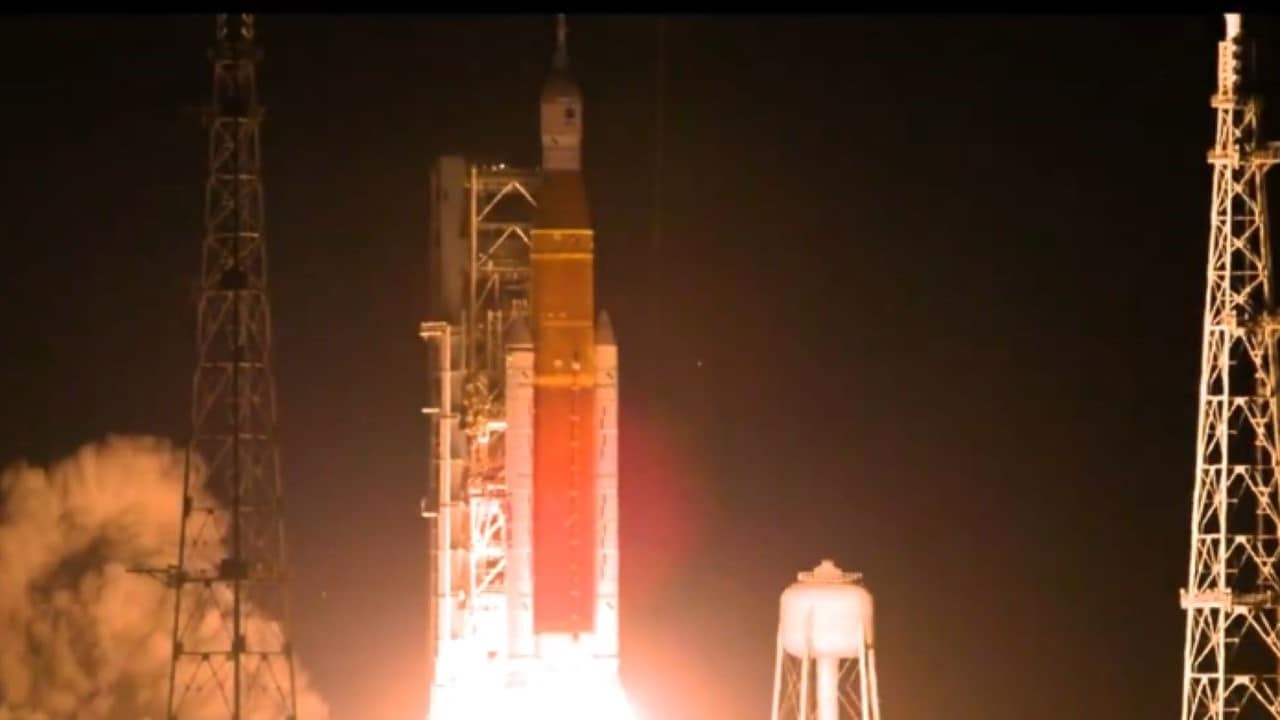
The Artemis II mission represents the first crewed integration of the Space Launch System (SLS) and the Orion spacecraft, transitioning the program from theoretical capability to operational execution. While public discourse focuses on the "return to the Moon," the mission’s true value lies in its role as a high-stakes verification of the Environmental Control and Life Support System (ECLSS) and the manual piloting interfaces required for future lunar landings. This is not a repeat of Apollo 8; it is a test of a modular, sustainable architecture designed for long-term orbital presence.
The SLS Block 1 Energy Budget
The success of Artemis II hinges on the performance of the SLS Block 1 configuration. The vehicle must generate 8.8 million pounds of maximum thrust to escape Earth’s gravity well, but the raw power is secondary to the precision of the Trans-Lunar Injection (TLI) burn.
The propulsion system operates on two distinct physical mechanisms:
- Chemical Solid Propulsion: Two five-segment Solid Rocket Boosters (SRBs) provide 75% of the initial thrust. These are non-throttleable, meaning the ascent profile is fixed once ignition occurs.
- Cryogenic Liquid Propulsion: Four RS-25 engines, fueled by liquid hydrogen and liquid oxygen, provide the remaining thrust and the specific impulse necessary for orbital insertion.
The bottleneck in this architecture is the thermal management of the RS-25 engines during the core stage's eight-minute burn. Any deviation in the mixture ratio of the propellants directly impacts the Delta-v ($\Delta v$) budget, potentially shortening the lunar flyby trajectory or necessitating a premature return.
The High Earth Orbit Mission Profile
Unlike previous lunar missions that utilized a direct injection, Artemis II employs a High Earth Orbit (HEO) strategy. This phase is a deliberate safeguard to test the Orion’s life support systems while still within a relatively rapid return window.
After reaching an initial parking orbit, the Interim Cryogenic Propulsion Stage (ICPS) performs a burn to raise the apogee to approximately 74,000 kilometers. This 24-hour elliptical orbit serves three strategic functions:
- ECLSS Stress Testing: The four-person crew will monitor CO2 scrubbing, humidity control, and oxygen regulation in a controlled environment before committing to the TLI.
- Proximity Operations: The crew will perform manual handling maneuvers using the spent ICPS as a target. This validates the optical navigation systems and the pilot’s ability to control the massive inertia of the Orion capsule.
- Radiation Assessment: The HEO trajectory takes the craft through the Van Allen belts twice, providing critical data on the shielding effectiveness of the Orion’s hull against solar energetic particles (SEP).
Human Systems Integration and the ECLSS Margin
The primary differentiator between the uncrewed Artemis I and this mission is the inclusion of the nitrogen/oxygen atmosphere required for human survival. The Orion ECLSS is a closed-loop system designed to minimize consumable mass, but it introduces significant failure modes that did not exist in the previous flight.
The risk profile is concentrated in the "Swing" bed CO2 scrubbers. These beds must cycle continuously to prevent the buildup of toxic carbon dioxide levels. A mechanical failure in the valve sequence would force an immediate mission abort. Furthermore, the heat rejection system, utilizing radiators on the European Service Module (ESM), must balance the internal metabolic heat of four astronauts against the extreme temperature gradients of cislunar space.
The "Cold Plate" technology used to cool avionics must operate in tandem with the cabin air loop. If the coolant pump fails, the redundancy resides in a secondary loop, but the loss of that second loop would lead to an avionics overheat and loss of vehicle control within hours.
Communications Latency and the Deep Space Network
As the Orion moves toward the lunar far side, it transitions from the Near Space Network (NSN) to the Deep Space Network (DSN). This transition involves a handover between the Tracking and Data Relay Satellite System (TDRSS) and ground stations in Goldstone, Madrid, and Canberra.
The technical challenge lies in the S-band and Ka-band link budgets. High-definition video and telemetry require Ka-band, which is highly directional. Maintaining this link during the "free-return" trajectory—where the spacecraft uses lunar gravity to swing back toward Earth without a major engine burn—requires high-precision pointing of the Orion’s phased-array antennas. Any misalignment during the lunar occultation (when the Moon blocks direct line-of-sight to Earth) results in total telemetry loss, requiring autonomous flight software to manage the craft’s state until re-acquisition.
Thermal Protection System Re-entry Dynamics
The most critical phase of the mission remains the atmospheric entry. Returning from a lunar trajectory, the Orion will hit the atmosphere at speeds exceeding 11 kilometers per second (approximately 25,000 mph). This generates temperatures of roughly 2,760°C (5,000°F).
The Avcoat ablative heat shield is designed to char and erode, carrying heat away from the capsule. However, Artemis I data revealed unexpected "pitting" or uneven erosion of the shield material. For Artemis II, the engineering requirement is to quantify if this erosion is a linear function of velocity or if localized turbulence creates "hot spots" that could threaten the structural integrity of the titanium pressure vessel.
The re-entry uses a "skip-entry" technique:
- Initial Entry: The capsule dips into the upper atmosphere to bleed off velocity.
- The Skip: It uses lift generated by the capsule's shape to "bounce" back out of the dense atmosphere briefly.
- Final Descent: It re-enters for the final time, significantly reducing the G-loads on the crew and allowing for a more precise splashdown in the Pacific Ocean.
Strategic Constraints and the Multi-Decadal Roadmap
The mission’s viability is constrained by the production rate of the SLS core stages and the refurbishment cycle of the Orion pressure vessels. NASA’s current cadence is limited by the manual labor-intensive process of applying the spray-on foam insulation (SOFI) to the core stage and the lead time for the RS-25 engine controllers.
The critical path to Artemis III (the lunar landing) is entirely dependent on the data harvested from the Artemis II ECLSS performance. If the oxygen recovery rates fall below 90% or the water recycling system experiences microbial growth—a common issue on the ISS—the timeline for a surface landing will shift by a minimum of 24 months to allow for hardware redesign.
The strategic play for the Artemis II crew is the execution of a "clean" HEO phase. Any anomaly in the first 24 hours must be met with an immediate decision: commit to the Moon or remain in Earth orbit to troubleshoot. The conservative nature of human spaceflight suggests that any deviation in the primary cooling loop or primary communication string will result in a "Low Earth Orbit" mission, sacrificing the lunar flyby to ensure crew survival. This risk-mitigation framework ensures that even a partial mission success provides the telemetry necessary to harden the systems for the subsequent lunar landing.
Focus must remain on the integrity of the Orion's side hatch and the pyrotechnic separation of the Forward Bay Cover. These mechanical systems, while seemingly simple compared to the propulsion logic, represent single-point failures. The successful deployment of the 11 parachutes—consisting of two drogue, three pilot, and three main chutes—is the final gate. A failure in the reefing sequence of a single main parachute would exceed the structural load limits of the remaining two, leading to a catastrophic impact velocity.
Management of the "Propellant Margin" is the final tactical variable. The Orion must retain enough hypergolic propellant in its Service Module to execute the final Course Correction Manuevers (CCM). If the TLI burn is slightly over-performed, the fuel required to nullify that excess velocity could deplete the reserves needed for the skip-entry alignment. This creates a narrow corridor of operational success where propulsion accuracy and navigational updates must be perfectly synchronized.
The mission is a test of the logistics of deep space. Every kilogram of oxygen, every watt of solar power, and every bit of data transmitted is a metric against which the feasibility of a permanent lunar gateway will be measured.