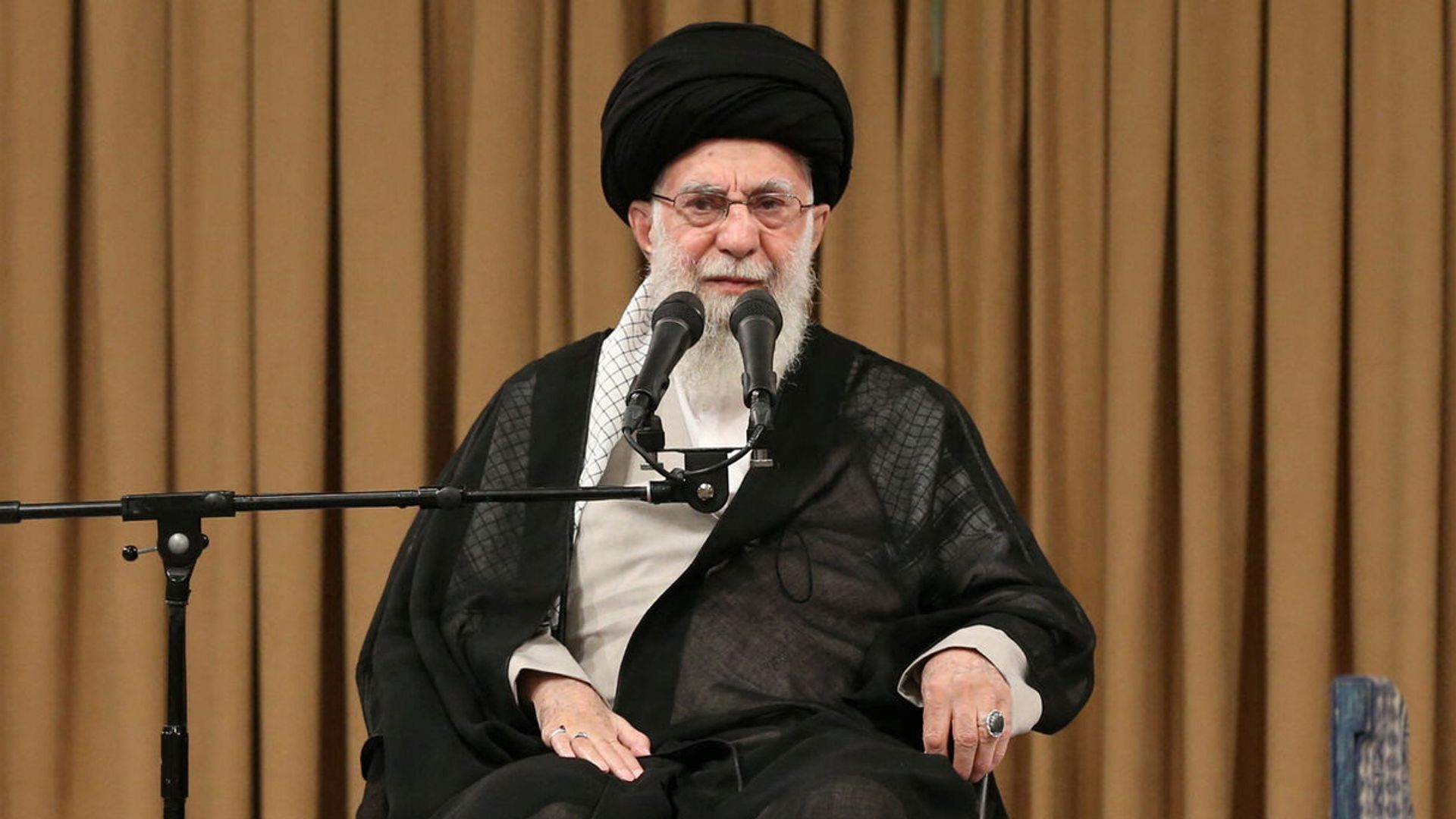
The stability of the Iranian state rests not on democratic consensus or traditional monarchical succession, but on the unique structural integration of the Velayat-e Faqih (Guardianship of the Jurist) into a modern bureaucratic framework. To understand the power of the Supreme Leader (Rahbar), one must move beyond the description of him as a "religious figurehead" and instead analyze the office as a venture-capital-style holding company that controls the military, the judiciary, and the economy through a network of non-elected parallel institutions. This system is designed to ensure that while the presidency and parliament manage the friction of daily governance, the Supreme Leader maintains a monopoly on the strategic trajectory of the state.
The Dual-Track Power Equation
The Iranian political system functions through two concurrent tracks: the elected (formal) and the unelected (supervisory). The Supreme Leader sits at the apex of the unelected track, which possesses the legal and kinetic tools to override any output from the elected track.
The Institutional Override Mechanism
The Supreme Leader’s authority is codified in Articles 5 and 110 of the Iranian Constitution. However, the true extent of this power is exercised through the Guardian Council. This body consists of twelve members—six clerics appointed directly by the Supreme Leader and six lawyers nominated by the head of the judiciary (who is himself a Rahbar appointee). This council acts as a filter for the entire legislative process:
- Candidate Vetting: The council determines who can run for President, Parliament, or the Assembly of Experts. By disqualifying reformist or dissident voices before a single vote is cast, the Supreme Leader ensures the candidate pool remains within a narrow ideological bandwidth.
- Legislative Veto: Every law passed by the Parliament must be ratified by the Guardian Council. If a law conflicts with Islamic law or the strategic interests of the leadership, it is neutralized.
The Security Monopolization
While the regular military (Artesh) defends the borders, the Supreme Leader maintains a direct command over the Islamic Revolutionary Guard Corps (IRGC). The IRGC is not merely a military branch; it is a praetorian guard with its own intelligence wing, naval force, and aerospace division. By bypassing the Ministry of Defense and reporting directly to the Supreme Leader, the IRGC creates a security environment where the elected government lacks the "monopoly on the legitimate use of physical force" traditionally defined by Weberian state theory.
The Three Pillars of Financial Autonomy
A common analytical error is to assume the Supreme Leader is dependent on the national budget passed by Parliament. In reality, the Office of the Supreme Leader controls a massive shadow economy that provides the liquidity necessary to fund regional proxies and domestic patronage without legislative oversight.
1. The Setad (EIKO)
The Execution of Imam Khomeini’s Order (Setad) is a multibillion-dollar conglomerate built on assets confiscated after the 1979 revolution. It holds stakes in almost every sector of the Iranian economy, from telecommunications to oil and gas. Because Setad reports only to the Supreme Leader, its assets are shielded from public audit or tax requirements.
2. The Bonyads (Charitable Foundations)
Foundations like the Bonyad Mostazafan (Foundation of the Oppressed) function as quasi-state entities. They control roughly 20% of Iran’s GDP. These organizations provide social services to the lower classes, creating a "clientelist" relationship where the poorest segments of society are economically dependent on the Leader's personal infrastructure rather than the state's welfare system.
3. The Astan Quds Razavi
This is the wealthiest foundation in the Islamic world, managing the shrine of Imam Reza in Mashhad. It serves as a massive regional economic hub, untouchable by the Ministry of Finance, and provides the Leader with a self-sustaining financial engine that is immune to international sanctions targeting the official government.
The Assembly of Experts and the Myth of Accountability
Theoretically, the Supreme Leader is accountable to the Assembly of Experts, a body of 88 clerics elected by the public. On paper, they have the power to remove the Leader if he becomes incapacitated or fails to perform his duties.
The structural flaw in this accountability loop is the Guardian Council. Since the Council (appointed by the Leader) must vet the candidates for the Assembly (who oversee the Leader), the system creates a circular validation. No candidate who would actually challenge the Leader can ever pass the vetting process to join the Assembly. This ensures that the body functions as a rubber-stamp organization rather than a check on power.
Succession Dynamics and the Legitimacy Crisis
Ali Khamenei has held the position since 1989. His predecessor, Ruhollah Khomeini, possessed "charismatic authority" derived from leading the revolution. Khamenei, however, had to rely on "legal-rational authority" and the cultivation of the IRGC to secure his position. As the system nears another succession event, the internal friction increases between three factions:
- The Traditional Clerics: Who seek a leader with high-level theological credentials (Marja status).
- The IRGC Command: Who prioritize a leader who will protect their vast economic interests and maintain a confrontational foreign policy.
- The Reformist Fringe: Who argue for a "Leadership Council" rather than a single absolute individual, though this group has been largely purged from the vetting process.
The bottleneck in the succession process is the lack of a clear, pre-designated heir. Under Article 111, if the Leader dies, a council consisting of the President, the head of the Judiciary, and a member of the Guardian Council temporarily takes over. This period of "interim leadership" is the highest-risk window for a military coup or a radical shift in the state's character.
Kinetic Influence: The Proxy Command Function
The Supreme Leader’s power extends beyond the Iranian border through the Quds Force, the external operations wing of the IRGC. This allows the Leader to project power in Iraq, Syria, Lebanon, and Yemen without involving the Iranian Ministry of Foreign Affairs.
This "dual diplomacy" creates a situation where the Iranian Foreign Minister may negotiate a treaty in Geneva, while the Supreme Leader’s commanders are simultaneously conducting kinetic operations in the Levant. The strategic advantage of this model is plausible deniability for the elected government and total control for the Leader.
The Cost Function of Centralized Power
The concentration of power in a single, non-elected office creates three distinct systemic risks that threaten the long-term viability of the Islamic Republic:
- The Information Silo: As the Leader’s inner circle (Beit-e Rahbari) becomes more insulated, the quality of intelligence reaching the top degrades. Decisions are increasingly made based on ideological purity rather than pragmatic geopolitical data.
- The Brain Drain: By prioritizing "commitment" (ta’ahod) over "expertise" (takhassos) in the vetting process, the state systematically excludes its most capable technocrats from governance.
- The Legitimacy Gap: With each election cycle, the gap between the aspirations of a young, globalized population and the 7th-century jurisprudence of the Guardian Council widens. The state's only remaining tool for bridging this gap is domestic repression, which is an increasingly expensive and diminishing-return strategy.
The Iranian Supreme Leader is not a "dictator" in the classical sense of a military strongman; he is the "Chief Executive of a theological-industrial complex." His power is derived from the deliberate fragmentation of the state, where no single entity—except his office—has the authority to coordinate the whole. This fragmentation is the system's greatest strength in preventing a coup, but its greatest weakness in responding to a systemic economic or social crisis.
The strategic pivot for any external observer or policy actor is to recognize that the Iranian President is a manager of constraints, while the Supreme Leader is the architect of the constraints. Engagement with the formal government is a tactic; understanding the Office of the Leader is the strategy. Future stability in the region depends on whether the IRGC decides to remain a tool of the Rahbar or whether, in the next succession, they decide to become the Rahbar themselves.