The incident at the Shajareh Tayyiba Primary School in Minab, which reportedly resulted in 160 to 175 civilian casualties on February 28, 2026, has become a flashpoint for disinformation regarding cruise missile proliferation. Claims suggesting that Iranian forces utilized a "generic" or "captured" Tomahawk Land Attack Missile (TLAM) to strike their own territory ignore the structural realities of missile procurement, guidance architecture, and the specific kinetic signatures observed in the southern Hormozgan province.
To analyze the veracity of these claims, one must apply a rigorous framework covering three distinct pillars: Supply Chain Exclusivity, Terminal Phase Ballistics, and Command-and-Control (C2) Integrity.
Supply Chain Exclusivity and the Myth of the Generic Missile
The assertion that the Tomahawk is a "generic" munition sold broadly to numerous nations is factually incorrect. The TLAM is a tightly controlled strategic asset managed through the U.S. Foreign Military Sales (FMS) program. Its distribution is limited to a tier-one group of allies:
- United Kingdom: Long-standing operator via the Royal Navy submarine fleet.
- Australia, Japan, and the Netherlands: Recent procurement partners under specific regional security frameworks.
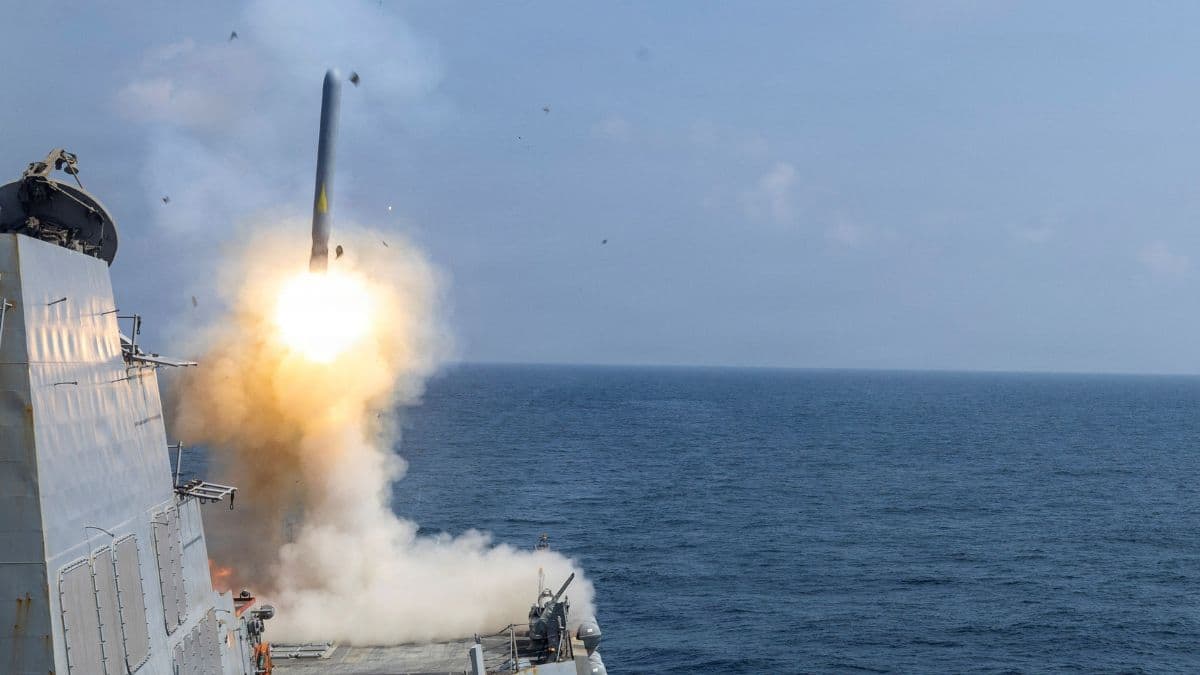
Iran possesses no documented inventory of the BGM-109 Tomahawk. While Tehran has successfully reverse-engineered older Soviet technology to produce the Soumar and Hoveyzeh cruise missiles—which bear a superficial resemblance to the Russian Kh-55—these systems utilize distinct turbojet engines and lack the specific aerodynamic profile of the Raytheon-produced TLAM. The "generic" argument collapses when one examines the Cruciform Control Surface Architecture: verified footage from the Minab strike shows a munition with centrally mounted wings and a specific tail-kit configuration unique to the Block IV and V Tomahawk.
Kinetic Fingerprinting: Distinguishing Targets from Collateral
The Minab disaster occurred within a high-density target environment. The school sits less than 300 meters from a critical Islamic Revolutionary Guard Corps (IRGC) naval base. A technical analysis of the strike pattern reveals a failure of Spatial Deconfliction rather than a "false flag" operation.
The Cost Function of Precision
In modern "Hyperwar," the speed of the kill chain often outpaces the granularity of collateral damage estimates (CDE). When a synchronized wave of over 100 munitions is launched, as seen in the opening phase of Operation Epic Fury, the probability of mechanical deviation or guidance drift increases.
- Guidance Drift: Even with GPS-aided Inertial Navigation Systems (INS), electronic warfare (EW) environments can induce "spoofing" or signal degradation.
- Target Proximity: The IRGC naval complex was targeted by multiple TLAMs. If a missile suffers a mid-flight control surface failure, the 300-meter buffer between the base and the school is insufficient to prevent high-casualty collateral impact.
- Warhead Yield: The Tomahawk carries a roughly 1,000-pound class high-explosive warhead. In a confined urban or academic structure, the overpressure wave and thermal ceiling are sufficient to cause the total structural collapse reported in Minab.
Structural Limitations of the "Iranian Tomahawk" Hypothesis
The hypothesis that Iran launched a Tomahawk requires the existence of a "shadow inventory" and a compatible launch platform. Iran’s naval and land-based launchers are calibrated for the Noor, Qader, and Ghadir series—missiles based on C-802 architecture—which utilize different launch canister dimensions and digital firing protocols.
To believe the Iranian-launch theory, one must account for three missing variables:
- The Launch Platform: No Iranian vessel or mobile TEL (Transporter Erector Launcher) is equipped with the Vertical Launch System (VLS) or the pressurized canisters required for a TLAM.
- The TERCOM Map Data: Tomahawks rely on Terrain Contour Matching (TERCOM) and Digital Scene Matching Area Correlation (DSMAC). This requires high-resolution satellite mapping data and proprietary mission planning software that Iran cannot access.
- The Forensic Gap: Post-strike wreckage analysis typically yields serial-numbered components from the Honeywell engines or the Williams International F107-WR-402 turbofans. No such components linking back to Iranian manufacture have been produced.
Operational Reality vs. Political Narrative
The attribution of the Minab strike to the United States by military investigators—as reported by multiple intelligence sources—aligns with the operational footprint of the conflict. The U.S. Navy launched approximately 160 Tomahawks in the initial 100 hours of the campaign to decapitate IRGC C2 nodes in southern Iran.
The strategic bottleneck here is not just the loss of life, but the Information Integrity Gap. When a high-precision weapon strikes a high-sensitivity civilian target, the resulting "Strategic Corporal" effect—where a tactical mistake has global strategic consequences—is magnified. Claiming the weapon belongs to the adversary is a standard psychological operation, but one that fails when the adversary’s industrial base cannot produce the specific sub-components of the weapon used.
The most likely mechanism for the school strike was a guidance malfunction or CDE miscalculation during the saturation of the adjacent IRGC facility. In a theater defined by 1,000-mile stand-off ranges, the margin for error is measured in centimeters, but the consequences are measured in generations.
The military objective now shifts to identifying if the Minab strike was a result of an uncorrected software bug in the Block V’s maritime strike logic or a simple failure of the "No-Strike List" (NSL) integration within the Joint Targeting Cycle.
Would you like me to analyze the specific electronic warfare capabilities Iran has deployed to spoof GPS-guided munitions in the Hormozgan region?